National Muslim group questions legitimacy of Quebec secularism report that recommends extending religious symbols ban
Posted August 27, 2025 4:19 pm.
Last Updated August 27, 2025 5:38 pm.
The National Council of Canadian Muslims (NCCM) is questioning the legitimacy of a Quebec committee report that proposes, among other things, that the province extend its religious symbols ban to daycare workers.
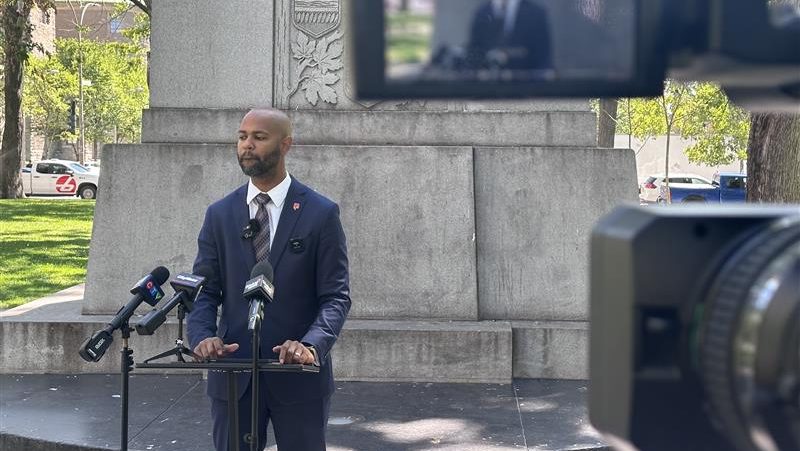
“What we’re really looking at is recommendations from the government to take away the rights of religious people and to impose a uniformity on them,” said NCCM CEO Stephen Brown at a press conference in Montreal Wednesday.
BACKGROUND: Quebec committee recommends extending religious symbols ban to daycare workers
Brown is accusing the committee of failing to interview institutions of repute that take care of, and are made up of, religious individuals. He feels the report, which was commissioned by the Legault government, does not actually solve anything.
“This report says that it’s looking to protect secularism, which is bizarre because many of its recommendations go against the very principles of secularism itself,” Brown said. “For example, one of the recommendations is for the government to start benefiting financially from the religious activities of its citizens. In another recommendation, just as spectacular, they’re inviting the government to investigate the religious practices of its citizens.
“We’re not saying that there are no difficulties in managing diversity and dealing with diversity in our society, but you cannot manage diversity by trying to force everybody to be the same. In order to deal with these issues, we have to move forward with audacity and solidarity. First, you have to deal with the way people behave, you have to deal with the behaviour, and not with your appearance. And second of all, we have to remain true to the values that make us a free society.”
Brown argues extending the religious symbols ban to daycare workers would exacerbate an existing shortfall of daycare spots, and said the idea is based on “zero evidence.”
“Right now, we know that thousands upon thousands of teachers are missing from this school system,” he said. “Meanwhile, we have many people who are qualified who could start teaching tomorrow. And not only are we not fixing this problem, which was self-created by the government, we’re looking in this report, they’re suggesting to export that problem as well to daycares. And many of the women who wear hijab who work at daycare argue that they are people that were educators in their country of origin, or study to be educators and can’t get a job because of what they look like.”
Among the document’s 50 recommendations is a proposal to gradually end state funding for private religious schools; limit religious accommodations; force municipalities to regulate public prayer; and create a national day for secularism.
The committee was announced in March by Secularism Minister Jean-François Roberge after investigations into 17 schools in Quebec for breaches of secularism. Its mandate was to “paint a picture of respect for secularism and religious neutrality within state institutions, document the phenomenon of religious influence, and make recommendations to the government to strengthen secularism in Quebec.”
On Tuesday, Minister Roberge welcomed the committee’s report “very favourably.”
The committee was co-chaired by former president of the Conseil du statut de la femme Christiane Pelchat and professor at the Faculty of Law at the University of Sherbrooke Guillaume Rousseau.
Other recommendations:
- End the practice of writing to parents to inform them in advance that content related to sexuality will be taught to their children.
- End funding for anti-choice and discriminatory organizations.
- Document issues related to religious influences promoting fasting among school-aged children and the effects of this type of fasting on these children with a view to improving methods of raising awareness of these issues.
- Prohibit the representation and wearing of religious symbols on posters and in advertisements by the government and public institutions, with some exceptions.
- Gradually phase out tax benefits and subsidies granted to religious organizations, after conducting a consultation and impact study.
“We believe in dialogue and coming up with real solutions to face the problems that we’re currently facing in society, including what it comes to dealing with diversity,” Brown said. “But to do that, we’re going to have to work together. And so our hand is stretched out and we hope that the government’s hand is stretched out as well.
“One of the ideas reiterated in the report is the rollout of Bill 21 is going on without a hitch, but they obviously didn’t speak to the hundreds of women who aren’t able to be teachers because of their appearance.
“This is a perfect example of what happens when the government starts excluding its citizens, or discriminating against its citizens based on what they look like and what they believe as opposed to how they behave. History teaches us that when you start going down that road, it causes real problems in society. And this is what we’re seeing in front of us right now.”
–With files from La Presse Canadienne