Permanent Peoples’ Tribunal rules Canada failing to prosecute genocide of Indigenous people, uphold international law
Posted September 30, 2026 8:31 am.
Last Updated September 30, 2026 12:16 pm.
The Permanent Peoples’ Tribunal (PPT) has ruled that Canada is in violation of international law for failing to investigate and prosecute crimes against Indigenous people.
In its final judgement issued Wednesday, the human rights panel said Canada was also in “a deliberate state of contempt” for what it calls a failure to sign and enforce international human rights doctrines on genocide, enforced disappearances and apartheid.
The international opinion court was created in 1979 to investigate crimes against humanity and human rights violations. The tribunal’s ruling comes on the sixth annual National Truth and Reconciliation Day Wednesday, following public hearings held in May in Montreal.
“Just the idea that they can say, that they’ve come to the conclusion that Canada has committed crimes against humanity and genocide, that’s huge just in itself,” said Na’kuset, the executive director of the Native Women’s Shelter of Montreal.
“We have the actual judgment in hand. Now we have to disperse it.”
Despite former Prime Minister Justin Trudeau’s declaration in 2019 accepting the finding of genocide by the Missing and Murdered Indigenous Women and Girls (MMIWG) National Inquiry and a motion in the House of Commons in 2022, the judges panel says there has been no accountability or changes in public policy regarding the treatment of Indigenous Peoples.
In a live-streamed announcement of the verdicat Wednesday, Andrew Woolford, a judge for the PPT, said, “We observe that genocide persists largely not because Canada continuously reiterates a murderous intent towards Indigenous peoples, instead, the ongoing nature of these prohibited acts reflects persistent and institutionalized relations of genocide, driven by government efforts to maintain the settler status quo.”
Woolford said he and the other judges found evidence of Canada’s responsibility for various forms of crimes against humanity: “enslavement, forcible transfer of population, severe deprivation of physical liberty and violation of fundamental rules of international law, torture, rape, and other forms of sexual violence of comparable gravity, enforced sterilization, persecution on racial grounds universally recognized as impermissible, enforced disappearances of persons, the crime of apartheid, and other inhumane acts intentionally causing great suffering or serious bodily, serious injury to body or to mental and physical health.”
The 78-page judgment also says Canada has failed to meet its responsibilities laid out by the Truth and Reconciliation Commission (TRC) in 2015.
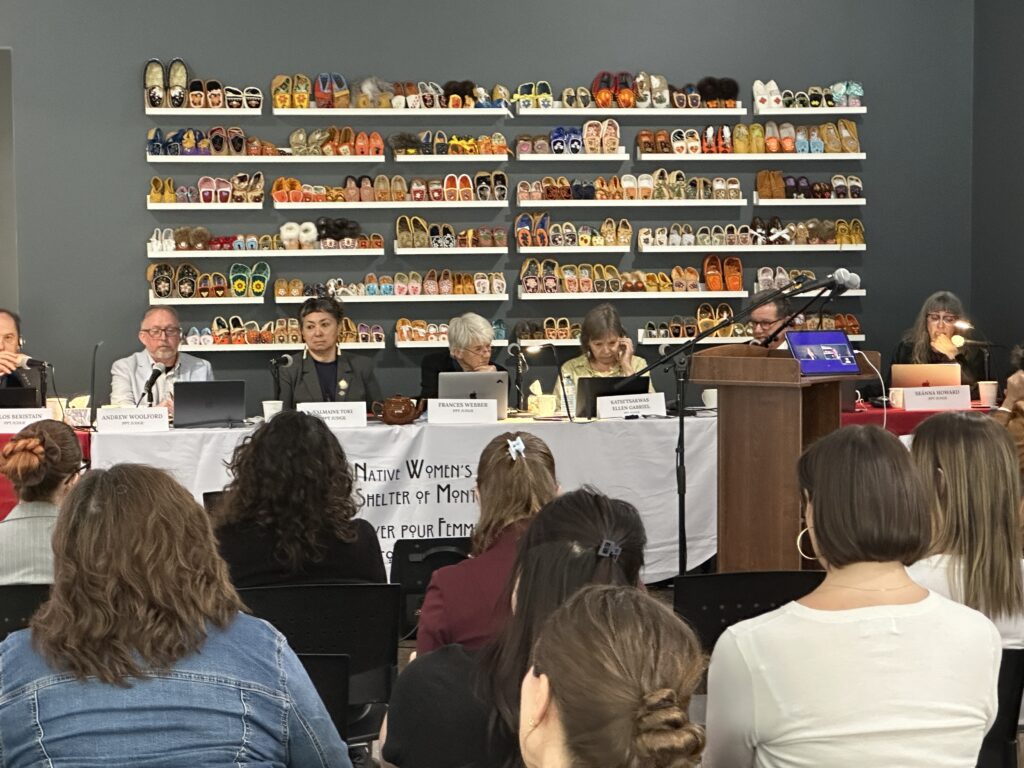
The PPT also released several recommendations for governments at all levels to investigate and maintain records of survivors and victims of residential schools, MMIWG as well as reforms to child welfare systems and funding for improving living conditions in consultation with Indigenous communities.
“After widespread, systematic and most serious violations of human rights, States have the duty to restore and guarantee the fundamental rights of the victims,” the judges wrote. “This includes the obligation to investigate, prosecute and punish the perpetrators, and to provide truth, reparations, and guarantees of non-recurrence.”
“There are so many recommendations that we’re hoping that Canada is actually going to read and try to implement, but it’s really on Canada to do something,” added Na’kuset. “They didn’t come to the PPT when we had it in May. We’re hoping that we’re going to get reaction from them. We’ll send them the findings and then we’re going to have to continue to put the pressure on.”
Residential schools
The PPT called for a full investigation and documentation of deaths and disappearances among around 150,000 Indigenous children sent to residential schools, juvenile detention centres, hospitals, among other places and reparations for survivors and their families.
“The TRC’s finding that residential schools were a central element of a policy amounting to cultural genocide is mostly deprived of practical effect by the extremely limited criminalization of genocide in Canadian domestic legislation,” the tribunal said.
The government should fully fund and support Indigenous-led investigation into residential school burial sites and disappeared children, including those located on private property as laid out in the TRC Call to Action, the panel said.
The panel also called for long-term strategy for safeguarding documents and evidence about abuse in institutions, including preventing survivor records of the Independent Assessment Process and the Alternative Dispute Resolution process of scheduled to be destroyed in 2027.
“Canada has a positive duty to preserve all documents and evidence, disclose all available information on every case of clandestine adoption, prosecute and punish perpetrators of enforced disappearances, preserve burial sites and make available to families, Indigenous communities, and society at large, all the information necessary to determine the final fate of missing and disappeared children,” Woolford said.
Forced and coerced sterilization
The PPT said the federal government further investigate the practice of forced and coerced sterilization of Indigenous people, which a senate committee on human rights had previously called for.
The tribunal also called for enforcing the federal law banning forced sterilization and for amending the Criminal Code to qualify the practice as an aggravated assault.
“Recognize the colonial nature of forced and coerced sterilization of Indigenous Peoples and issue formal apologies and reparations to Survivors,” the report said.
Murdered and Missing Indigenous Women and Girls
The panel called for implementation of previous recommendations by bodies like the TRC, CRED and CAT for transparency into investigations and convictions and an independent review of unsolved cases of MMIWG.
The PPT also called for Indigenous-led cultural safety program and training for law enforcement professionals and funding for Indigenous women’s shelters, health care and legal assistance.
The Child Welfare System
The international opinion court called for reforms to the child welfare system to address the overrepresentation of Indigenous children in the system and for preventing the removal of children from their families. It also called for effectively implementing the Jordan’s Principle and the Joyce Principle and for ensuring that Indigenous children in the system get culturally appropriate care and education.
Living Conditions
The PPT called on the governments to fund housing, health care, water infrastructure and other services in collaboration with the communities and while acknowledging the treaty rights.
Land defence
The tribunal said the governments should recognize the sovereignty of Indigenous people and stop criminalizing Indigenous people who resist and defend their territory and resources.
“Rescind the Building Canada Act, which uses ‘projects of national interest’ to justify the persistent land dispossession of Indigenous Peoples,” the panel wrote.
The report also called on all government departments and policies to comply with Canadian and international legal obligations, including amending the Criminal Code to codify different forms of genocide.
The PPT also asked the Catholic Church to release documents related to deaths in residential schools operated by the church. It also asked for acknowledgement for harms to Indigenous people as a result of the Doctrine of Discovery and for returning lands where churches were previously to Indigenous people.
Response from Crown-Indigenous Relations
In a written response to CityNews, the federal department of Crown-Indigenous Relations and Northern Affairs Canada confirmed that the Government of Canada was not a participant in the proceedings of the Permanent Peoples’ Tribunal, an “independent non-governmental initiative.”
They added that the “Government of Canada is working with partners, including Survivors, Indigenous leaders, and families and communities to support healing, address historical injustice, and advance reconciliation. This includes ongoing work to respond to the Calls to Action of the Truth and Reconciliation Commission of Canada and to build renewed relationships with Indigenous Peoples based on respect, partnership, and recognition of rights.”