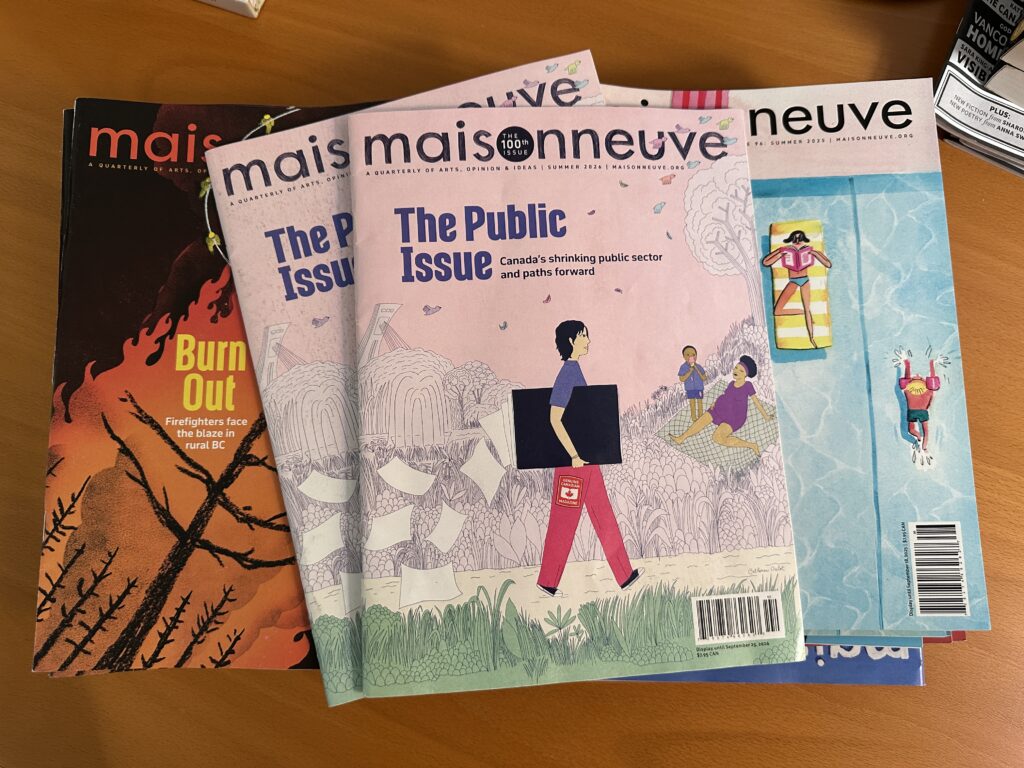
‘The power of print’: Maisonneuve marks 100th issue
Posted October 12, 2026 12:19 pm.
In a time where people spend hours scrolling on their phones, Maisonneuve magazine is inviting readers to slow down.
The Montreal-based publication has reached a milestone that its editor-in-chief, Aysha White, describes as a small miracle for any print magazine, particularly an independent one: the release of its 100th issue.
White, who first discovered the magazine when she moved to Montreal 10 years ago, said being part of its continuing story remains a surreal experience.
“The enduring success of Maisonneuve is something that I’m just so grateful to be a part of,” White said.
“There’s so many people that have kind of worked at Maisonneuve through the years that I just admire so much. And I think that caring about independent journalism and the power of print, it’s something that’s really important,” she added.

An award-winning, not-for-profit quarterly focused on arts, opinion and ideas, Maisonneuve has spent more than two decades publishing stories that explore issues beyond the daily news cycle.
Founded in 2002, the magazine has built its identity around independent literary journalism, bringing together long-form reporting, distinctive writing and visual art.
White said the magazine’s 100th issue, published in the summer, takes a closer look at Canada’s shrinking public sector and possible paths forward. Themed around the public sector, the issue features more long-form stories than the magazine would typically publish.
“It’s the public issue, Canada’s shrinking public sector and the path forward. I think we did, I would say, a good job of covering, I guess, where Canada is as a country and maybe some of the issues we’re facing, but also we tried to make it positive and solutions journalism oriented, where there are fixes to these things. And I think I’m really proud of this issue. We published more long-form stories than we usually do. So it was a big lift. But I’m proud of every single story. I think they help illustrate the strengths and minuses of this country,” White said.
Inside, the reporting includes a story on arts cuts in Nova Scotia. For White, the story demonstrates why long-form journalism matters.
“A lot of the shorter news articles I read, it’s like, okay, cuts happened,” she said. “But this story gets into the human impacts of it and how people are fighting back and the sort of long-reaching impacts of it. And I think that when you have thousands of words, it really gives you the opportunity to go deeper.”
Making room for stories that go deeper
That approach is central to Maisonneuve’s identity, particularly as audiences increasingly consume information online.
“I really believe that the combination of words and art together creates this kind of secret third thing and it allows you to kind of understand the story better so when you pick up a magazine and you can kind of it’s almost like a sensory experience where you step into the world of the story. And I think that because we watch so much on screens today, I’m super guilty of it as well, like just checking my phone first thing in the morning. It’s increasingly important to try and give ourselves opportunities to get off of screens,” White said.
Publisher Jennifer Varkonyi shares that view, describing the magazine as a premium product that readers can hold, appreciate and return to at their own pace.
“When you’re dealing with long-form pieces, like Maisonneuve has pieces that are sometimes 7,000, 8,000 words, to be able to just hold the magazine on beautiful paper and look at beautiful art is, you know, I just think a luxury that is increasingly scarce. And we’re here to try to make it last,” Varkonyi said.

However, maintaining that print experience comes with challenges.
“The challenge is really kind of competition for eyeballs and attention, I think. Increasingly, media needs to be online and of course we have a website and we have content that is available online. We do still have most of it paywalled for our subscribers because we’re a paid circulation model, which again helps us survive and continue to exist in print. But it is a real challenge. Discoverability is a real challenge. But so we’re trying to have more events in Montreal. We get a little bit of recognition when we win awards every year at the National Magazine Awards. So these things help, but it is a real struggle to get noticed and to get new readers, for sure,” Varkonyi said.
The magazine also relies on public funding, subscribers, editors, writers and its art director to keep each issue going.
“First and foremost, the editors are responsible for building each issue and getting content that is not always easy. We don’t have the biggest budget, but they work incredibly hard to get great stories that aren’t being told elsewhere. And they work really hard with the writers who also are just a massive part of the magazine, of course, to produce the best possible version of that story that they want to tell,” Varkonyi said.
She added that public funding and subscriber support are essential to the publication’s survival.
Championing emerging voices
Beyond its commitment to print, Maisonneuve places importance on giving both established and emerging writers opportunities to develop their work.
“I’m really proud of the fact that we support emerging writers because you never know, like someone who maybe doesn’t have a lot of experience could just need kind of like a helping hand or an opportunity to win. And I think what I love about being an editor is kind of like being like a cheerleader, a supporter,” White said.
For White, the process benefits both writers and editors, creating opportunities to learn, experiment and approach stories from different perspectives.
“I’ve been so lucky that I have been mentored and supported along my career journey. So I really think it’s so important to nurture emerging talent,” she said.

Varkonyi said the magazine continues to encourage new voices, particularly within Montreal’s English-language community, while maintaining a national scope that includes writers from across Canada.
The magazine also provides experienced journalists with opportunities to explore long-form print storytelling, even if their work has primarily appeared in digital formats. That commitment to nurturing talent is part of what White hopes will sustain the publication in the years ahead.
“You never know who’s like the next Margaret Atwood or someone,” White said.
Keeping independent journalism alive
For all the pride surrounding the 100th issue, the milestone also highlights the ongoing work required to keep an independent publication in circulation.
Varkonyi said the magazine is available through subscriptions and newsstands, as well as independent bookstores, including Drawn and Quarterly in Montreal and Book City in Toronto.
“We want people to really value this product and hopefully subscribe and get it,” Varkonyi said.
White’s message is similarly straightforward: independent media needs support, and print remains worth preserving.
“I think it’s so important to support independent media, and there’s an expression in, like, the American South, the power of prayer. And I kind of would edit that to be the power of print. I think that it is something that is so powerful,” White said.
“We live in a world where we’re so oversaturated with images. Like you go on Instagram and it’s like, whoa, you know, it feels like you’re bombarded. And so I really do encourage people to buy a magazine and have a coffee and sit quietly. And I think it’s the sort of experience that can be enriching for your mind and body together,” she added.
As Maisonneuve celebrates its 100th issue, the team is looking beyond the milestone.
“It’s a really kind of scrappy independent magazine that hopes to be around for another 20 years,” Varkonyi said.
“We couldn’t be prouder of the work we’ve put out both in the 100th issue, but the 99 that preceded it as well,” she added.