Navigating COVID rapid test false negatives amid Quebec’s sixth wave
Posted April 6, 2022 12:02 pm.
Last Updated April 6, 2022 6:59 pm.
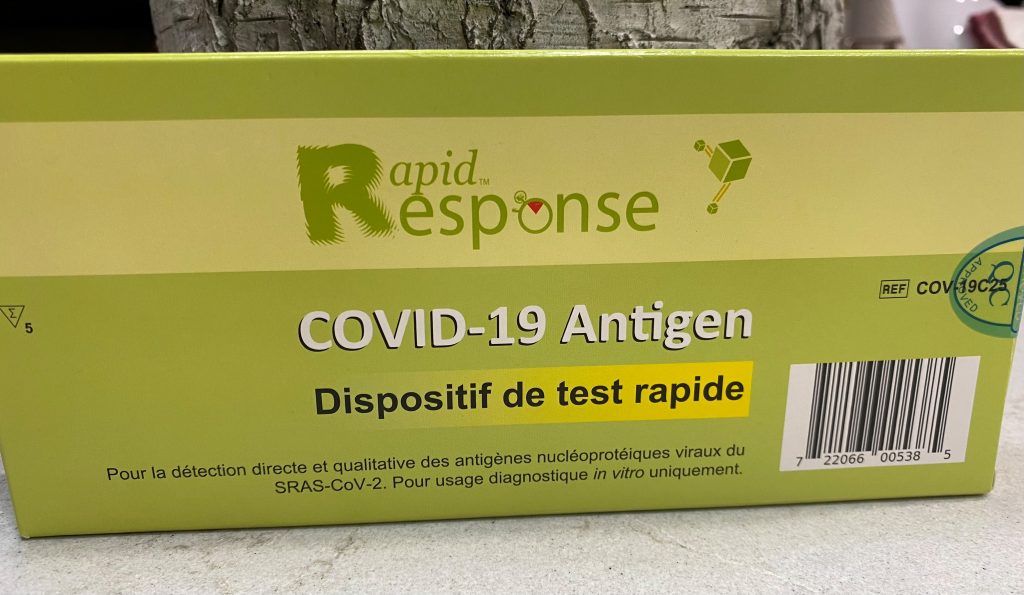
As COVID cases are rising in Quebec, with a Montreal-based study estimating up to 32,000 new infections were recorded per day last week in the province, demand for rapid tests is skyrocketing.
But just because you have COVID-like symptoms and you do a test at home, experts say it doesn’t mean you’ll have a clear picture of your situation on the first day of your symptoms.
“A lot of different patients say that they’ve tested negative one, two or three times, only to have a positive test later on. So there are a lot of false negatives here,” said epidemiologist and cardiologist, Dr. Christopher Labos. “A lot of cases of friends, colleagues, who say everybody in the family got sick and they’re the only ones who tested negative and then a few days later, they say they tested positive now.”
This was the case for Montrealer Gabe Morehouse-Anderson who had COVID on March 25.
“I was feeling symptoms, and then I tested myself, actually, a week before that, and I was negative,” Morehouse-Anderson said. “Then, my neighbour who I’m friends with then said that they tested positive. So then I tested and I ended up being positive.”
it took her and those in her entourage more than one rapid test to find out
“I’m an essential worker, so it was pretty tough to just have to be unsure,” she said. “And then a bunch of people on my work are testing positive and then negative and then positive and it’s not great for having a bunch of essential workers not being sure what’s happening.”
As PCR tests in Quebec are limited to priority groups like frontline workers, the average Quebecer is resorting to a rapid test. But Dr. Labos said there can be issues of accuracy depending on when and how you test yourself.
“If you test too early in the course of the illness, it’s likely to be a false negative. So if you get your symptoms today, you probably won’t develop a positive test for at least three four days because for the first two days you don’t have enough virus in your nasal cavity to be detected by the test,” he said.
“The other issues that come up is how people take the swabs: if you don’t get a good enough sample, that decreases the sensitivity of the test as well,” he added.
READ MORE:
Quebec COVID hospitalizations see major increase
Quebec extends mask mandate until April 30, for now: Dr. Luc Boileau
On Tuesday, 1,726 Quebecers self-declared their rapid tests results, 1,481 of which were positive.
“If you think that one test is going to be the gold standard, you are going to miss some cases,” Dr. Labos said. “If it looks like you have COVID and you were exposed to somebody who has COVID, it’s probable that you have COVID, even if the first rapid test that you do is negative.”
“You’re not really sure what you can or can’t do if you can’t go outside the house, if you can continue your job or go to school,” said Morehouse-Anderson.
Public health estimates that 75 per cent of new cases in Quebec are the Omicron BA.2 subvariant.
They remind Quebecer to isolate for at least five days as soon as they either test positive or show symptoms of COVID-19, and for the five days after that, to avoid going out in public.
“We have so much COVID circulating and you have the ability to work from home, just do the full isolation work from home, don’t come into contact with people,” Dr. Labos said. “Because whether it’s COVID or not, if you are sick, you can still make other people sick.”
Experts say testing is still the best way to mitigate risk. Since the sixth wave was officially declared in Quebec, the demand for rapid tests in pharmacies has increased three to four times in the last week. But the Quebec Association of Pharmacy Wholesalers says there’s enough stock.
Quebecers 14 and older can get their hands on a box of five rapids tests once every month for free with their Medicare card.
“It’s important to test sequentially, meaning to test multiple times and to remember the old adage that if it looks like a duck and quacks like a duck, it’s probably a duck,” Dr. Labos said.