Quebec party leaders dealing with heightened security on campaign trail
Posted August 30, 2022 4:40 pm.
Last Updated August 30, 2022 5:16 pm.
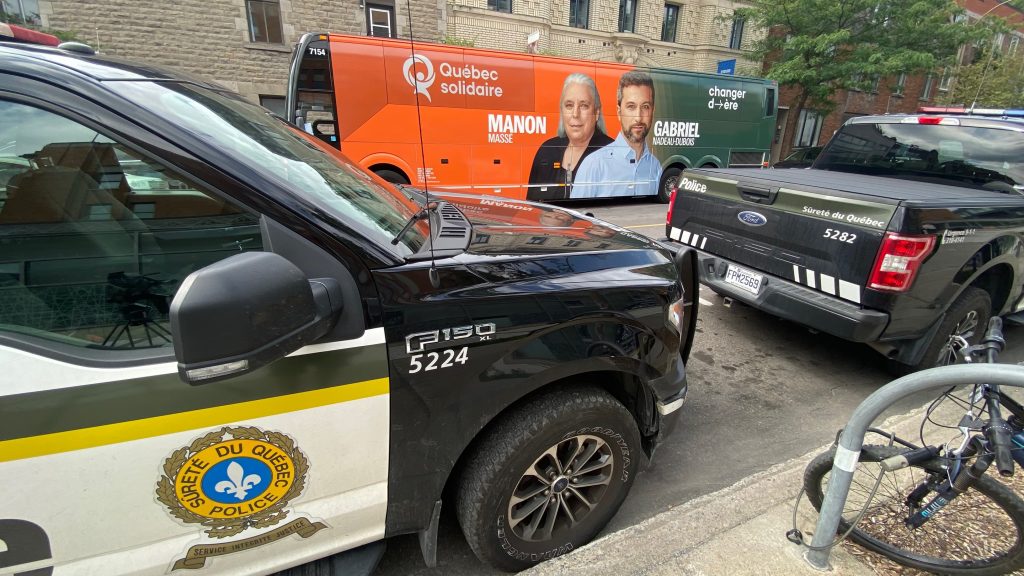
Party leaders in Quebec are surrounded by heightened security and taking extra precautionary measures as they campaign across the province.
The Parti Quebecois’ Paul St-Pierre Plamondon, for instance, says he was given a bulletproof vest.
Plamondon says it’s the sign of a changing political climate in Quebec.
Plamondon said security is a sensitive topic for his party as it approaches the 10-year anniversary of a deadly election-night shooting that marred the victory party of former premier Pauline Marois. One man was killed and another was injured after a gunman opened fire outside the Metropolis concert hall as Marois was inside delivering her victory speech on Sept. 4, 2012.
Plamondon called on society at large to engage in respectful discussions and a “debate of ideas” during the campaign in order to foster a healthy political climate, while he acknowledged the role played by social media in amplifying tensions.
Quebec provincial police spokesman Nicolas Scholtus did not confirm whether security around the campaigning leaders was higher than in previous years, but he acknowledged that there was a rise in reports of harassment or threats directed at politicians during the COVID-19 pandemic.
Scholtus said Tuesday that there had been “some” reports of what he called “disparaging remarks” since the current campaign started, but he refused to give details. Provincial police, he added, are generally responsible for the security of indoor events and for guarding the leaders, adding that they work in combination with local police to manage outdoor events.
Threats against Quebec’s MNAs soared during the pandemic, forcing an increase in security at the legislature.
“We need to ask the question, as a society, why is this necessary now?” said Québec solidaire co-spokesperson Gabriel Nadeau-Dubois. “We are seeing a rise of tensions in Quebec and Canada and honestly in a lot of countries around the world, a lot of tensions around politicians as well.
“So we need to ask ourselves the questions: why are we going in that direction? Do we want to see in Quebec or Canada the kind of scene we saw in the United States for example in the last years? Those are serious issues that should be taken seriously.”

Québec solidaire spokesperson Gabriel Nadeau-Dubois at a press conference in Montreal Aug. 30, 2022. (CREDIT: Martin Daigle/CITYNEWS)
While Nadeau-Dubois would not discuss specifics received from provincial police regarding security, he did say he felt safe.
“On a personal level I am adapting to that new reality,” he said. “Of course I need a period of adaptation. It changes a little bit my everyday workflow. But you know those are professional people. I trust them. I felt in security before, I felt in security now.
“I trust them to take the necessary measures to make sure our campaign goes well.”
Like Nadeau-Dubois, the CAQ’s François Legault did not provide specifics on his security detail.
Not all party leaders say they’ve been provided additional protection, though.
The Conservative Party of Quebec says it didn’t get any instructions from provincial police.
The Quebec Liberals said they trust the SQ to evaluate how much security is needed.
Impact on politics long term
Nadeau-Dubois said potential security issues could have a larger impact on the political sphere in Quebec.
“I don’t think it encourages people a lot to go into politics if they have the impression that it’s difficult or a dangerous, a dangerous job to do,” he said. “And yes, that’s one of the reasons we need to think about this if we want to have young people, new people, all generation people coming into politics.
“We need to make sure it’s a secure job.”
The questions around security came days after a video posted on Twitter appeared to show a man approaching and hurling profanities and insults at Deputy Prime Minister Chrystia Freeland as she boarded an elevator in Grande Prairie, Alta.
The video drew widespread condemnation and prompted other politicians and public figures – especially women – to come forward and describe instances where they felt physically intimidated or verbally abused while out in public.
—With files from The Canadiens Press