Quebec’s highest court to begin hearing appeals on provincial secularism law

Posted November 7, 2022 8:25 am.
Last Updated November 7, 2022 6:29 pm.
Quebec’s highest court is set to begin hearing appeals on the constitutionality of the province’s secularism law, known as Bill 21.
“For more than three years now, Quebecers have had their rights removed…teachers, competent prosecutors are not allowed to pursue their dreams to contribute to Quebec because of this bill,” says Lina El Bakir, part of the National Council of Canadian Muslims.
Both the Quebec government and groups opposing the law are challenging an April 2021 court decision that largely upheld the controversial religious symbols law, while striking down provisions that related to English-language school boards and a ban on members of the provincial legislature wearing face coverings
The law prohibits public sector workers who are deemed to be in positions of authority, including teachers, police officers and judges, from wearing symbols such as hijabs, kippas or turbans at work.
A Superior Court justice ruled last year that the law has “serious and negative” impacts on people who wear religious symbols, but is largely legal and does not violate the constitution.
Efforts to challenge the law are complicated by the Quebec government’s pre-emptive use of the charter’s notwithstanding clause, which shields legislation from most court challenges over violations of fundamental rights.
The groups opposing the law filed arguments in December saying the bill goes against Canada’s constitutional architecture and it infringes on federal jurisdiction.
“By thus excluding a group of people from several spheres of society because of their religion in an attempt to ‘protect’ a certain vision of social peace or fundamental social values, Law 21 contradicts the principle of religious inclusion stemming from our Constitution, and it represents an invalid attempt to legislate in an area of jurisdiction reserved for the federal legislator,” read the legal arguments filed to the Court of Appeal in Dec. 2021.
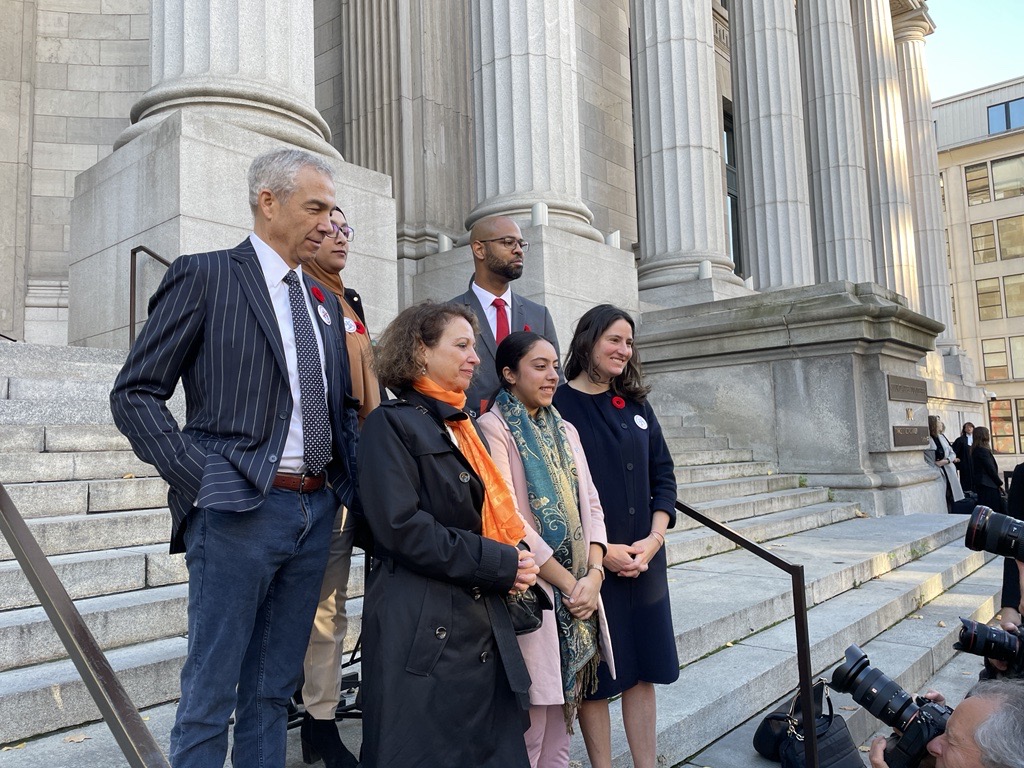
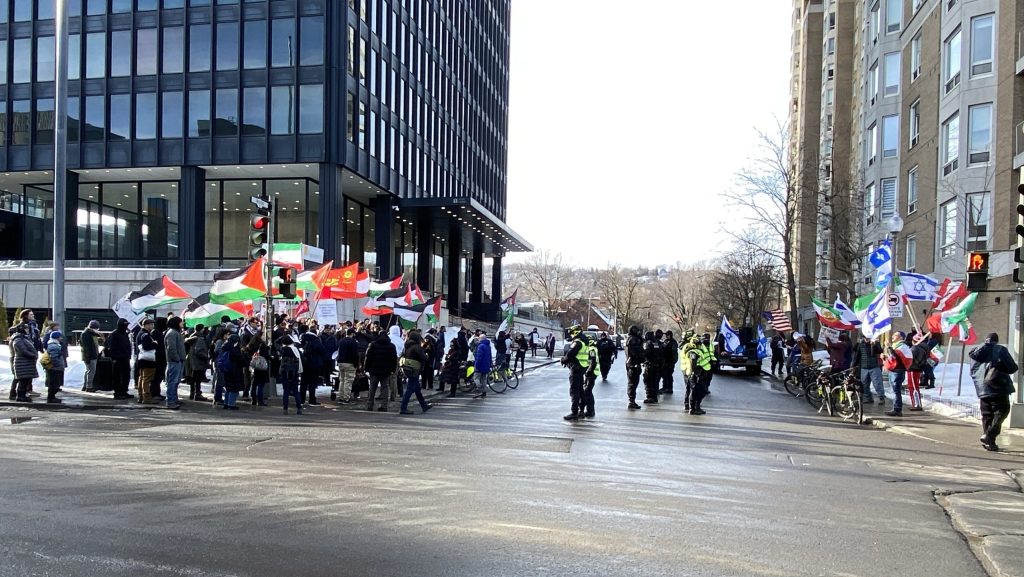
Members of groups opposing Bill 21 stand in front of Quebec’s Court of Appeal, November 7th 2022. (Photo credit: Felisha Adam)
Representatives from the Canadian Civil Liberties Association and the National Council of Canadian Muslims addressed the media Monday morning ahead of the start of the hearings, which are expected to take place this week and next at the Court of Appeal in Montreal.
RELATED:
- Muslim council wants Bill 21 abolished, among other recommendations in Quebec election policy guide
- Legault criticized, apologizes after linking immigration to ‘extremists,’ ‘violence’
- How Quebec’s Bill 21 could be vanquished by a rarely used Charter provision
Bill 21 was first introduced by the Coalition Avenir Québec government in 2019 and as soon as it was passed civil liberties groups began challenging it in court. The CAQ government has repeatedly argued the law is moderate and supported by a majority of Quebecers.
Critics, on the other hand, have argued it targets racialized minorities who choose to practice their religion, especially Muslim women.
Stephen Brown, from the National Council of Canadian Muslims says the introduction of the Bill shows, “religious minorities in Canada or minorities in Canada, do not have rights. What they have or permissions, we have permissions because any government can take away any one of our rights any time without having to justify at all. What that does effectively is make us second class citizens,”
In his 2021 decision, Justice Marc-André Blanchard acknowledged that the law has “cruel” and “dehumanizing” consequences for those who wear religious symbols, many of whom would no longer be able to seek out new jobs in the public service without compromising their beliefs.
He noted the law “negatively impacts Muslim women first and foremost,” and violates their freedom of expression and religion.
But he ruled the law was allowed to stand due to the government’s invocation of the notwithstanding clause, which shields the legislation from most charter challenges.
Blanchard did strike down a portion of the law that applies to English school boards, as well as a section that banned members of the provincial legislature from wearing face coverings.
The Quebec government is appealing that ruling.
The federal government has said it is prepared to join the legal challenge to the law if it eventually ends up in the Supreme Court of Canada.

Prabhjot Singh and Harginder Kaur part of World Sikh Organization of Canada, stand infront of Quebec’s Court of Appeal, November 7th 2022. (Photo credit: Felisha Adam)
For Quebecers impacted they say Bill 21 is pushing them out of the province.
“We want to stay here. You know, we we want to build our futures here. We want future generations to be here. And we cannot do that because of such laws. And what we fear is that this is the first law, the first steps to bigger laws that might start disconnecting everyone and separating and creating more discrimination.”
This report published with files from the Canadian Press