Ethics commission too quick to dismiss racial profiling cases involving Repentigny police?
Posted December 4, 2022 5:41 pm.
Last Updated December 6, 2022 11:46 pm.
Black residents of Repentigny, northeast of Montreal, are questioning the legitimacy and transparency of the police ethics commission when it comes to racial profiling cases.
They say the process of filing a racial profiling complaint with the ethics commissioner is intimidating, dehumanizing and useless.
“There’s a lack of transparency and that lack of transparency increasingly calls into question the integrity of the complaints system with the police ethics commission,” said Fo Niemi, the executive director the Centre for Research-Action on Race Relations (CRARR).
Many Black Repentigny citizens say their complaints of racial profiling to the commissioner involving local police have all been dismissed after conciliation, while their complaints to the human rights commission over the same incidents have been upheld and brought to the human rights tribunal.
“Repentigny is the small town that has the most number of complaints of racial profiling that you have seen the last five years and it’s where you’ve seen the most dismissal,” said Niemi.
RELATED:
- Racial profiling: police can’t stop motorists without reason, Quebec Superior Court judge rules
- Quebec appealing racial profiling ruling banning police traffic stops without cause
In 2013 Fabien Ruault’s 12-year-old boy Kelian and his friend Shewany were arrested and searched because officers suspected they broke a car windshield. It was later proven they hadn’t.
Ruault filed a complaint with the police ethics commissioner and the human rights commission. Police ethics dismissed the case while human rights commission ruled in favour of the victim, forcing the Repentigny police to pay $42,000 in damages.
“There’s racial profiling and that’s a fact,” said Ruault. “But there’s also hostile behaviour by the police to not admit their wrongs up to a point of absurdity.”
WATCH: First racial profiling court decision in Repentigny
François Ducas, Hézu Kpowbié and Natacha Mainville experienced similar situations – all dismissed by police ethics and won the case at the human rights commission. Mainville is awaiting the Commission’s decision in her case.
Ducas was driving his BMW to work on the morning of Dec. 8, 2017, when two officers followed him for kilometres for a routine check, stopped him, and asked for his ID. When he refused, he was arrested, handcuffed and searched. He later received two tickets in the mail totalling $631.
“To be handcuffed in front of people on a morning where I was going to work and to find myself with these police officers that were laughing in their nonverbal,” said Ducas.
The human rights tribunal concluded the stop was an act of racial profiling but that what followed, including the arrest and the search, was not. He was awarded $8,000.

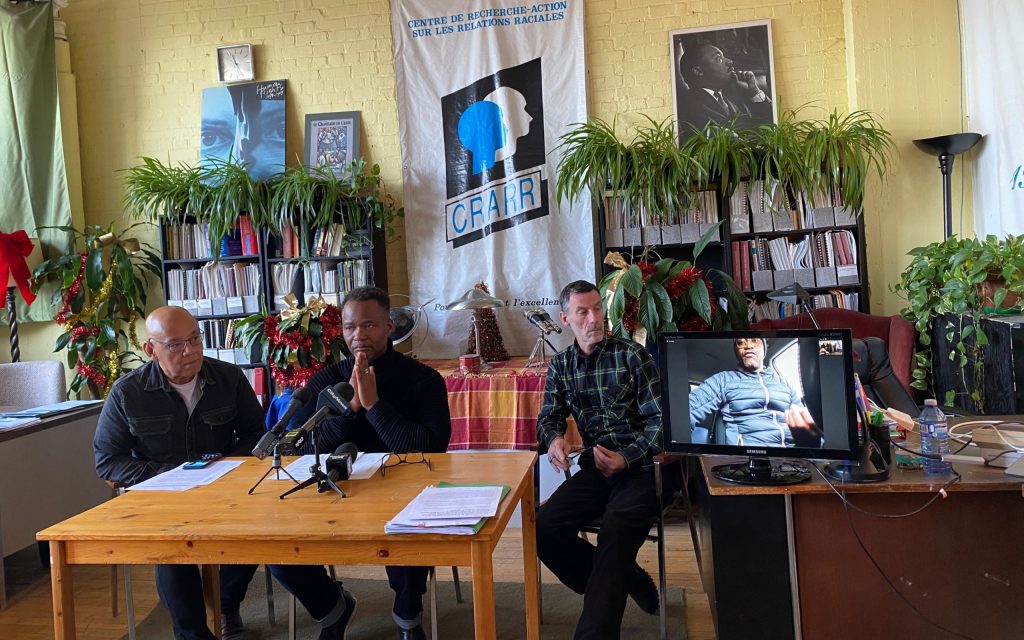
Fo Niemi, Francois Ducas, Fabien Ruault and Hézu Kpowbié (via video) at CRARR on Dec. 4, 2022. (Credit: CityNews/Brittany Henriques.
Ducas is calling on the Quebec government to take action and abolish Bill 636, which allows police to conduct road stops without cause. The province is set to appeal a recent court decision banning the random roadside stops.
CRARR says the law that allows police officers that are targeted by a complaint to not cooperate with the investigation also needs to be dropped.