Hazardous waste: Mayor of Blainville requests meeting with Premier
Posted March 3, 2025 9:43 am.
Last Updated March 3, 2025 4:15 pm.
Criticized from all sides for its expansion project endorsed by the Legault government, the hazardous waste treatment company Stablex retaliated Monday by saying it was the victim of misinformation.
The mayor of Blainville is asking to meet with Premier François Legault by Tuesday to stop the project to expand a hazardous waste dump, which is gaining unanimous support.
In a statement, the company said it wanted to “set the record straight” regarding “several erroneous pieces of information,” assuring that its process is safe and that there is no alternative.
The project is moving forward rapidly, even though it was rejected by the BAPE: the government tabled Bill 93 last Thursday to expropriate the city in order to transfer land to the Stablex company, which processes hazardous materials from the United States.
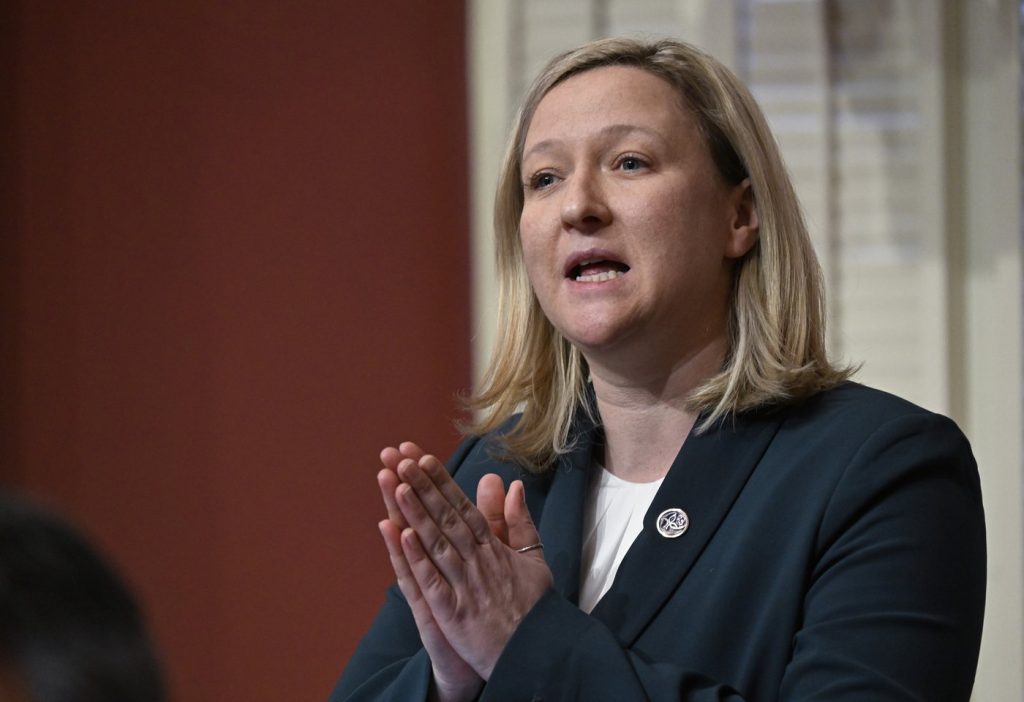
In a letter sent to Legault’s office and obtained by The Canadian Press, Mayor Liza Poulin accuses Legault of creating a dangerous precedent that will encourage other companies to demand this type of preferential treatment.
The mayor also accuses the Premier of breaking his commitment to preserve municipal autonomy by submitting a project which, according to her, flouts the will of the municipality, of the citizens, but also metropolitan regulations.
“Safe” process
Stablex assures that its process is “safe” and “meets the strictest environmental standards.”
Poulin said she contacted various ministries in vain: Environment, Economy, Municipal Affairs, Natural Resources.
She therefore demands to talk to Legault to, she writes, make the people’s point of view heard on the preservation of natural environments and make him listen to reason.
“It is time for you to listen to reason in this case,” she said.
In this way, it wishes to protect the Grande Tourbière de Blainville, a wetland which would be affected by the expansion.
“The location identified to host the new cell is not a national park: it is an industrial site currently leased by the city to a company that has been using it as an explosives storage site since World War II,” Stablex replied.
The land coveted by Stablex includes nine hectares of wetlands and 58 hectares of woodlands.
According to the Bureau d’audiences publiques sur l’environnement (BAPE), it is a natural environment of exceptional quality which is home to plants, amphibians and reptiles with special status.
In a decision rendered in September 2023, the BAPE recommended not authorizing the project.
An interim control regulation (RCI) is in force on this land, it is therefore a territory protected by the Metropolitan Community of Montreal.
Quebec would offer $17,002,580 to the City as compensation.
The government owns a neighbouring piece of land, but it is not as large as the one owned by Blainville and this solution was ruled out.
The larger plot of land that the government wants to offer to Stablex would therefore allow it to continue its activities for the next 40 years, rather than only 20 with a smaller plot of land.
According to the Minister of Natural Resources, Maïté Blanchette Vézina, who is leading the bill, the situation is critical for the company and must move forward.
All scenarios have been evaluated and the one recommended by the government is the best, she argued in the House.
She suggested that Quebec would face retaliation if it blocked the import of hazardous waste from the United States. She argued that Quebec exports four times more hazardous waste than it imports.
However, the BAPE has contrary data. In its report on the Stablex project, we see that “even if the MELCCFP database does not provide a precise picture of the quantities imported and exported”, we can see “that imports gravitate around an annual average of 302,201 tonnes from 2019 to 2021 compared to an average of 183,918 tonnes for exports”.
The Stablex industrial waste treatment center currently includes a treatment plant and five landfill cells.
The waste processed by Stablex is residual hazardous materials, contaminated soils and non-hazardous materials with properties of environmental concern.
This waste comes, for example, from the mining industry or the pharmaceutical industry.
They are partly imported from the United States and other Canadian provinces.
The company intends to create a sixth landfill cell on land owned by the city of Blainville.
–This report by La Presse Canadienne was translated by CityNews