Quebec businesses look to new markets amid trade tensions
Posted May 5, 2025 3:08 pm.
Last Updated May 5, 2025 5:08 pm.
Against the backdrop of a trade war with the United States, Quebec wants to attract foreign investment while also helping its businesses expand to new markets.
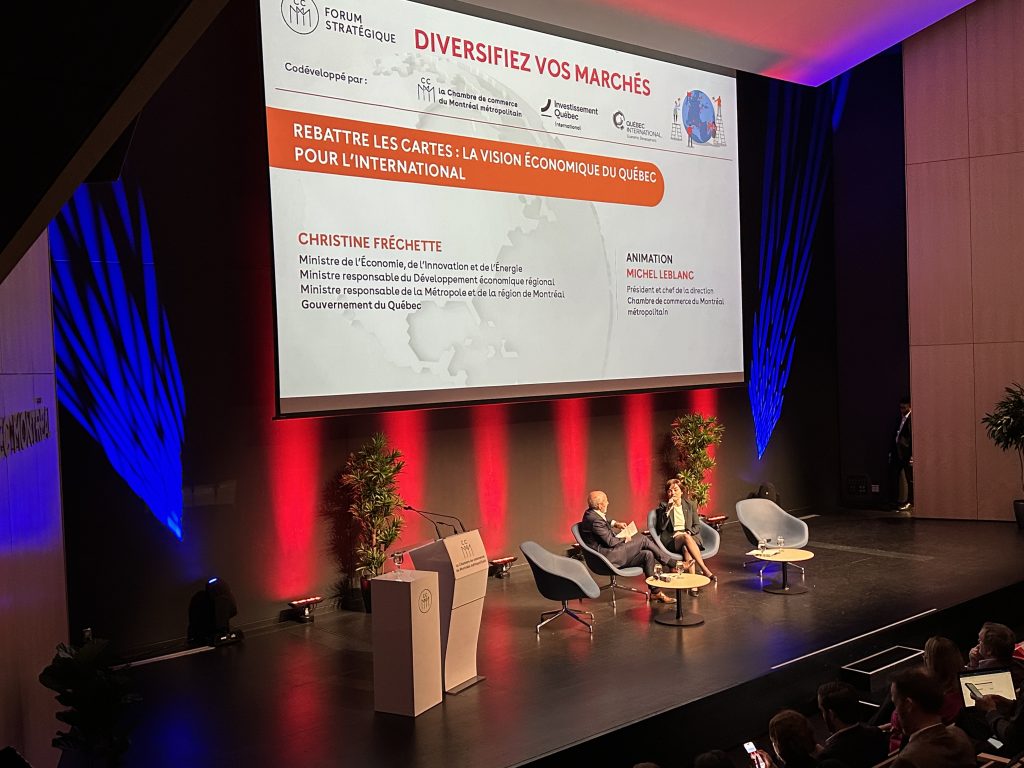
That was the message at the Strategic Forum on Market Diversification in Montreal on Monday.
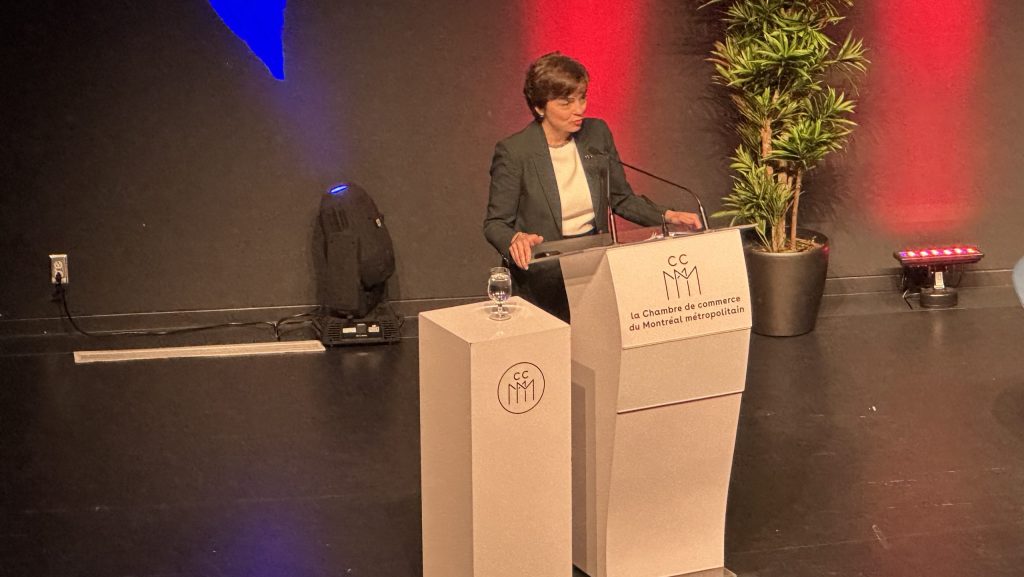
The event was hosted by the Chamber of Commerce of Metropolitan Montreal and brought together Investissement Québec International and Quebec Minister of Economy, Innovation and Energy Christine Fréchette.
The forum came during a period of uncertainty in Canada-U.S. trade, including threats of new tariffs. Business leaders and government officials say Quebec must reduce its dependence on American markets by building new trade relationships.
Minister Christine Fréchette opened her speech by acknowledging the role of collaboration and adaptability in turbulent times. “Thank you to Investissement Québec International and the Chamber of Commerce for responding quickly and taking the initiative. In the current context of a trade war, we need to be agile and we need to act fast,” she said.
“The uncertainty around tariffs has been felt for several months. We’ve seen a slowdown in investment projects since late November or early December, which may permanently reshape the face of international trade relations—not only for Quebec and Canada, but globally.”
Michel Leblanc, president and CEO of the Chamber of Commerce of Metropolitan Montreal, says businesses can no longer rely solely on the U.S.
“There is a real wake-up call from a situation that made sense,” Leblanc said. “If you were a business in Quebec and you wanted to export, the U.S. market made sense. It’s a huge market… But again, it means there’s a risk. And we saw that relationship becoming more sour with the U.S. So right now it’s a strong wake-up call.”

Minister Fréchette said the fast-changing global economy requires quick and flexible action: “In a context like the one we’re facing today—a trade war—we need to be agile and act quickly.”
Fréchette emphasized the need to rethink Quebec’s approach: “We must truly rethink our economy region by region, sector by sector, to respond appropriately to the challenges brought on by changes introduced by the Trump administration. Repositioning ourselves is not easy—but if we succeed, I am convinced we will come out stronger.
“We don’t know what the future holds, but one thing is clear: diversifying our export markets is essential. And to do that, we need to work together—the chambers of commerce, Québec International, Montréal International, the government, and businesses. Everyone has to contribute to this effort.”
Challenges ahead for smaller companies
Leblanc said exporting to Europe or Asia presents new challenges, especially for smaller firms used to shipping goods by truck across the border. Companies need to learn how to navigate longer transport routes, build trust with new buyers and invest in building local relationships.
“If it’s the first time you are going to export, those markets initially are more challenging,” he said. “If you go in Asia… it’s maybe a year, a year-and-a-half. You need to develop relationships.”
He said the forum aimed to be both strategic and practical, offering workshops and tools to help businesses take the leap. “There are all those programs. They exist. Sometimes they provide funding. Usually, they provide expertise,” he said.
Investissement Québec reports strong results
The forum followed the release of Investissement Québec International’s annual results, showing Quebec companies made significant progress in expanding beyond the U.S.
Between April 2024 and March 2025, more than $4.3 billion in confirmed export sales were recorded, and 82 foreign direct investment projects brought in nearly $6.5 billion to Quebec. The province also saw 10,242 business meetings organized to connect Quebec exporters with international buyers.
Fréchette highlighted these accomplishments in her speech: “Québec companies sold $4.3 billion internationally. These are results that are three to four times higher than those recorded in 2018–2019. So you can really see the phenomenal growth of recent years.”
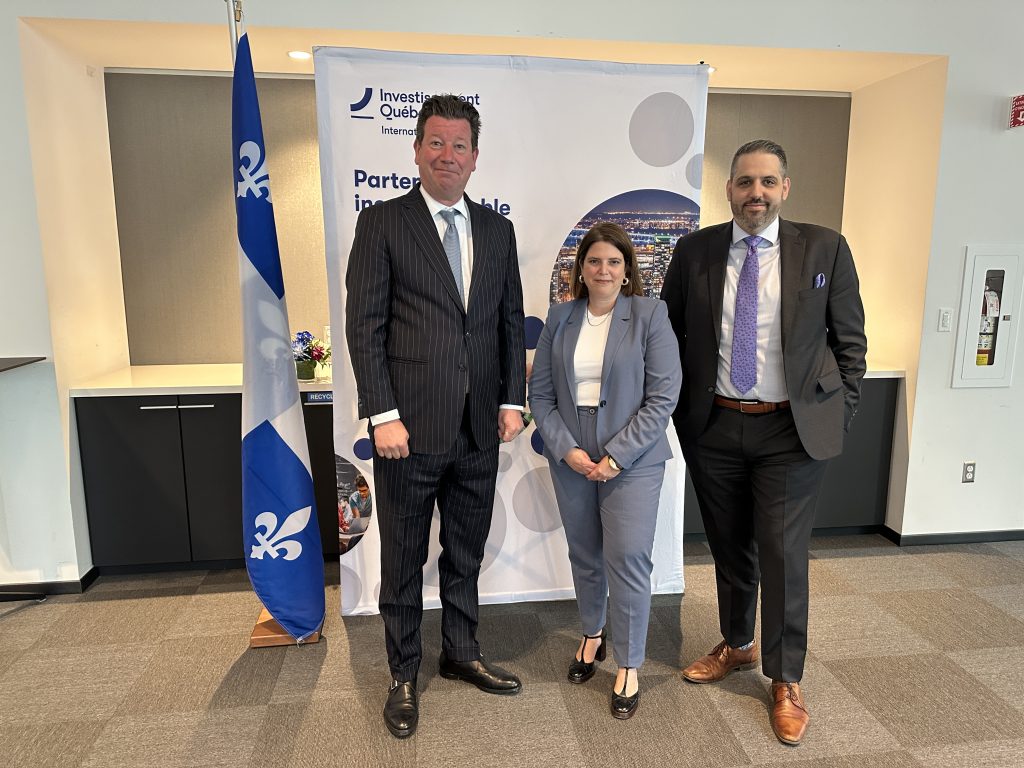
Hubert Bolduc, president of Investissement Québec International, said despite a slower year compared to 2023’s record-breaking numbers, the results are still strong.
“It was a good year,” Bolduc said. “Yes, a little bit slower than last year, but last year was an exceptional one… Actually, it’s the second best year ever in terms of foreign direct investment. And it’s the second best year ever as well in terms of trade.”
Fréchette reinforced the need to continue the momentum: “We must keep working and, of course, continue to diversify our economy by prioritizing markets outside the United States. Our strategy is clearly working.”
Growing interest beyond the U.S.
Marie-Eve Jean, vice-president of exports at Investissement Québec International, said Quebec companies are showing more interest in markets outside of the U.S., even though the export share remains steady.
“We’re seeing an increased interest of Quebec companies to seek for our services to go outside of the U.S. markets,” she said. “To me, what is very encouraging is to see this increased interest… companies are really interested in doing the effort, putting in the resources.”
Fréchette pointed out that this shift predates current events but has accelerated in recent years: “Even before the Trump administration, there was a significant will to diversify markets. Since Trump’s arrival, this intention has grown. That amounted to $2.1 billion in firm sales outside the U.S. market.”
This shift is partly driven by the uncertainty in North American trade. While 59 per cent of export sales still went to the U.S., 33 per cent were made in Europe, Asia, Africa, the Middle East and Latin America. Another eight per cent were made elsewhere in Canada.
Leblanc said Quebec businesses must adopt a more global mindset from the beginning.
“Clearly we have said for almost 40 years from the Chamber perspective: if you are a Quebec-based company, your future, your growth very rarely resides in the local market,” he said. “In this age where you have all those international competitors, you need to have access to that market. Ideally you’d be born global—when you set up your business plan, think about which markets and how you’ll access them in three years’ time.”
He added that while the U.S. was once the natural first step, companies now need to consider alternatives. “It doesn’t have to be the U.S. Maybe it should be somewhere else in the world. So your growth is about export, but it’s not necessarily about export to the U.S.”
Attracting the right investments
Daniel Silverman, vice-president of foreign direct investment at Investissement Québec International, said the drop from last year’s $13-billion total was expected, especially after several large battery sector investments in 2023.
He said the focus is now on building a long-term pipeline of strategic investments aligned with government priorities like clean tech, aerospace and advanced materials.
“What we’re doing now is we’re focusing on the pipeline and complementing the Quebec-based businesses that we have here and the ecosystems that we’re continuing to build,” Silverman said.
He added that Quebec’s attractiveness lies in its ability to offer both financial support and export guidance, giving it an edge globally. “It’s a one-two punch,” he said.
Fréchette echoed the need to support businesses on the ground: “The teams at Investissement Québec and OPECs like Québec International, the Chamber of Commerce of Metropolitan Montreal—they are at your side to support you. Don’t hesitate to knock on their door for guidance.”
Government sees results from strategy
Fréchette said Quebec’s economic strategy is delivering concrete results.
“More than ever, we need to diversify our markets and attract investment in our strategic sectors to strengthen Quebec’s economy and competitiveness,” she said. “Our businesses are true ambassadors of Quebec expertise and talent on the international stage, and we will continue to support them in conquering new markets.
“We are not lacking the means to get there, so we must remain confident.”
Bicha Ngo, CEO of Investissement Québec, said the results were strong despite global instability.
“After the record year we had last year, and in the context of a trade war that marked the end of our fiscal year, our results are remarkable and I want to highlight the significant efforts of our teams to promote Quebec’s know-how internationally,” she said.
She added that political shifts in the U.S. made market diversification even more essential. “With the election last fall in the United States, the importance of diversifying our export markets became clear, and we doubled our efforts.”
Collaboration is key
Bolduc said the province’s achievements depend on many partnerships.
“These results to make Quebec shine beyond our borders would not be possible without the collaboration of our government partners,” he said. “Despite the headwinds, we managed to maintain this cohesion and collectively multiply our efforts to promote Quebec to foreign investors and Quebec expertise on the international stage.
“I can only be proud of our ability to adapt and navigate through changing, competitive economic conditions influenced by our trading partners’ public policies.”
Fréchette emphasized the importance of coordinated effort: “This is our collective success. We must emerge from this trade war and the challenges it brings even stronger.”
Concern over new U.S. tariffs
At the forum, concerns were also raised about new threats from Washington. Leblanc said U.S. President Donald Trump’s proposal to impose a 100 per cent tariff on foreign-made films could hurt Montreal’s film and production industry.
“It’s very troublesome,” he said. “First, it’s one of our strong sectors in Montreal. We have all those experts there… For now, it’s only goods. It’s not a good thing. But if you go to services, it’s very bad.”
Fréchette said she’s heard firsthand concerns from European partners: “The Europeans are particularly worried about Trump’s aggressive rhetoric—not just in trade, but territorially, including his ambitions related to Greenland. And the interview he gave yesterday will do nothing to reassure them.”
Next steps: planning together
Leblanc said it’s now time to move from talk to action. That means coordinating trade missions, building port capacity and making sure small businesses know how to access help.
“We were discussing very concrete matters,” he said. “How do we bring those people? How do we ship the goods? Do we use airplanes? Cargo? It’s really about how do we do it and how do we do it together.”
Fréchette closed with a final call to businesses: “I encourage companies to revisit their supply chains—we must ‘Québec-ize’ as much as possible. That will be the key to our success. And our success will be collective.”