Gallant Commission begins second phase of investigation into Quebec’s failed SAAQclic digital shift
Posted May 14, 2025 10:44 am.
Last Updated May 14, 2025 11:27 am.
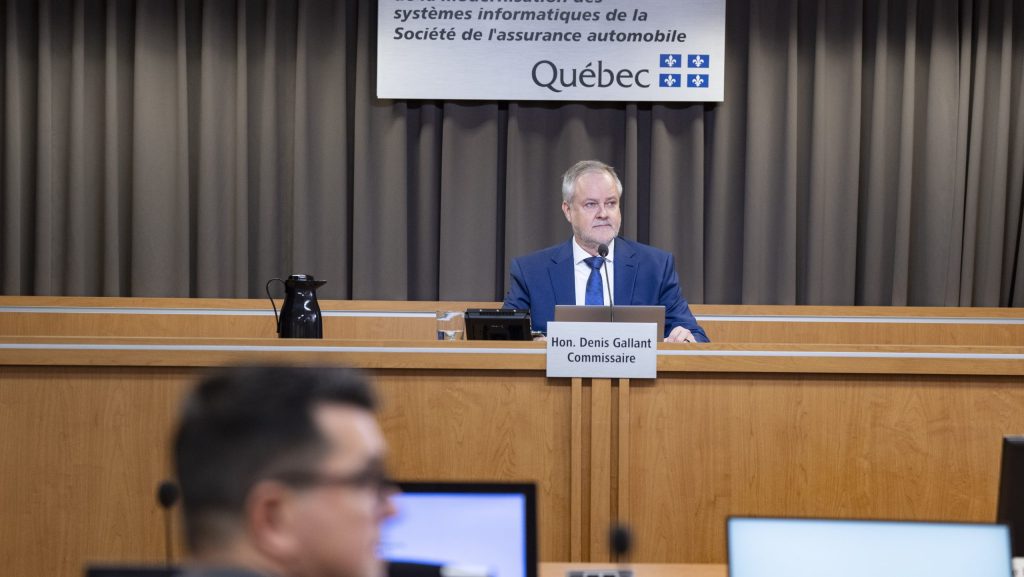
The Gallant Commission, which is investigating the failed digital transformation of the Société de l’assurance automobile du Québec (SAAQ), travelled to Quebec City on Tuesday to begin the second phase of its work.
Chief prosecutor Simon Tremblay announced that after “laying the foundations of the investigation” in late April or early May in Montreal, the commission was ready to hear witnesses involved in the creation of SAAQclic.
The digital transformation at the SAAQ is likely to cost more than $1.1 billion by 2027, an increase of $500 million over the initial budget, according to the Auditor General of Quebec.
On Tuesday, former SAAQ Chairman Guy Morneau, who held the position from 2013 to 2016, told the commission that the SAAQ had no in-house expertise to make the necessary digital shift.
He explained the government corporation had chosen to move its IT services to an integrated management software package, a solution considered modern and sustainable.
Hydro-Québec, which had tested it, had experienced some “difficult” moments, but Morneau felt the situation was “overall manageable.” The SAAQ teams were motivated and dedicated, he said.
“We were looking for a (private) partner capable of providing us with specialized resources. … We wanted our staff to learn a lot from these people, … that way, they would develop their expertise,” he said.
Speaking of a project of “unspeakable complexity,” Morneau stated that cost overruns are sometimes “inevitable” and must be put into perspective.
“What is the SAAQ’s administrative budget? Even if it costs $50 million, $100 million, $200 million more, … that’s not going to stop the world from turning,” he said.
Cost overruns are not a “recurring” expense and can be amortized over several years, he argued. “And a well-functioning ERP system generates economies of scale,” he argued.
“$200 million, $300 million all at once is shocking; they’re poor managers.
“Would you live without this today?” No. The SAAQ could not fulfill its mission.”
In a press scrum, he qualified his statement, stating that, when he was Chairman of the Board, there was no indication of cost overruns of $500 million. “If there was malfeasance, fraud, or incompetence, it deserves to be highlighted and corrected,” he said.
One thing is certain: under his leadership, the members of the Board met 10 to 12 times a year, and Morneau himself met with the Minister of Transport every six months.
The two ministers he dealt with, the Parti Québécois’ Sylvain Gaudreault and Liberal Robert Poëti, were interested in the digital shift; with them, he reviewed the “major indicators,” which were all positive, he testified.
“When I left, this project was on track. … I don’t see how we could have done better in terms of preparation,” he concluded. Morneau will continue his testimony and will be cross-examined on Wednesday.
Recommendations ignored
In the morning, the committee asked organizational transformation specialist Nathalie Giguère to summarize previous VGQ reports for Justice Gallant.
Since 2006, the VGQ has been warning against the risks of over-reliance on external IT resources (conflicts of interest, collusion, increased costs, etc.).
“We always come back to the same recommendations,” Giguère emphasized. “The use of external resources is the driving force. We see a recurrence. We really see the redundancy.”
“And now we find ourselves with a commission of inquiry in 2025,” added Justice Gallant. The expert noted that the government has had access to several best practice guides for contract management over the years.
The Gallant Commission will continue its work in Quebec City all week. It will hear from several former members of the SAAQ board of directors. A final report is expected no later than Sept. 30, 2025.
–This report by La Presse Canadienne was translated by CityNews