Quebec names mediator as Montreal STM strike enters third day

Posted June 11, 2025 7:08 am.
Last Updated June 12, 2025 9:16 am.
Quebec’s labour minister says he has named a mediator in a labour dispute between Montreal’s public transit authority and its maintenance workers that has limited bus and metro service across the city.
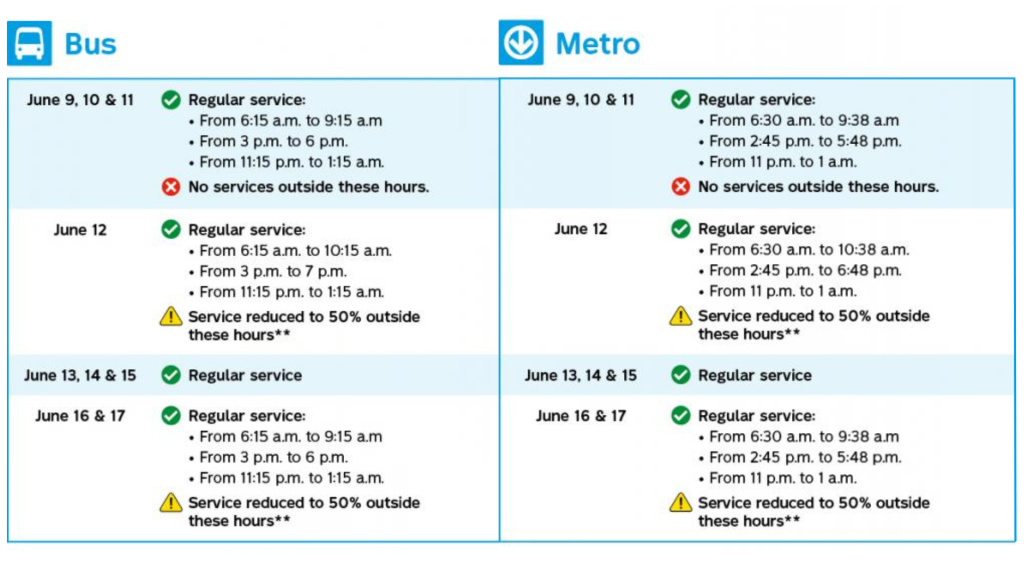
About 2,400 maintenance workers have been on strike since Monday after more than a year of negotiating. As a result, buses and metros are only operating during morning and afternoon rush hours and late at night.
Labour Minister Jean Boulet said Wednesday on social media that the mediator will be tasked with easing tensions between both sides and restoring a dialogue “conducive to negotiations.”
One day earlier, he urged the union and the transit authority to jointly seek mediation to bring them closer to a deal.
In a news release on Wednesday, the transit authority — Société de transport de Montréal — said negotiations with the union extended late into the prior night before the two sides agreed on the conditions governing mediation. Both sides filed a joint application for mediation to the Labour Department.
“Meetings with the union continue and are still scheduled several times a week,” the transit authority said.
The mediation deal is a “step in the right direction,” said Marie-Claude Léonard, general director of the agency. But she said, “we are not one meeting away from reaching a solution.” The agency noted it had proposed mediation as early as May 29.
Bruno Jeannotte, president of the maintenance workers union, said in an emailed statement that mediation will hopefully accelerate negotiations “to quickly resolve the issues that separate us.”
As part of an agreement reached with Quebec’s labour tribunal, regular service will be maintained from Friday to Sunday for the Canadian Grand Prix weekend, but operations will be restricted on other days until the strike is set to end on June 17.
“You need transit,” said Éric Alan Caldwell, chair of the STM. “You need transit to put bread on the table. You need transit to get work.”
Earlier this week, Jeannotte also said his team is in talks with the union representing bus and subway drivers — who have also voted for a strike mandate — on ways to increase pressure on the transit authority.
In a post on the X platform, Mayor Valérie Plante thanked Boulet for getting involved. “This is an important step that will help move things forward,” Plante wrote. “Our wish is clear: that the dialogue accelerates to reach an agreement.”
She also sympathized with Montrealers who’ve been affected by the service cuts.
“The situation is difficult and complex for thousands of us. Public transit is essential and must resume quickly,” Plante said.
Many local businesses are already seeing the direct toll it’s had on their day-to-day operation and sales.
“Our staff have seen a drop and a lot of cancellations in their appointments,” said Annie Bouchard, local business owner of La Source en Soi. “Clients are not necessarily happy either because they can’t make it to their scheduled appointment. It’s creating a bit of dissatisfaction among clients, but also among our staff. It’s their livelihood.”
“We had to change the schedule a little so that I could leave on time for the first bus home, which is at 3:00 p.m.,” said Beatrice Dessureault, receptionist at La Source en Soi. “I had to change my schedule a bit.”
On the first day of the strike, Dessureault had a medical appointment in the afternoon, but no buses were in service to bring her back to her work after.
“I could have missed two hours and then come back to work, but in this case, I missed the whole day,” she said.
Philippe Jacques, co-general director for the advocacy group for public transit users Trajectoire Québec, says that small businesses they’ve been in touch with saw their sales drop by half. However, he was unable to grasp the STM’s decision to be fully open for Grand Prix weekend.
“We don’t get it. What’s the priority of our society, saying it’s essential service for people to go to a place where they just watch cars burning gas,” Jacques said, criticizing the STM for prioritizing Grand Prix fans over those who rely on public commute, such as the everyday workers and students.
Adding, “They even have a REM until one in the morning, so they can party after the Grand Prix Formula 1 in downtown Montreal.”
“We hope there won’t be another other strike this fall because it hurts the trust of the people toward public transit,” said Jacques.
“Whether it’s the Grand Prix as an event, or the Francofolies, or people having to go to work, or having to miss an appointment because there was no option for them, for me, is not acceptable,” said Valérie Plante, mayor of Montreal. “I’m really hoping that this process, having Ministre Boulet appointing a mediator, they will find a solution, because it’s absolutely needed.”
There will once again be reduced bus and metro service Thursday, with hours extended by an hour. The full schedule can be found at stm.info.