Gilbert Rozon uncertain about therapy he claims to have undergone
Posted July 7, 2025 2:45 pm.
Last Updated July 7, 2025 3:09 pm.
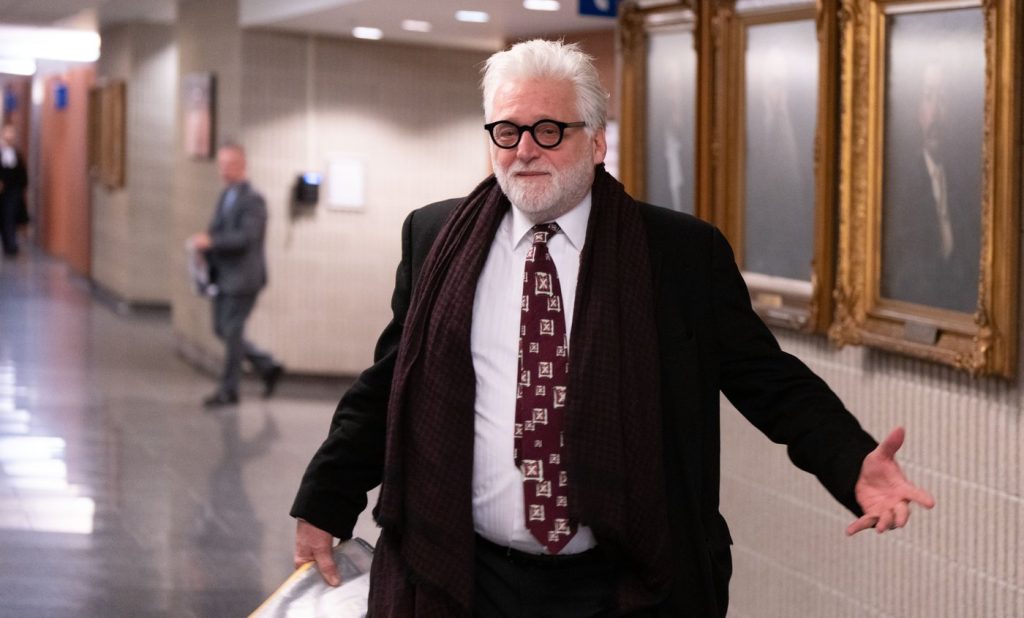
A few dozen protesters gathered early Monday morning in front of the Montreal courthouse to denounce Gilbert Rozon, whose cross-examination resumed in his civil trial.
Nine women are suing the disgraced former comedy mogul for nearly $14 million, alleging they were sexually assaulted by the defendant.
The plaintiffs’ lawyer, Bruce Johnston, revisited an interview with Josélito Michaud in which the sexual assault of a young female croupier at a party at the Manoir Rouville Campbell in 1998, an assault for which he admitted guilt at the time, was discussed at length.
‘Nuance’ between words and intent
During the interview with Michaud in 2011, Rozon said: “I’m paying for this one, but I could have paid for many others before that.”
Before Judge Chantal Tremblay, he maintained that he was referring to episodes of drunk driving and that he had in no way admitted to having committed such acts. Since the beginning of the trial, Rozon has repeatedly stated that he did not commit this assault, that the young woman consented, and that he pleaded guilty under pressure from his family to save the Juste pour rire business.
“There is a nuance between what I said and what I intended to say. … I wasn’t guilty of that offence, but I did other stupid things,” he maintained.
“I’m not an aggressor, I hate violence,” the witness repeated more than once, reaffirming, as he had earlier, that he had pleaded guilty as part of a plea agreement. “Making me say anything more than that is a game to get things that don’t exist.”
Therapy or not?
Johnston raised the fact that he had told Michaud that he had been in therapy for five years, even though he had said he hadn’t been in therapy during the preliminary examinations.
“I saw therapists several times to try to understand this need for affection, seduction, but above all to get through my separation,” he then stated. “I may have said I was doing self-therapy.”
When pressed further, he said he couldn’t remember the name of any therapist.
“My greatest therapist, I’ll tell you, was Pierre Marc Johnson,” the witness affirmed, calling the former premier of Quebec a confidant.
He also mentioned priests without naming them, and clergymen, specifying that a clergyman whose name he no longer remembers was “the person who helped me the most.”
‘100% false’
Johnston then prompted Rozon to explain an article published in La Presse in February 2018, which described a dinner tour in Quebec City and an eventful night in a hotel. In this article, an actor, speaking on condition of anonymity, recounts that Rozon appeared at his room door naked, with a towel over his shoulder, saying he wanted to sodomize him and demanding oral sex.
Previously, during dinner, he was, according to the same article, which quotes actress Dominique Pétin on this subject, “obnoxious to the restaurant staff,” behaving like “a rude person.”
“Everything written here is 100 per cent false,” Rozon replied.
Regarding walking naked in the hotel corridor, he replied that “at some point, it has to make a little sense.”
As for the comments made against the actor, whom he has repeatedly criticized for his anonymity, he stated: “I never said that, I’m not homosexual.” I don’t talk like that, especially after 1998 (the Manoir Rouville-Campbell affair), I was embarrassed. An actress would flirt with me, I would blush, I wouldn’t look at her directly.”
He said he saw the #MeToo movement as “a kind of war of women against men that I don’t understand at all. I was a symbol,” a statement that has come up several times since he began testifying.
Since the beginning of his testimony, the founder of Just for Laughs has often stated that the notion of consent has evolved to the point where today, “yes, it doesn’t necessarily mean yes, if there isn’t a written document or a video” to prove it.
The nine plaintiffs are Patricia Tulasne, Lyne Charlebois, Anne-Marie Charrette, Annick Charrette, Sophie Moreau, Danie Frenette, Guylaine Courcelles, Mary Sicari, and Martine Roy. An initial request for authorization of class action against the businessman, filed in 2017 by a group of women nicknamed Les Courageuses, was first granted at first instance in 2018 and then rejected on appeal in 2020.
Meanwhile, 14 women filed complaints with the police, but the Director of Criminal and Penal Prosecutions only accepted that of Charrette. Rozon was acquitted in 2020 on the basis of reasonable doubt.
Tulasne, who acted as spokesperson for Les Courageuses, was the first to file a civil lawsuit against Rozon in April 2021. The other eight women followed suit, and all the lawsuits were consolidated to lead to the trial, which began last December and was repeatedly interrupted due to legal disputes.
–This report by La Presse Canadienne was translated by CityNews