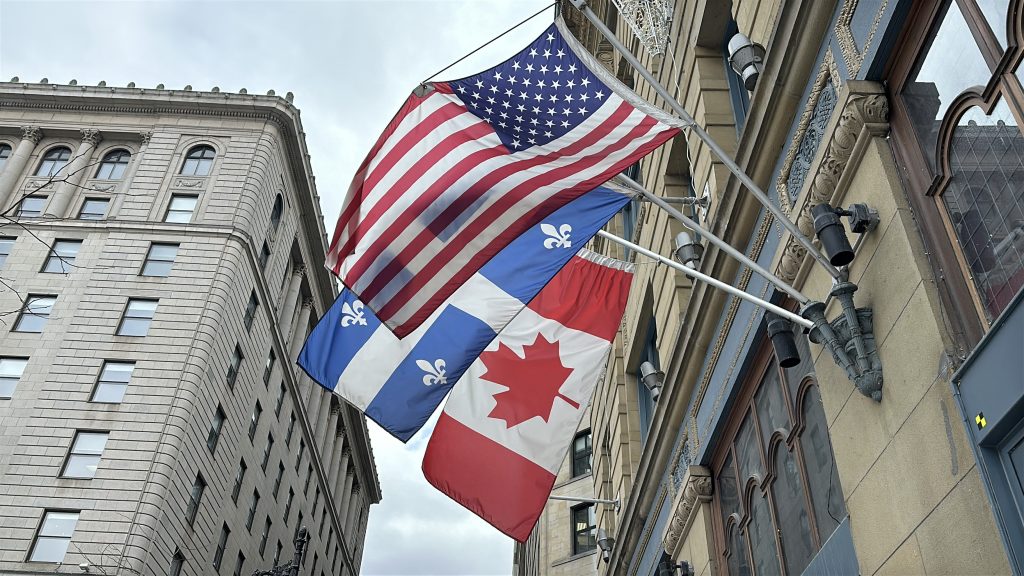
Quebec braces for impact from U.S tariffs on Canadian goods
Posted August 1, 2025 10:01 am.
Last Updated August 1, 2025 5:52 pm.
Since U.S. president Donald Trump signed an executive order on Thursday to raise the tariffs on Canadian goods from 25 per cent to 35 per cent, the reaction in Quebec has been mixed. That’s because these tariffs will be applied to products that are not covered by the U.S.-Mexico-Canada trade agreement also referred to as CUSMA.
“It’s the uncertainty that is caused by these announcements that is hurting our companies and putting on pause our economy,” said Véronique Proulx, CEO of Federation of Chambers of Commerce of Quebec. “We have to understand that as of now, 91 per cent of the goods that are exported to the US from Canada are exempt of tariffs, which means that all 91 per cent of these products are USMCA compliant, so there are no tariffs.”
Quebec Premier François Legault reacted on social media to the increase in tariffs for Canada from 25 per cent to 35 per cent on Canadian products not covered by a pre-existing trade agreement.
In a social media post, Legault said the tariffs are “damaging to our workers, our businesses. These tariffs also hurt American citizens who need our products and resources.”
Legault reiterated the need for Quebec and Canada to diversify their markets and increase their economic autonomy. He also made a promise to support Quebec workers and businesses.
“It’s going to hurt more on the symbolism side than it will on the actual side,” said Yan Cimon, professor of strategy at the Faculty of Business Administration at Université Laval. “Going from 25 to 35 is not the end of the world. It’s going to be hard for certain businesses for sure.”
The Quebec premier also mentioned that he is in contact with the federal government and the other provinces for the next steps and that he will continue working to defend the interests of Quebecers.
“The announcement yesterday does not stop the current uncertainty,” said Jasmin Guénette, Vice-President of National Affairs at the Canadian Federation of Independent Business (CFIB).
Quebec’s Federation of Chambers of Commerce (FCCQ) says that just in Quebec alone the uncertainty that President Trump has created with tariffs has led to 25,000 job losses in construction between Jan. and June of this year as well as another 15,000 job losses in the manufacturing sector during the same period.
“What we’ve seen is that the uncertainty has brought a lot of companies to choose to not invest in their production plants in their operations here in Quebec,” said Proulx.
“Uncertainty means that business won’t maybe invest in their operation as much because they don’t know what could come next,” said Guénette.
“Right now the uncertainty is probably the main impact of going from 25 to 35, because it does mitigate investment projects. It does have a negative impact on potential investments in Quebec and Canada,” said Cimon. “It also has an impact on the business climate, because businesses need a certainty of access to the US market for our exporters, because the US is our main export destination. So, that is probably what’s at stake here.”
The FCCQ adds that because of the uncertainty, certain small to medium-sized businesses in Quebec such as those in the lumber industry that manufacture construction goods and those in the agri-food sector might choose to invest in the United States to have better access to their market.
“It’s a variety of companies from the different regions of Quebec and also in Montreal, who are saying you know what, the US is our main export market, we want to make sure we maintain this access, we’ll go ahead and we’ll invest in the US,” said Proulx. “And that’s what we’re concerned about in the long run.”
The increase in tariffs from 25 per cent to 35 per cent was justified by the White House as a response to the fact that it believes Ottawa has not cooperated to reduce the flow of fentanyl and other drugs across the border. This, even though Canada accounts for only 1 per cent of U.S. fentanyl exports.
In a statement released at midnight on Friday, Canadian Prime Minister Mark Carney said the federal government is “disappointed by this measure.”
However, he attempted to put the real impact of these new customs duties into perspective, recalling that, “thanks to CUSMA, the average tariff rate applied by the United States on Canadian products remains one of the lowest among all its trading partners.”
Despite this observation, the Prime Minister acknowledged that certain sectors of the Canadian economy, notably lumber, steel, aluminum and automobiles, are “heavily affected by American customs duties.”
For these sectors, the federal government “will take measures to protect Canadian jobs,” he assured.
“Canadians will be our best customers and will help create more well-paying jobs at home as we strengthen and diversify our trade partnerships around the world,” said the Prime Minister.
“By working with Canadian workers and using our country’s resources for the benefit of all Canadians, we can give more than any foreign government can ever take from us.”
In response, Conservative Leader Pierre Poilievre said his party remained hopeful for an agreement ending all U.S. tariffs on Canada, including the sectoral tariffs imposed by Donald Trump on specific industries.
“We must also take back control of our economic future by ending our dependence on the United States. We call on liberals to repeal anti-development laws and cut taxes on labor, energy, investment, and home construction to make our economy strong, self-reliant, and sovereign,” he added.
Bloc Québécois leader Yves-François Blanchet also says that reaching an agreement is crucial. He didn’t hesitate to issue a warning. “Quebec must be united, but vigilant and a stakeholder in preserving its economic interests, which differ from those of Ontario or the oil-rich West,” he wrote on X. “Faced with the arbitrariness of Donald Trump’s decrees, maintaining the rules of the CUSMA is not a lasting protection against uncertainty, especially not for forestry, aluminum, or culture.”
Interim NDP leader Don Davies criticized Prime Minister Carney for making concessions “that did not achieve his objectives.”
“Carney knew his strategy was failing. He suggested days ago that the process would not be completed on time, and now it has,” he said in a press release issued Friday. “Canada must continue to press for a strong trade agreement. New Democrats urge the Liberal government to act now to protect workers and the economy.”
Building a “strong Canada”
In his statement, Mark Carney said that trade negotiations with the United States are continuing, but that his government is focusing more on what it can control.
“The federal government, provinces and territories are working together to reduce barriers to trade in order to build a single Canadian economy,” he reiterated.
He also mentioned the “major projects of national interest” on which his government intends to focus to give new impetus to the Canadian economy.
“Together, these initiatives could generate new investments of more than $500 billion in Canada,” the Prime Minister argued.
On Thursday, President Trump also said that Canada’s willingness to recognize the Palestinian state would “make it very difficult” for the United States to conclude a trade agreement with its northern neighbor. Carney did not respond to this assertion in his statement.
— With information from Pierre Saint-Arnaud and the Associated Press