Successful heart surgery using Batman technique: A first in Quebec
Posted August 7, 2025 12:21 pm.
Last Updated August 7, 2025 4:05 pm.
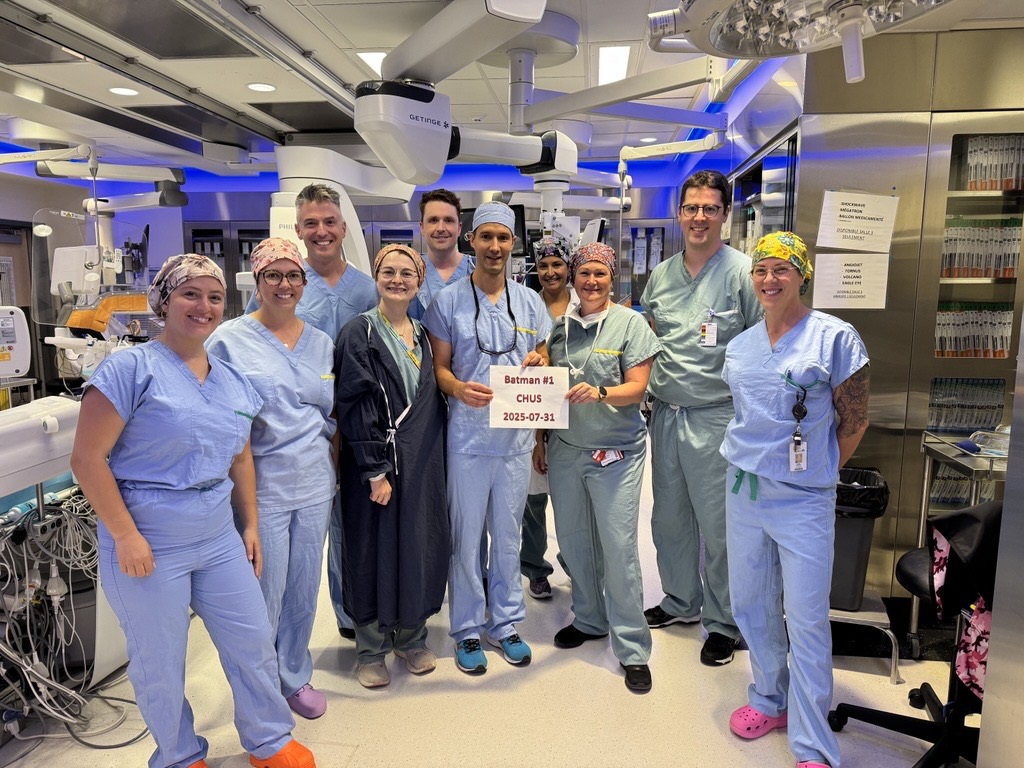
An 85-year-old patient was able to benefit from the expertise of a team from the CIUSSS de l’Estrie – CHUS, led by Dr. Étienne Couture, who performed a heart operation that was unprecedented in Quebec until now: the repair of a heart valve using the Batman technique.
Without this innovative technique, the octogenarian, who had already undergone open heart surgery before, would not have been able to undergo a second such operation because the risks would have been too high. Doctors would not have been able to offer him any intervention.
The procedure required a lot of preparation, as Dr. Couture explains. “I spent over 60 hours working, studying the technique, communicating with a colleague in Toronto to be fully prepared, and holding meetings with my team: the anesthesiologists, nurses, and imaging technologists,” he describes.
The most interesting thing about the Batman technique is that it allows for a much faster recovery for patients who would not otherwise be eligible for catheter valve replacement.
Unlike heart surgery, where patients will stay in the hospital for five to seven days—sometimes longer—with a recovery period that can last two to three months, in the case of the 85-year-old Quebec patient, he was discharged from the hospital the day after the procedure.
“The Batman technique allows us to replace the mitral valve by catheter through the groin in patients with specific cardiac anatomy for whom this less invasive option could not previously be offered,” explains Dr. Couture.
Without the Batman method, patients would have been forced to resort to open-heart surgery—much riskier—or no treatment at all.
Why the name Batman?
“To understand the Batman technique, you have to understand that the heart is a pump that pushes blood to the brain, muscles and organs to feed them, and that the blood circulates in the heart through valves that are made up of leaflets that open like doors to let the blood through and close to prevent the blood from flowing back,” explains Dr. Couture.
“Normally, when we replace the mitral valve by catheter, we will position the valve between the two gates of the mitral valve, which will mean that the native leaflets will always be in the open position. And in some patients, this could cause obstruction to the outflow of blood from the heart,” he continues.
With the Batman technique, instead of positioning the prosthesis by catheter between the two gates of the mitral valve, doctors will create a hole inside one of the two gates with a small electrified guide, then they will inflate balloons to enlarge the hole. They will position the prosthesis in the hole of the gate, and when the valve is deployed, the leaflet will be moved in a way that will not obstruct the outflow of blood from the heart.
Hence the name Batman, which simply corresponds to the English acronym “balloon assisted translocation of the anterior mitral leaflet”.
The Batman technique has already been performed six times in Toronto, says Dr. Couture, which explains his close collaboration with a Toronto cardiologist.
More than 10 healthcare professionals participated in the procedure at the CIUSSS de l’Estrie – CHUS. For the first time, the operation lasted four hours, a little longer than other catheter replacement procedures, which normally last about 45 minutes to an hour.
—The Canadian Press’s health coverage is supported by a partnership with the Canadian Medical Association. The Canadian Press is solely responsible for this journalistic content.
–This report by La Presse Canadienne was translated by CityNews