Montreal roadwork: Number of major projects remain unchanged from spring to fall
Posted August 27, 2025 5:04 pm.
Last Updated August 27, 2025 5:13 pm.
There will be 44 major road construction projects slated for this upcoming fall season, according to Mobilité Montréal, the city’s coordination committee overseen by Quebec’s transport ministry.
The projects are set to take place in Montreal and across the Greater Montreal Area, and are large-scale overhauls that could spell out full road closures for motorists.
Officials say the most significant disruptions will be concentrated in Montreal’s downtown core, where overlapping projects could make driving especially difficult.
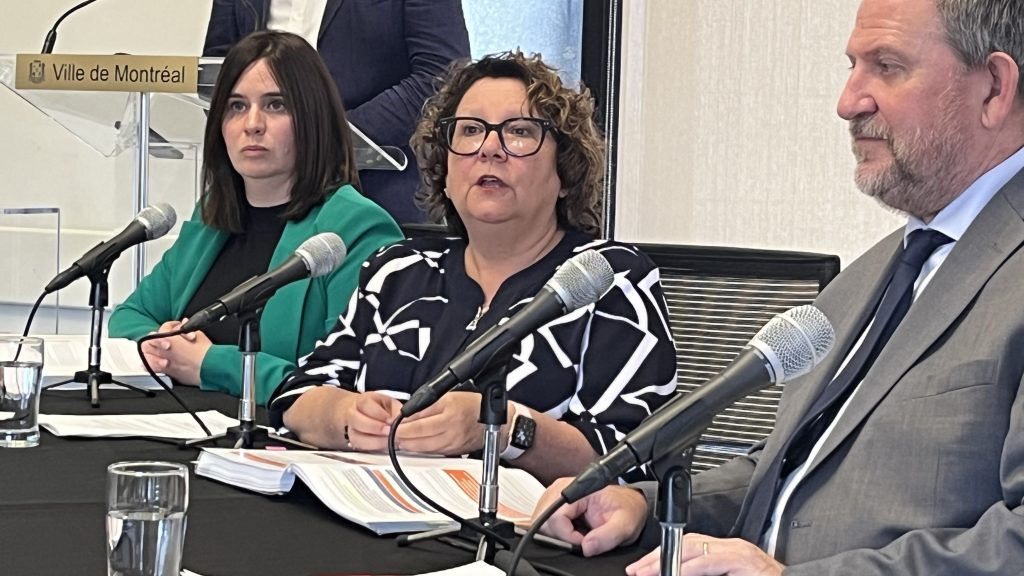
“If you have to head to downtown Montreal, you better come with public transit,” city spokesperson Philippe Sabourin told reporters Wednesday.
The announcement was made during Mobilité Montréal’s seasonal update, which noted that the total number of major project remains unchanged from the spring. The city said it aims to keep the number of large-scale projects to under 50.
“We have three that were completely done since last June and three that were replanned in 2026,” said Quebec Transportation Ministry spokesperson Sarah Bensadoun.
“There’s no useless construction work site. The job needs to be done,” Sabourin added, saying large overhauls need to be done across the city to support Montreal’s aging road infrastructure.
Of the 44 ongoing projects set for this fall, seven of them are brand new. They are:
- Route 340 (Vaudreuil-Dorion and Saint-Lazare)
- Partial or full closures on sections of Route 340, Boulevard de la Gare, and Rue Henry-Ford
- Occasional ramp closures to and from Highway 30
- Redevelopment work until December 2028
- Honoré-Mercier Bridge
- One lane per direction on several nights and weekends
- Full closures toward Montreal for about four weekends
- Work to run from September to November 2025
- Chemin de la Côte-Sainte-Catherine (Côte-des-Neiges)
- Partial closure between Avenue de la Brunante and Avenue Darlington
- Infrastructure work (roads, sewers, water, lighting, traffic lights) until November 2027
- Boulevard LaSalle (Verdun)
- Infrastructure upgrades (water, sewers, utilities, lighting) between 2nd Avenue and Rue Gordon
- Full closure from September 2025 to December 2026 (with winter pauses)
- Highway 40 & Highway 640
- Partial nighttime closures
- Ramp closures at Montée des Pionniers and Boulevard Marcel-Therrien
- Work to continue until late 2025
- Chemin du Tremblay (Longueuil)
- Full closure westbound toward Longueuil
- Occasional eastbound closures at night and on weekends
- Urbanization project until November 2025
- Highway 20 / Route 132 East (Saint-Lambert, Brossard)
- Nighttime lane closures and ramp closures
- Long-term single-lane closure on Boulevard Marie-Victorin eastbound near the Champlain Bridge
- Work to continue until October 2025

Increasing communication with boroughs following Montreal auditor general’s report
Mobilité Montréal’s update came just a day after Montreal’s auditor general (AG) blamed the city’s mismanagement for poor coordination on construction.
The auditor general took aim at Montreal’s road maintenance after releasing an over 500-page report Monday, pointing to “insufficient mechanisms” and a “compartmentalized” approach that hinders preventive maintenance and long-term planning.
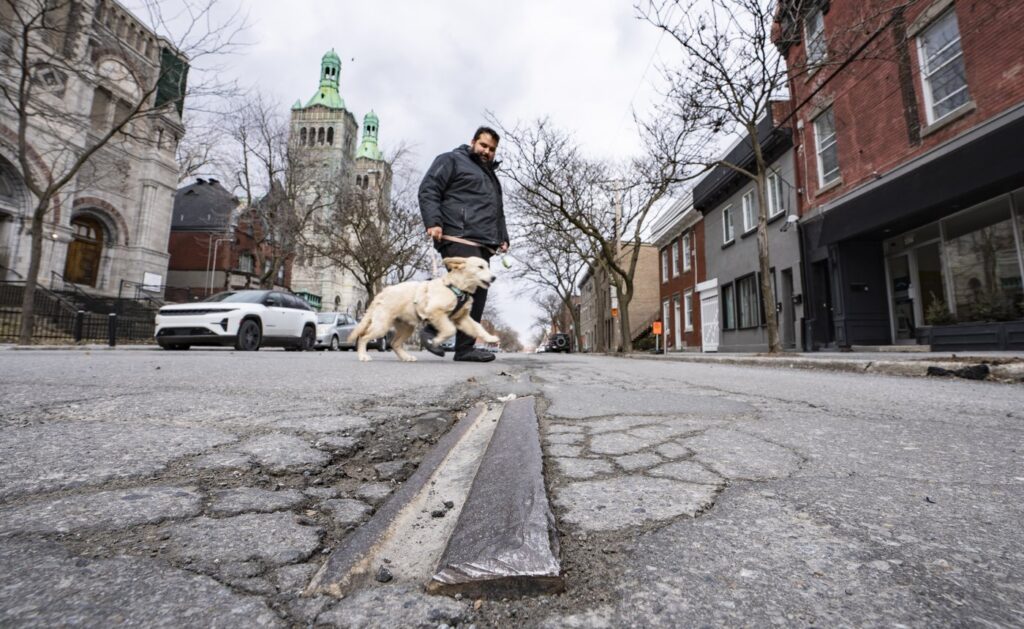
The report found that nearly 40 per cent of local streets, managed by the boroughs, were in “poor” or “very poor” condition in 2024, in Montreal — a number that rose following the year prior. As well, barely three per cent of Montreal’s local streets in “poor” condition received repairs between 2022 and 2024.
Sabourin told reporters that the large-scale overhauls presented by the city Wednesday were not the target of the AG’s report.
“It’s important that you make the distinction between patching a pothole,” he said, “(and) doing the reconstruction of the street.”
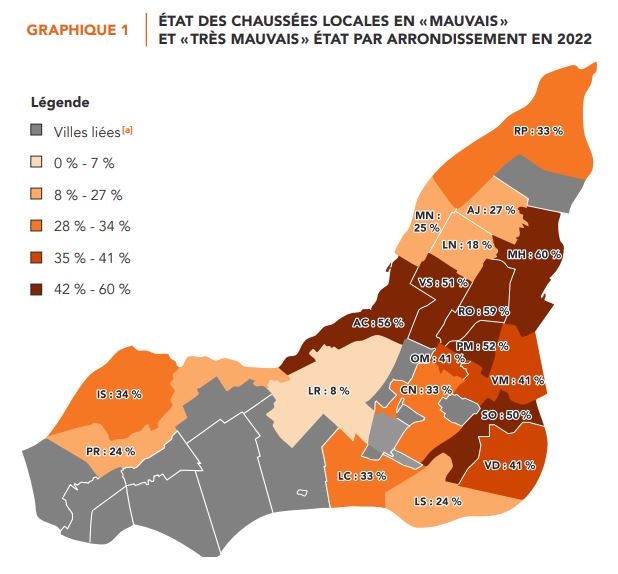
local street surveys conducted in 2022. (Credit: Auditor General 2024 report)
The AG instead flagged the city’s approach to routine maintenance — the hundreds of smaller repairs happening in tandem with the over 40 major projects happening this fall.
The report traces the roots of Montreal’s poorly coordinated construction to a larger issue it said the city has been facing for years: too much confusion between city hall and the boroughs over who’s responsible for what. The AG’s recommendation: give boroughs a larger role in major repair projects.
However, Sabourin insisted that the city will look to boost communication between itself and the boroughs when coordinating day-to-day road interventions. He says the City of Montreal has taken to using the Assistant à la gestion des interventions dans la rue (AGIR), an online platform meant to serve as a centralized hub for communication.
“We let (the boroughs) know what are the projects that we have in mind for the coming years, and what are the projects that we have already on the ground,” Sabourin said.
‘Montreal is the city of construction’: residents react to ongoing roadwork
Even still, many Montrealers are exasperated with the constant road work that they say clogs their commutes.
“Paris is the city of love,” one Montrealer said, “but Montreal is the city of construction.”
“I dont know how people who are working every day dealing with it,” another said.
“It causes me to be late for my deliveries often, especially downtown,” a courier driving a truck told CityNews.
The frustration is shared by Montrealer Aisha Hamilton, who said she often feels like projects pop up without much coordination.
“I’m hoping there’s a bigger plan in place with logistics in mind,” she said.
Hamilton said part of her skepticism comes from the sight of traffic cones scattered across the city with no clear purpose. Sabourin acknowledged the problem Wednesday, telling reporters that since Jan. 1, crews have collected around 3000 “useless cones” that weren’t tied to active construction work.
For Hamilton, the issue isn’t just the road closures themselves, but how they’re communicated to residents.
“I feel like their lack of transparency,” she said. “It’s like, you can’t just keep closing a bunch of roads and be like, ‘oh, we’re working on it.'”