Disabled Montreal seniors trapped in Nuns’ Island apartments for months due to elevator construction
Posted September 7, 2025 7:23 pm.
Last Updated September 8, 2025 8:41 am.
Two disabled Montreal seniors in apartment buildings owned by the same property management company in Verdun say they have been trapped in their homes for months due to elevator construction.
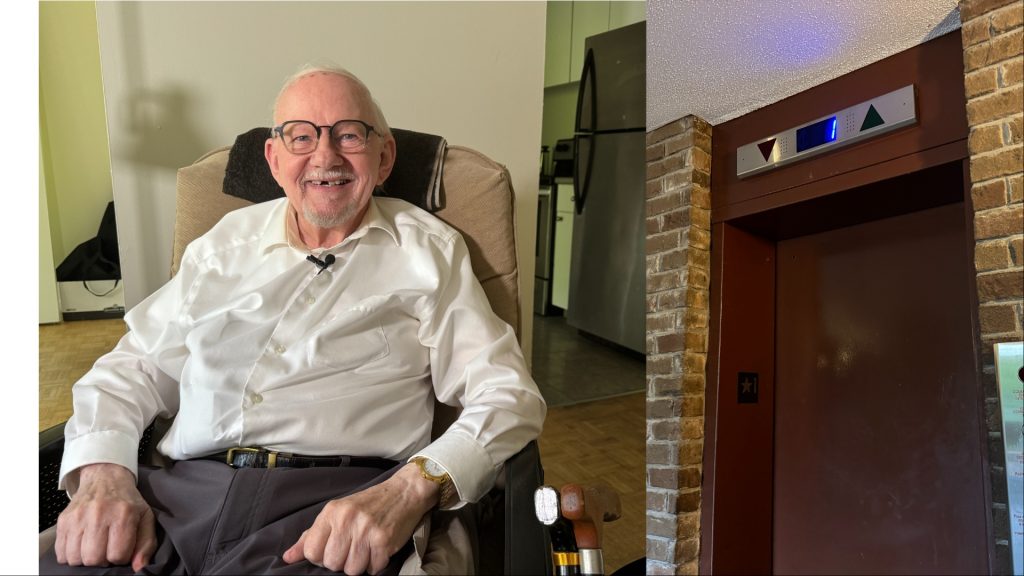
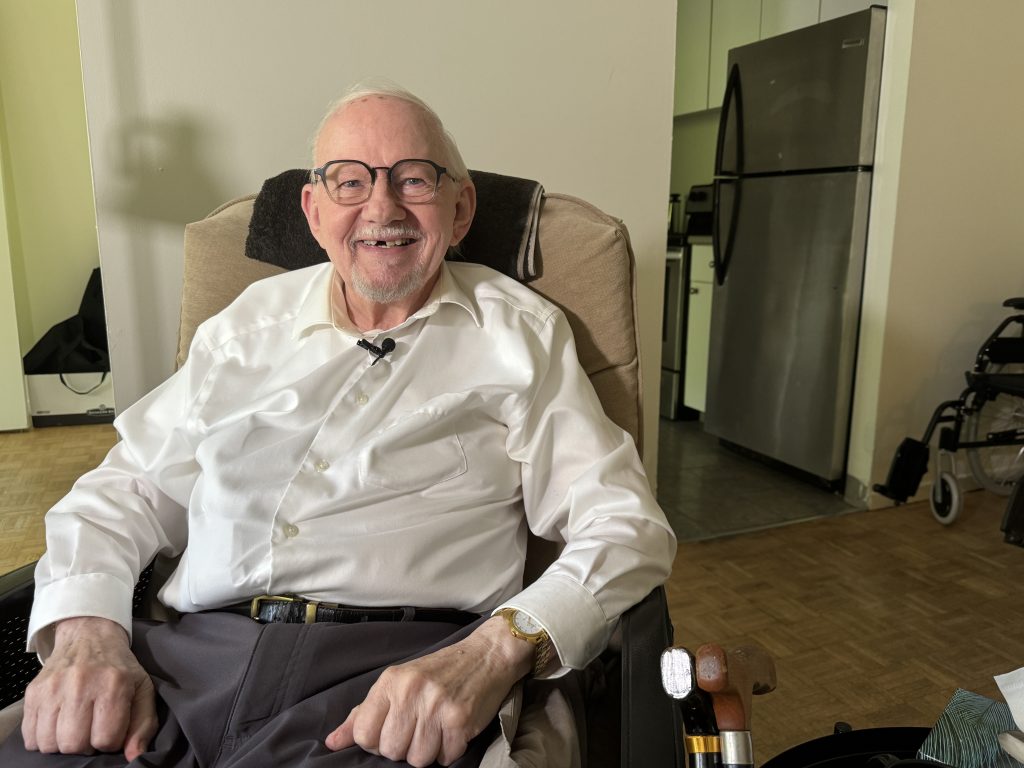
“This is an organization that has very, very little regard for their tenants,” said Nuns’ Island resident Harald Osberg, 86, referring to his landlord Structures Métropolitaines and its parent company Boardwalk Inc.
Osberg was confined to his fourth-floor apartment for eight weeks this summer before he said he had no choice but to move.
Living with severe osteoarthritis and relying on canes and a wheelchair, the elevator was his only way to leave his unit. When it became clear repairs weren’t ending on schedule, he transferred at the end of July into a temporary, unfurnished apartment nearby, bringing only a third of his belongings with him.
“I’m not the same person I was before,” Osberg said. “This whole exercise has put an enormous strain on me.”
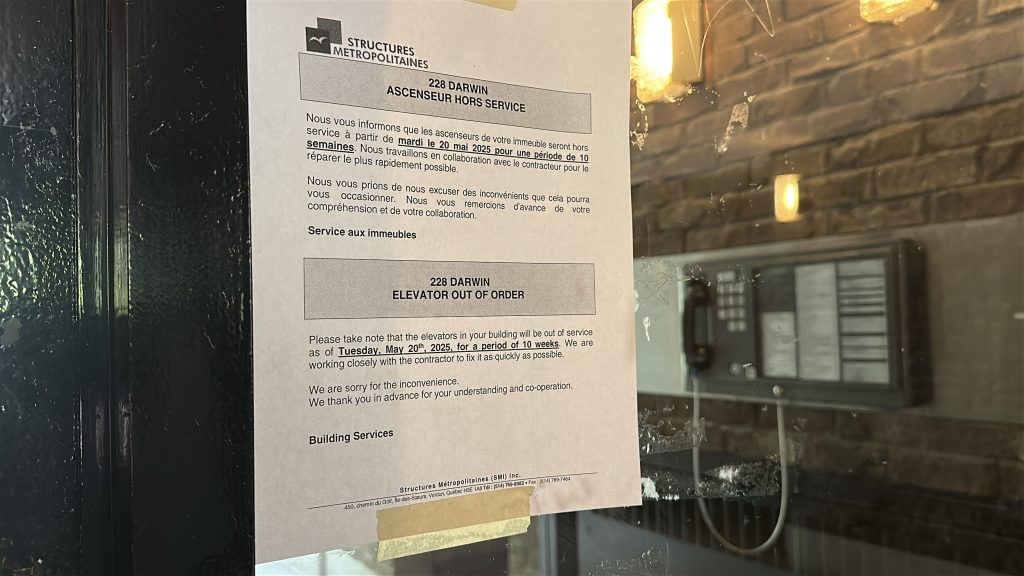
Osberg said construction on the elevator in his building began on June 2 and was supposed to last 10 weeks, but ended up running overtime for a total of 13 weeks.
He said he was given just one week’s notice before the elevator was put out of commission, and even after the timeline was pushed back by two weeks, he didn’t have enough time to find a wheelchair-accessible home before the work started.
Osberg said that he called the building’s management four times to no avail, telling CityNews that he was “completely ignored.”
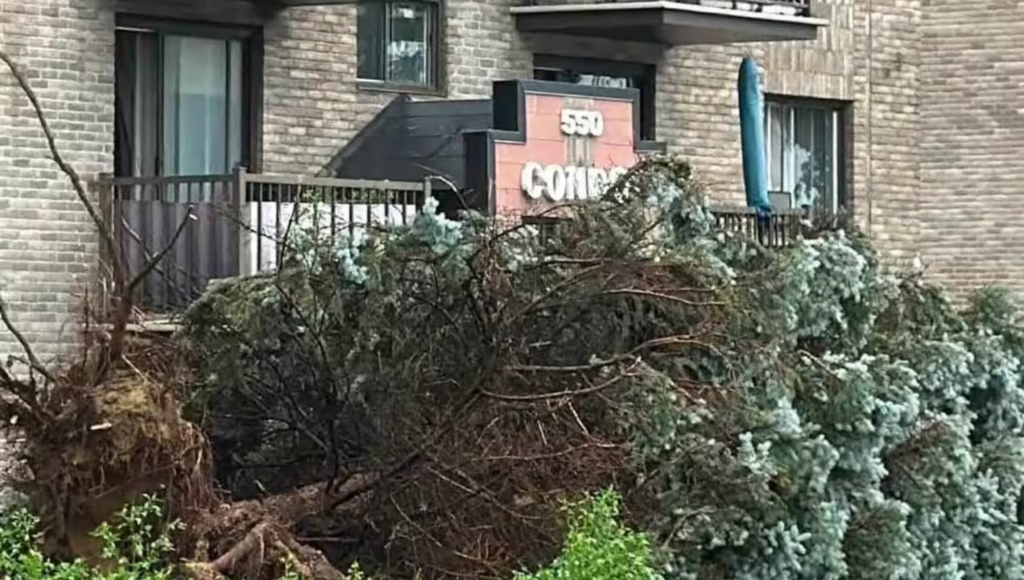
A few blocks away, resident Stan Schwartz faced a similar ordeal. He said the elevator in his building was out of service since March 17 — a period of 23 weeks.
“The landlord representative, the receptionist, admitted that they were as much in the dark as we were,” Schwartz said. “The excuses were very shallow.”
At 81 years old and living with spinal stenosis, Schwartz uses a rollator to walk and stand. He said he received no updates from the landlord while the end date for the elevator’s repairs kept shifting.
Living alone and without assistance, he was forced to wait until the elevator was finally restored two weeks ago.
“When the elevator stopped, I figured I could tough it out. But it was a little different,” Schwartz said. “It was another extended isolation, which was difficult.”
In a statement to CityNews, Boardwalk Regional Director Pierre-Olivier Lauzon said the elevators in both buildings underwent construction as part of a modernization overhaul. They have now been fully repaired.
“Many of the elevators in our Montreal portfolio are nearly 60 years old, and following continuous, detailed technical evaluations,” Lauzon said. “Boardwalk is fully conscious of the age of some of its assets, and for that reason has been conducting major modernization work across our portfolio for years.”
Elevator construction dragged on for months because the installation of new equipment required “a necessary period of fine-tuning and calibration,” he added.
“These adjustments can sometimes take longer than anticipated, and in some cases, supply chain challenges for specialized components have also contributed to extending completion timelines,” Lauzon said.
Lack of accommodations a violation of rights, activists say
Steven Laperrière, general director of Regroupement des activistes pour l’inclusion au Québec (RAPLIQ), says that any elevator under construction for that amount of time without providing proper accommodations for disabled tenants is illegal.
In the case of health issues, he said, a functioning elevator can literally be a matter of life or death.
“Every minute counts,” Laperrière said. “By putting out an elevator for such a long period of time, you’re putting all your tenants at risk, disabled or not, in case there’s a fire.”
Other accommodations that leave disabled tenants in their apartments, he added, are not enough and run the risk of leaving disabled tenants feeling uncomfortable.
“When you need intimate services,” Laperrière said, “you don’t want strangers to do that if you can avoid it.”
An on-site concierge service consisting of two staff members was implemented in Osberg’s apartment building to support residents during the construction. But Osberg said the small team, consisting of people he didn’t personally know, wasn’t adequate for physically demanding tasks like carrying him down the stairs.
“There’s no way anyone was going to carry me down four flights of stairs. It would be danger to me,” he said.
While neither the city nor the province possess laws obliging landlords to pay for moving their tenants to adapted living spaces, Laperrière argues that failing to do so infringes on a person’s right to life, liberty, and security of the person guaranteed under Section 7 of the Charter of Rights and Freedoms.
He added that the only fair solution in a situation where an elevator must remain out of service for an extended period of time is to move affected tenants to a safe, adapted space at the landlord’s expense.
“It’s the only thing that’s really acceptable because not everyone in the world can count on their kids or their family members,” Laperrière said.
Osberg said Boardwalk arranged his move into another one of the company’s apartments just a few blocks away. Although the temporary one-bedroom unit is smaller than his previous home, he said he’s still paying the same rent.
He described the unit as “no gift,” pointing to unclean floors, raised wooden floor panels that could cause him to trip and a bathroom that he called “inundated with spiders.”
“That one day made me a nervous wreck. The two days following I was unable to walk,” he said, of his move-in day in July.
Tenants can appeal to Quebec’s housing authority, the Tribunal administratif du logement (TAL), Laperrière said, but disputes can run on for months or even years depending on the case. He recommends tenants call the fire department to inform them of any escape hazards.
“Fire departments all through the province have a lot of influence on decisions,” Laperrière said. “They could even say ‘hey, this is dangerous,” and they might stop it or they might propose other solutions depending on where (the building) is.”
‘Some vindication for the difficulty’: Tenants seeking compensation
Verdun borough mayor Marie-Andrée Mauger told CityNews in a statement that while the city is “concerned about the delays in repairing the elevator,” enforcing proper accommodations ultimately falls outside their jurisdiction.
“We have contacted the owner to urge him to speed up the work and hope for a quick resolution to the situation,” the statement read. “It should be noted that the borough does not require a permit for elevator maintenance work, as this type of work falls under the jurisdiction of the (TAL).”
Schwartz is preparing to file a formal complaint against Boardwalk with support from the Verdun Citizen’s Action Committee, a housing rights group that assists tenants in disputes with landlords. He said he isn’t looking for a specific amount in compensation, but rather “some vindication for the difficulty.”
“Any kind of financial compensation is appreciated,” he said. “The amounts are less important than the offer.”

Meanwhile, Osberg said his case has already been brought before the TAL, where his legal representatives and Boardwalk have reached an impasse.
“We were unable to make a settlement between us,” he said. “The Quebec government will facilitate and examine both sides and they’ll make a judgment.”
Though Osberg is now preparing to move back into his old apartment, he said the experience of being stuck to his apartment has left lasting scars.
“It’s amazing how being confined in a space for that long can really affect you — but it it did,” Osberg said. “Psychologically it was definitely tough situation.”