‘Highest tariffs since the Great Depression’: Feds put in place measures to support aluminum and steel industries amid U.S. tariffs

Posted September 8, 2025 11:01 am.
Last Updated September 8, 2025 5:23 pm.
A series of new measures for Canadian industries most impacted by US tariffs, including aluminum and steel sectors, were announced at a press conference Monday morning in Montreal — where the federal government unveiled a Strategic Response Fund which includes a $5 billion investment, a new Buy Canadian policy, immediate liquidity relief, and regional tariff Response Initiatives.
With Quebec being one of the largest producers in North America, Minister of Innovation, Science & Industry of Canada, Mélanie Joly, and Jean Simard, President of the Aluminium Association of Canada, stated that the Quebec aluminum sector will get its fair share of the investment.
Joly suggests hundreds of millions of dollars.

“I can’t go into the details because we have to negotiate. But the goal is to continue to be at the forefront of the aluminum sector worldwide,” Joly said.
Sky-high tariffs
Joly reiterated that nearly all of Canada’s aluminum is produced in Quebec, and despite this, Canadian aluminum and steel exports continue to face 50 per cent U.S. tariffs.
“We’re now dealing with the highest tariffs since the Great Depression, and that’s their choice, and they’ve decided to put that on us and the rest of the world,” Joly said on Monday.

The new measures are said to help Canadian businesses ‘retool their production’ and diversify their products. The government will now allocate $5 billion to the Strategic Response Fund, a new reserve to assist businesses across all sectors negatively affected by the tariffs. The money is intended to help these companies survive and grow amid the trade war while also providing support through “new workforce alliances to align training and workforce needs.”
Small and medium-sized enterprises (SME) may also be cut a cheque to the tune of up to $1 million. New federal dollars will be issued through the Regional Tariff Response Initiative, whose funds will be more than doubled from $450 million to $1 billion over three years.
Ottawa will also increase new non-repayable contributions to eligible businesses impacted by tariffs across all affected sectors, including agriculture and seafood.
Providing a clear signal
“I don’t think we’re talking about saving the industry,” Simard said.
“What we’re talking about is making sure that an industry that is highly impacted financially by this situation is able to transition ahead while remaining competitive.”

Loans from the Business Development Bank of Canada for SMEs will also be expanded from $2 million to $5 million. This will provide “more flexible financing” through the Large Enterprise Tariff Loan, a program offering interest-bearing loans to Canadian companies facing cash shortfalls.
Canada’s auto sector is also getting relief. Automakers will no longer be required to meet the 20 per cent electric vehicle sales quota for the 2026 model year under the Electric Vehicle Availability Standard.
Earlier this year, uncertainty loomed over many Canadian and Quebec industries during the initial phases of Donald Trump’s tariff war. Stress levels rose among workers in the industries concerned.
“The stress that the aluminum communities around Quebec and in B.C. [British Columbia] has been going through over the past months because of this situation has been tremendous,” Simard said.

“Today’s announcement is a very clear signal from the federal government, the Canadian government, that [the] government stands behind us and its intention is to nurture the resilience of our assets,” Simard added.
Alu Quebec CEO Charlotte Laramée provided insight on some measures, including the immediate liquidity relief, which she says answers a need from SME’s.
“[It’s] really good news for the industry because there is a focus on our industry for the SMEs,” Laramée said.
“It helps because right now it will support their liquidity, like in the very short term, and they have time to invest in some kind of productivity, some kind of competitivity innovation, and they are checking different kinds of boxes, you know?” She explained.
“In the end, it will switch the loans into a subsidy, so it’s really positive.”
Canada must also be “its own best customer,” Joly said, with the government promising that it will source its spending exclusively from Canadian suppliers. Crown corporations are also expected to follow suit, and Ottawa says provinces and municipalities will be given a “roadmap” to follow the same standards.
Julie White, President and CEO of the Quebec Manufacturers and Exporters Association (MEQ), welcomed the announcement.
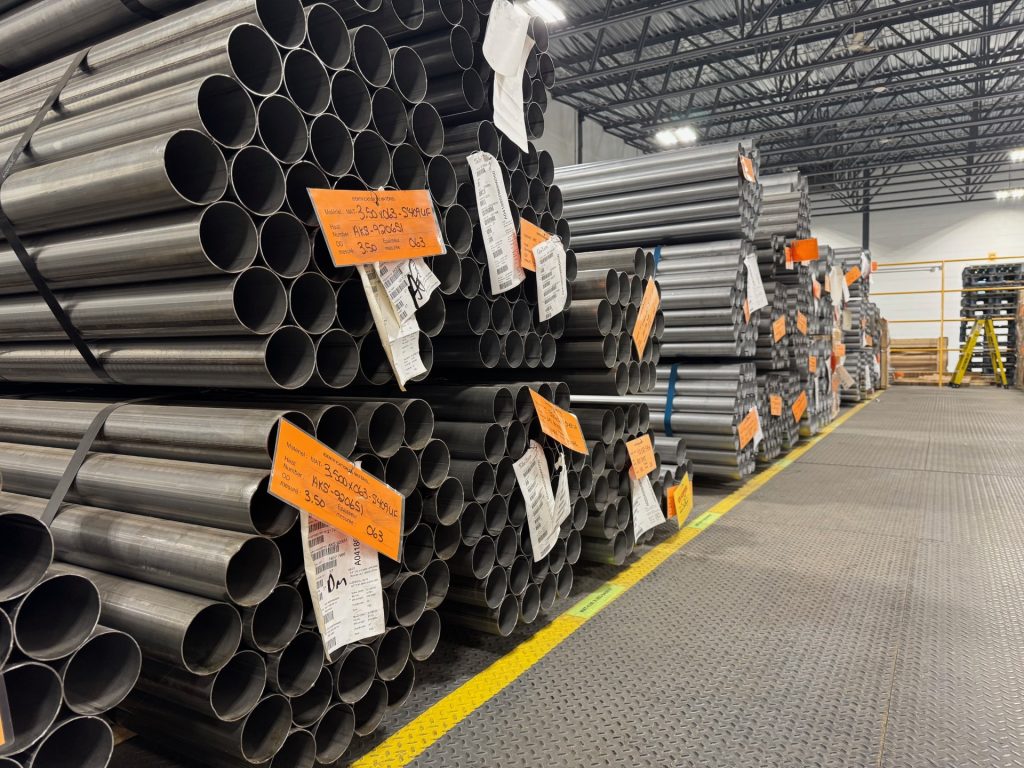
“The signal sent is important it recognizes the strategic role of our manufacturing sectors, including aluminum, and their need for support to invest, innovate, and diversify,” White wrote in a press release on Monday.
But she added that time is of the essence, saying that the federal government should waste no time implementing these measures. Simple and accessible programs, especially for businesses in the aluminum sector, are key to their survival amid the trade war, she said.
“For our businesses, what will count is the speed of access to programs and the simplicity of administrative procedures,” White said.
Aluminum sector to diversify: industry leaders
While Canada does have aluminum markets in Europe and Asia, the vast majority of the metal produced here is exported to the U.S., Simard said.
“We produced 3.3 million tonnes of metal in 2024, which is our biggest year ever. We exported 90 per cent of that, and 90 per cent of that 90 per cent was going to the U.S.,” he said.
Despite this milestone, he emphasized that they lost a significant value of up to 75$ million USD weekly. Additionally, Simard detailed that aluminum producers shipped more product to Europe over the summer because they were losing money on exports to the U.S.
“We’re capturing back the impact, but we’ve been…we went through weeks without this occurring, so we lost tremendous amounts of money,”
Simard added that while the Canadian aluminum sector is eyeing future growth in European and Asian markets, it can’t fully cut ties with the U.S. market.
— with files from the Canadian Press