Hydro-Québec monitors the election campaign in Newfoundland
Posted September 16, 2025 9:50 pm.
Despite the escalation of criticism that is likely to occur during the election campaign in Newfoundland and Labrador, Hydro-Québec doubts it will be able to significantly improve the agreement signed with this province for revenue sharing and the development of the Churchill Falls complex.
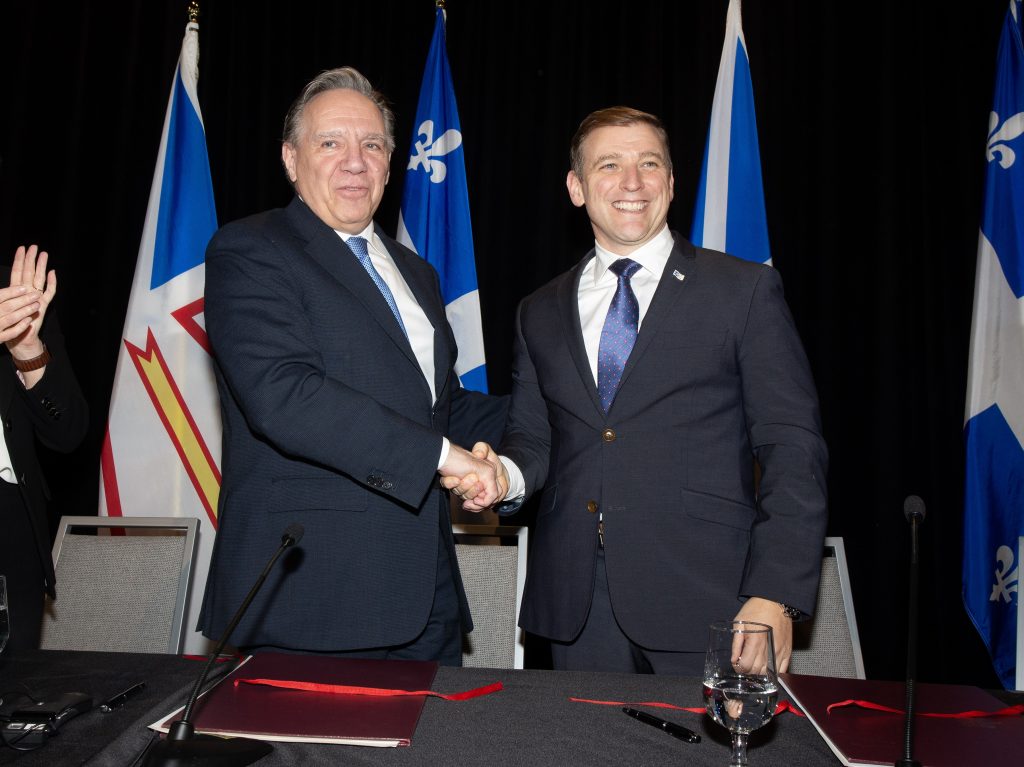
The election called Monday, and its outcome could jeopardize the memorandum of understanding signed last December between Premier of Quebec François Legault and his then-Liberal counterpart, Andrew Furey.
It’s the agreement that Legault said he was most proud of, but it has fueled constant controversy among Newfoundlanders ever since.
The text provides for Hydro-Québec to pay a total of $33.8 billion to the Churchill Falls consortium until the end of 2075, to increase energy production with new dams and increase royalties in Newfoundland. It would replace before its expiration in 2041 the current contract signed in 1969, deemed unfair by Newfoundlanders.
But the Newfoundland Conservative Party has suggested that if it takes power, it will demand “better conditions” in the new agreement, something that observers and citizen groups are also demanding.
However, at Hydro-Québec, it is difficult to see how the draft of this contract could be significantly revised and improved. Will the state-owned company have to outbid and put more money on the table to save the agreement?
“I don’t have the answer to that question,” said an official Hydro-Québec source in a telephone interview with The Canadian Press.
However, the current text is already advantageous for both parties and the final version should not deviate much from it, said this source close to the case, whose identity cannot be revealed.
“I don’t know what kind of changes there could be between the agreement in principle and the final agreement,” said our source, who requested anonymity.
“But what I understand is that the agreement in principle is still quite detailed. (…) We are starting with a very elaborate work that has been done beforehand.”
Hydro-Québec has assured that it does not want to interfere in the internal affairs of the neighboring province.
His representative indicated that preparatory work and negotiations to reach a final agreement by April 2026 are continuing, despite the election campaign.
“Discussions are ongoing, there is no break or pause in the discussions,” it was reported.
Are there any concerns among Hydro-Québec’s senior management regarding the outcome of the elections and the future of the agreement?
“We certainly follow the news like you do,” replied the senior official of the state-owned company.
“When there’s an election campaign, there’s political ‘noise’, there are different opinions, and I’m not saying that to be reductive. So we understand that it’s part of the background. We know a little bit about how these things unfold. (…) We follow it, but we remain convinced of the beneficial aspects for both provinces.”
The representative recalled that the president of Hydro-Québec at the time, Michael Sabia, one of the architects of the agreement, spoke of a “momentum” for “energy projects that have a structuring effect on the economy.”
However, Michael Sabia has since left Hydro to become Clerk of the Privy Council, while Legault’s partner, whom he considered his “friend,” Andrew Furey, has also resigned.
However, Hydro-Québec assures that the relationship with the neighboring province has survived and is doing well, the communication channel remains open.
“There is a certain connection, a good understanding has been created between the two, at least from what we can see,” commented our source.
“There is still good collaboration between the Hydro-Québec teams and the (Newfoundland and Labrador) Hydro teams.”
It should be recalled that the memorandum of understanding announced last December with great fanfare in Saint John by the two premiers aims to put an end to nearly 60 years of dispute over the operation of the current Churchill Falls hydroelectric power station, located in Labrador.
Newfoundland and Labrador felt cheated by the contract signed in 1969, under which Hydro-Québec bought electricity at 0.2 cents per kWh, but then resold it at a high price. The price would gradually rise to 6 cents per kWh, a 30-fold increase.
For example, in 2019, the agreement generated nearly $28 billion in profits for Quebec and approximately $2 billion for Newfoundland and Labrador.
But François Legault has been arguing for several years that the partnership needed to be renegotiated sooner rather than later, to avoid signing under pressure from the 2041 deadline, but also to be able to meet Quebec’s future energy needs.
Thus, in exchange for higher royalties for Newfoundland, Hydro-Québec will be the prime contractor for increasing the power of the current Churchill Falls power station, but also for a second power station nearby, as well as a power station downstream of the Churchill River at Gull Island, projects valued at a total of $25 billion.
Quebec would have access to an additional 7,200 MW to meet its needs.
A transmission line will have to connect Gull Island to La Romaine, conditional on the consent of the indigenous communities.
The production cost will be 11 cents per kilowatt hour (kWh), which remains very competitive, Sabia was keen to point out at the time.
“It’s truly an extraordinary agreement,” Legault said at a press conference in December. “I’ve been Premier of Quebec for six years, and this is by far the agreement I’m most proud of.”
Currently, Churchill Falls has a capacity of 5,400 MW and provides 15 per cent of Hydro-Québec’s electricity.
–This report by La Presse Canadienne was translated by CityNews