Day 5 of STM strike: Montreal transit users face ongoing disruptions
Posted October 1, 2025 6:54 am.
Last Updated October 1, 2025 5:54 pm.
Montreal’s public transit system remains disrupted for a fifth day as a rotating strike by nearly 2,400 STM maintenance workers continues, with no resolution in sight.
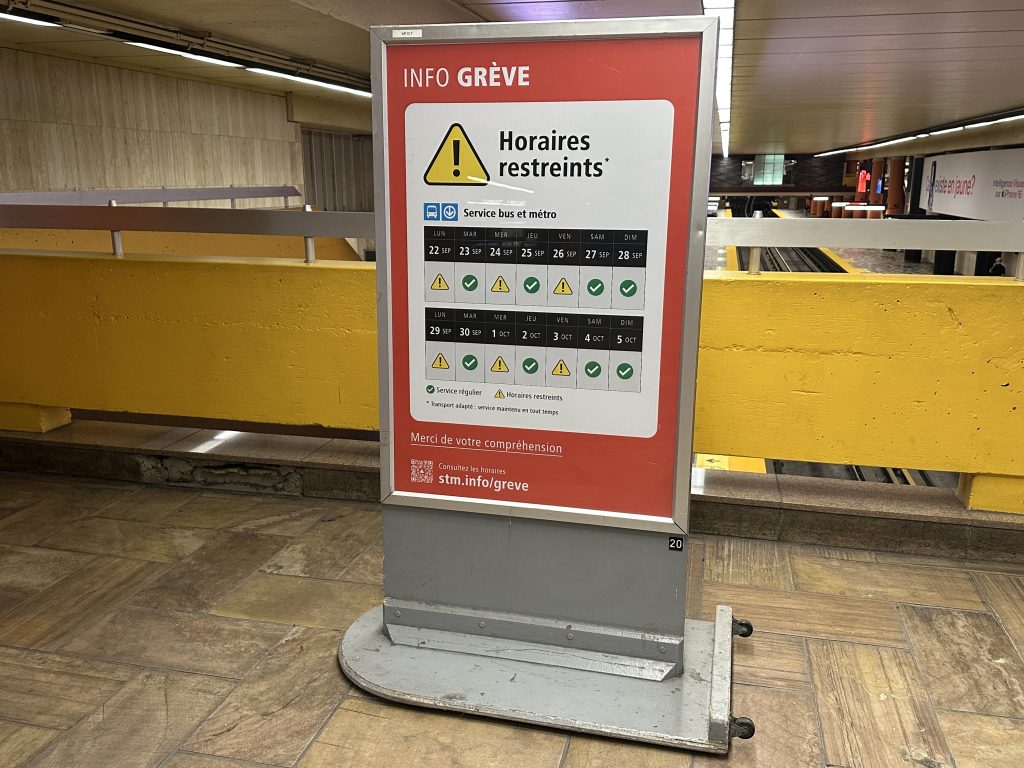
Metro service is currently limited to three short windows on strike days—mornings from 6:30 to 9:30 a.m., afternoons from 2:45 to 5:45 p.m., and late nights from 11 p.m. until closing.
The union plans to continue this schedule three days a week—on Mondays, Wednesdays, and Fridays—until at least Oct. 5, unless an agreement is reached.
“The goal is to reach an agreement and make it last as little time as possible,” said Quebec Minister of Municipal Affairs Geneviève Guilbault. “That’s what bothers me right now because there are users, as we speak, who are unable to take public transportation, once again because of a strike and a union dispute.
“If it ever comes to the means at my disposal, I will take appropriate action very quickly because, once again, the important thing is the citizen user who pays taxes and is entitled to these services.”
The strike, which began Sept. 22, comes after more than a year of stalled negotiations over wages, subcontracting, and workplace conditions. This is the second strike by the maintenance workers this year.
Mediation ends with no agreement
This is the second strike action this year by the unionized maintenance workers. The current strike began Sept. 22 and follows more than a year of stalled negotiations over wages, subcontracting, and working conditions.
Over the weekend, the union presented a new counter-offer addressing several non-monetary demands, but the STM rejected it, citing major operational and financial concerns, and made its own counter-proposal. That too was turned down by the union.
The provincial mediator’s 60-day mandate expired Tuesday at 11:59 p.m. Without a deal in place, the transit agency said it has reached an impasse.
In a press release Wednesday, the STM announced it will submit a formal request to appoint a special mandatary—the next step under provincial labour law.
The Ministry of Municipal Affairs confirmed Wednesday that it has not yet received a formal request.
“We have not received any official request from the STM for the appointment of a substitute decision-maker. The labour dispute is very worrying and it unfairly takes citizens hostage. Minister Guilbault is following the file closely and is in discussion with the Minister of Labour for the next steps,” said Jonathan Guay, deputy chief of staff and director of communications for the Minister of Municipal Affairs.
“After two comprehensive offers and setbacks, we must face the facts: we are at an impasse,” said STM CEO Marie-Claude Léonard in the statement. “We believe that moving to the next step provided by law, to continue negotiations with another third party, is the best option to move toward a resolution and avoid another strike.”

She said recent exchanges “offered no progress,” demanded major concessions, and even included rollbacks on items already agreed upon.
If approved by the Ministry of Municipal Affairs, the special mandatary would act as a neutral third party, making non-binding recommendations aimed at resolving the dispute.
STM: Service cuts may be on the table if no deal reached
In a press conference Wednesday morning, STM Director of Public Affairs Katherine Roux Groleau said the union’s latest offer failed to move talks forward and came with significant financial implications.
“We’re facing financial reductions, we’re facing increased pressure to have increased cost savings,” she said. “We need to modernize our working conditions, we need to work with the unions to bring those working conditions up to this 2025 reality. So they make sense in 20, even 30 years from now.”
Roux Groleau said the STM’s counter-offer was designed to build momentum and encourage agreement on 17 key union demands. However, with no progress and the mediation period expired, the STM is now ready to continue talks with a new third party.

She emphasized that 70% of the STM’s operating budget is payroll, and 89% of that is tied to collective agreements. She said changes are necessary to keep the system financially sustainable.
“If the union wants more money at the table, then we’ll need to find new ways, modernize the working conditions, find cost savings, use those savings to fund the desired financial framework,” she said. “If it is not the case, then we’ll have to cut back on the level of service.”
She added that the agency is not stalling while waiting for provincial Bill 89 to pass—a law that could limit the duration of strikes. Instead, she said, the STM is committed to resolving the dispute quickly, but within its financial limits.

Union says STM has ‘walked away’ from talks
Union president Bruno Jannotte said the STM’s decision to end mediation and request a special mandatary amounts to walking away from the table.
“We were ready to maintain it, to renew ourselves. Of course, mediation involves two parties. It’s not complicated—the STM decided not to continue with mediation, so that was their choice,” he said Wednesday. “For us, it’s kind of a disguised way of saying we may have broken off negotiations.”
He said both sides made proposals that involved some setbacks, which is a normal part of bargaining. But he accused STM of sidelining key decision-makers and sending only external spokespersons to the table—slowing progress.
“We reiterate that if the STM brings competent negotiators to the table, as we did over the weekend, and if we have the right people in front of us, that may change things at the negotiating table,” Jannotte said.
He also said the union has full mandates to escalate pressure tactics, including the possibility of an unlimited general strike, though that is not the union’s preferred outcome.
“We tried to organize a strike that took users into consideration, that took into account the fact that it would have an impact on the STM. Do we understand that we need to be more forceful in our pressure tactics? If that’s the solution, then that’s the solution, but that’s not what we’re experiencing right now. We hope that we will be able to move forward with negotiations.”
Commuters caught in the middle
Frustration is growing among public transit users amid stalled negotiations.
“It’s horribly inconvenient,” said one commuter. “I have to leave earlier and I have to leave work earlier as well, otherwise it has to have to take a new Uber or go get my car, which is a whole other situation.”
“I did take an Uber last week, but I tried to avoid it. It does add to my budget. I’m pretty lucky that I have flexible schedules. That helps a lot. That’s not the case for everyone,” said another.

The STM confirmed two cases of damage to metro doors during recent strike days and reminded the public that vandalism could result in fines of up to $500.
Roux Groleau urged the public to check STM’s website for service updates and reiterated the agency’s commitment to reaching a resolution.
“We understand the impact the strike has on commuters and the frustration it could create.”
“We’re fully committed to reaching an agreement and working together with the union to find a resolution. But the resolution needs to take into account our need for flexibility and the financial context in which we are currently operating.”
The rotating strike is set to end Friday unless extended. If the STM’s request for a special mandatary is approved by the Ministry, both sides would be legally required to cooperate during the next stage of negotiations. In the meantime, further disruption remains a possibility.