Quebec zoning rules exclude less fortunate in search of better life: MEI
Posted October 2, 2025 7:36 am.
Last Updated October 2, 2025 1:43 pm.
Overly restrictive zoning regulations in Quebec municipalities indirectly prevent the less fortunate from improving their lives by moving to a more prosperous area, according to the Montreal Economic Institute (MEI).
This is one of the conclusions of a new social mobility ranking published Thursday by the think tank associated with the economic right.
Social mobility is the ability to improve one’s relative position on the income scale compared to one’s parents. It’s not just about having a better standard of living, explained MEI senior economist Vincent Geloso in an interview.
“If everyone gets 50 per cent richer and I get 50 per cent richer, I’m still at the same point as my parents were relative to everyone else in their time,” he explained.
However, many obstacles stand in the way of Quebecers who aspire to a better socio-economic environment, according to the MEI.
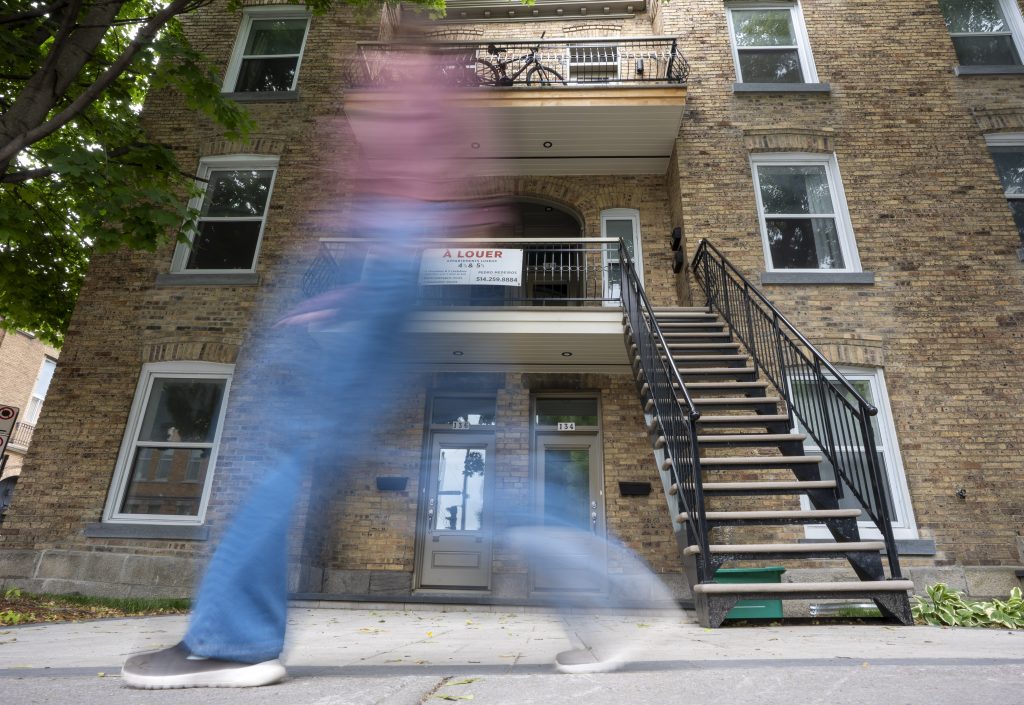
Zoning rules that limit the construction of new housing are one of the main obstacles to social mobility, according to Geloso. Regulations reduce supply, making housing more expensive. “Therefore, less accessible.”
Housing prices thus become higher in areas where the economy is more prosperous, which limits the ability of the less well-off to move there and benefit from this dynamism, the economist explained.
He cites the example of the metropolis. “Montreal is a high-productivity place,” he emphasized. “There’s a lot of innovation happening in Montreal, and wages are higher than elsewhere.”
However, it can be difficult for a resident of the regions to move there to earn more income, because housing is inaccessible there, he added. “When you look at the literature on social mobility, one of the most important correlations is people’s geographic mobility.”
The MEI also identifies the criteria for obtaining professional certification as a barrier to social mobility. They “restrict access to certain professions by imposing costly training, lengthy apprenticeship programs, a minimum number of hours before practicing, and registration fees,” the document states.
A higher marginal tax rate would also hinder social mobility, again according to the MEI, notably by discouraging work, “but in the overall scheme of things, that’s not the most important factor,” the economist explained.
Government revenues can fund social programs that promote social mobility, such as education. “The two can cancel each other out and have almost no effect,” he summarized.
Is Quebec a mobility dud?
Quebec ranks last in the MEI ranking among Canadian provinces, based on the conditions the MEI considers favourable to long-term social mobility.
For the mobility of the millennial generation, Quebec ranked relatively close to the Canadian average in terms of social mobility.
In Quebec, an adult born between 1982 and 1985 to parents in the poorest 20 per cent had a 33 per cent chance of finding themselves in the same group as an adult, according to a study published in the Canadian Journal of Economics in 2023.
This is slightly less mobile than in Ontario (31.7 per cent), but better than in Manitoba (42.2 per cent) and Saskatchewan (41.5 per cent).
As everywhere in Canada, however, mobility is lower for children of the 1980s than it was for children born in the 1960s.
According to the MEI, Quebec ranks last in almost all indicators that promote social mobility, except for education and corporate taxes.
“Quebec is average, maybe even a little better than average, for corporate taxes,” replied Geloso. “Many people are surprised when I mention it.”
Young Quebecers also regularly rank among the best in the world in mathematics rankings. This success is attributable to the education system, according to the economist.
Certain characteristics of the social fabric, such as the level of trust among citizens, also hinder social mobility, according to the MEI. “Quebec doesn’t perform as well in this area as one might think,” lamented the economist.
“When we look at indicators of the social fabric, particularly philanthropy and volunteerism, Quebec is clearly at the bottom of the scale in Canada,” he added. “It’s a bit depressing, frankly.”
–This report by La Presse Canadienne was translated by CityNews