Forced labour: Bloc Québécois urges Liberals to turn words into action
Posted October 22, 2025 9:53 pm.
Last Updated October 22, 2025 9:57 pm.
The Bloc Québécois is challenging Mark Carney’s government to follow through on a Liberal commitment to do more to ensure that Canadian supply chains are free of any goods produced using forced or child labor.
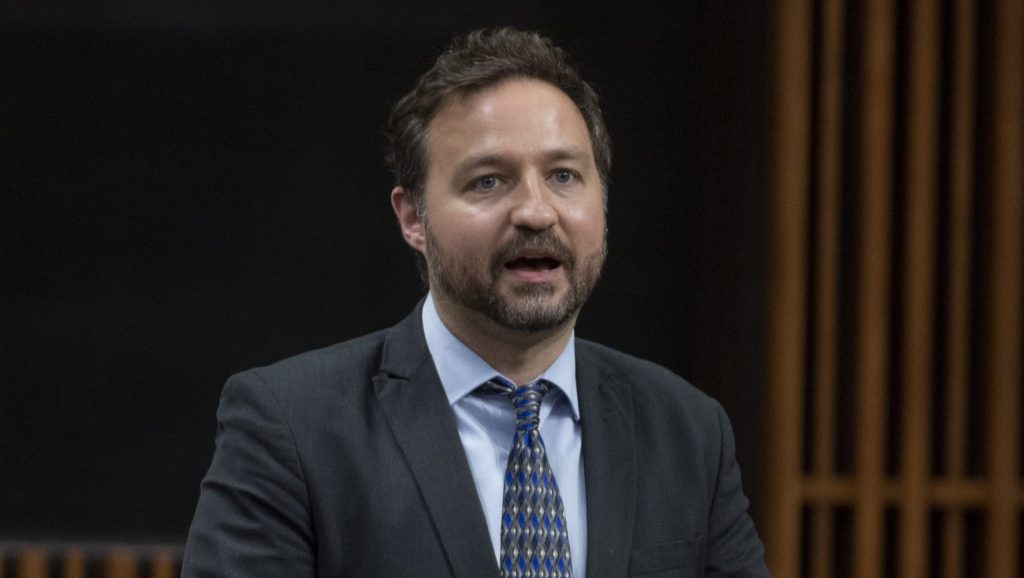
To this end, Bloc Québécois MP Simon-Pierre Savard-Tremblay tabled a bill on Tuesday which, if adopted, will allow the Council of Ministers to designate a list of regions of the world that raise concerns in this regard.
If a good comes from a place appearing on the list, its entry into Canada would be systematically rejected by customs agents, a refusal that could be reversed only if the exporter can demonstrate that follow-ups have been made to ensure that no forced or child labor has taken place.
Savard-Tremblay, accompanied by his party leader, Yves-François Blanchet, explained that his political party was inspired by American regulations because it believes that this approach allows “reversing the burden of proof.”
“Because the Canadian model, at present, relies on the customs officer (whose responsibility it is) to decide whether or not forced labour has been used, as if it were something that could be observed with a flashlight,” illustrated the Bloc’s international trade critic in the foyer of the House of Commons.
Blanchet said he was “quite confident” that the proposed legislation could move forward in a spirit of collaboration between the different parties represented in the Commons, including the Liberals who form the government.
“I am extremely confident that MPs, from all parties, will say to themselves, ‘Well, it’s obvious.’ Okay, we’ll overlook the fact that it hasn’t been done so far; perhaps agendas have been disrupted,” he said.
The Bloc, as well as the executive director of the Uyghur Rights Project, Mehmet Tohti, who traveled for the occasion, emphasized that the Liberals have promised to take additional measures to clean up Canadian supply chains of any results of forced labor.
“Canada is going backwards, not putting words into action, only pretending to do something without actually doing anything,” he said.
The Liberal commitment is reflected in the 2023 and 2024 economic statements, as well as the most recent federal budget. These budget documents were all tabled under former Prime Minister Justin Trudeau.
In the Dec. 2024 economic update, the Liberals promised to introduce legislation and make other legislative changes, in addition to creating a new oversight body.
Mehmet Tohti is now asking the government, this time led by Mark Carney, to take possession of the Bloc Québécois bill to speed up its study and allow its adoption “as soon as possible.”
Asked how hopeful he was that Carney’s troops would comply with this request, Blanchet said he was “reasonably optimistic.”
“If Carney’s entourage says to me, ‘Yes, but we could do it the same way rather than like that so it goes faster,’ we are completely open-minded,” he concluded.
Government bills are more likely to be prioritized on the legislative agenda than those introduced by opposition parties or by Liberal MPs who move forward on an individual basis.
A government bill had been considered as early as 2022 by the then Minister of Labour, Seamus O’Regan, to tackle the use of forced labour.
The initiative ultimately did not see the light of day in this form, but the minister had endorsed a bill from Quebec Senator Julie Miville-Dechêne. Bill S-211 was passed in the House with Conservative support. The Bloc and New Democrats had initially supported the bill earlier in the legislative process, but later preferred another piece of legislation they co-sponsored, the Bloc reported.
Bill S-211’s approach differs from that of the Bloc, which believes the legislation does not go far enough. This bill requires federal institutions and other entities to report on the measures they take against the use of forced labour. It does not provide for a list of regions of concern where customs officers would prohibit the entry of goods.
It was after S-211 became law in May 2023 that the former Trudeau government declared in 2024 that it intended to “strengthen Canada’s ban on the import of goods produced using forced labor.”
It is not yet clear what the intentions of Carney’s troops are on this front.
The office of current Labour Minister Patty Hajdu indicated that the file is now being handled by the Global Affairs Canada team and forwarded a request for comment from The Canadian Press to the office of Foreign Affairs Minister Anita Anand. However, her team then indicated late in the afternoon that it would instead be the office of International Trade Minister Maninder Sidhu that would respond to these questions. By late evening, no response had been provided.
–This report by La Presse Canadienne was translated by CityNews