STM strike Day 10: Labour tribunal hears from STM, union, Montreal food bank

Posted November 10, 2025 7:21 am.
Last Updated November 10, 2025 6:40 pm.
As talks continue about the possibility of introducing back-to-work legislation for striking STM workers, a labour tribunal met with the STM and union Monday to evaluate whether essential public services are being maintained.
The outcome of the Quebec Administrative Labour Tribunal could influence how the CAQ government proceeds with potential legislation that would force striking public transit employees back to work by Saturday.
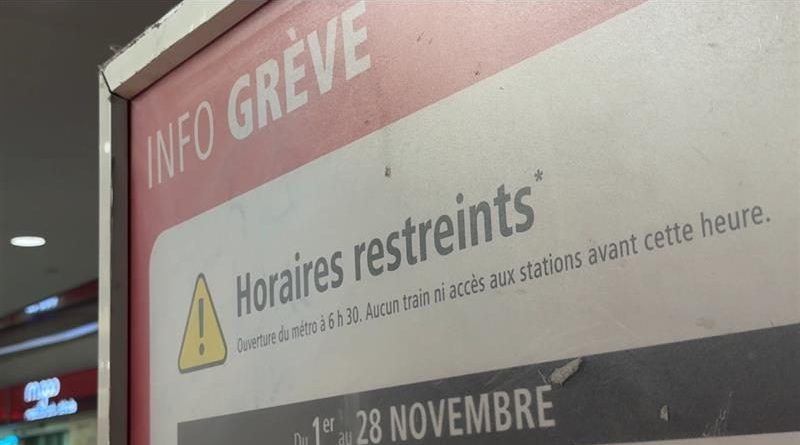
Maintenance workers at the Société de transport de Montréal have been on strike for a week, limiting service to rush hours only. Their mandate lasts until Nov. 28. Bus drivers and metro operators are planning additional strike days on Nov. 15 and 16.
The unions remained at the bargaining table on Sunday but an agreement could not be reached. The union representing the maintenance workers said “things are progressing at the bargaining table, and we must continue to work towards a settlement.”
“The best way to end the conflict is to reach a negotiated agreement,” said Bruno Jeannotte, president of the Syndicat du transport de Montréal-CSN. “To achieve this, we need to put pressure on the STM to get them to enter into settlement mode quickly. Our struggles over the past few years have allowed us to win good working conditions. What is certain is that we must maintain good conditions for maintenance employees to take care of the STM’s aging infrastructure.”
Long lines at food bank
Monday’s labour tribunal — which is trying to determine if the strike is preventing essential services and posing a danger to health — heard from Jean-Sébastien Patrice, the director general of the MultiCaf, a non-profit dedicated to fighting food insecurity in Côte-des-Neiges.
He told the tribunal his organization saw wait lines of up to an hour-and-a-half — levels not seen since the COVID-19 pandemic — because of transit limited to rush hours only. As a result, some people left without being served because they had to catch the bus or metro before the end of essential services, Patrice testified.
Patrice also said during the full shutdown of Nov. 1 — when maintenance workers, bus drivers and metro operators were all on strike at the same time — the MultiCaf saw only one-tenth of its usual clientele, who he described as people in “survival mode.” There were 50 people instead of the usual 500, he explained.
“We are able to remove some financial strain on these people,” Patrice said of the MultiCaf’s services, but added that becomes problematic when buses and metros close down.
There was a “very big impact that Saturday,” Patrice said, with some people having to pick up meals for others who could not make it to the centre. “Our population often doesn’t talk either French or English, and some are not connected (to the news).”
He says the combination of both strikes led to a temporary suspension of services by the end of that week in order to redistribute staff to working during rush hours. The MultiCaf was closed on Nov. 8 and it’s expected to be closed again Nov. 15.
After the hearing, the administrative judge, Karine Blouin, will make a decision that will be submitted by Thursday at the latest.
Two days without transit ‘unacceptable for seniors’
Several organizations have expressed their concerns to the labour tribunal: the Fédération de l’âge d’or de Montréal (FADOQ), Aéroports de Montréal, the Société du parc Jean-Drapeau, Trajectoire Québec, the Autorité régionale de transport métropolitain, and the Autorité régionale de la santé publique.
These organizations submitted their views in writing to the tribunal; they did not testify in person.
FADOQ’s general director for the Montreal region, Rosée Tremblay, nevertheless told reporters that many seniors were very worried with the two full upcoming strike days — Nov. 15-16 — since the union is not planning to provide essential services.
“We consider the right to transportation to be an essential need,” Tremblay said. “And we want to emphasize that people feel insecure. They need to have access to services such as groceries, pharmacies, medical appointments, and other activities as well. And two days without any means of transportation is unacceptable for seniors.
“Regarding caregivers who visit someone who is in a vulnerable health situation and cannot get around, if the caregiver’s only means of transportation is the bus or the metro, they cannot get there to provide help, or they cannot receive the help they need.”
She reported that “we receive calls almost every day. These aren’t scientifically compiled figures, but we, with our team, discuss it: practically one out of every two calls mentions the negative effects of the strike.”
“Many people rely on public transit to go to work, to go to medical appointments that they will miss, to go to food banks as we heard as well,” added Philippe Jacques, the co-manager of Trajectoire Québec.
Montreal Mayor Soraya Martinez Ferrada has urged both sides to reach an agreement by Nov. 15, while Labour Minister Jean Boulet is considering moving up the implementation of his controversial law allowing him to impose a settlement by decree.
The measure is currently scheduled to take effect on Nov. 30.
The leader of the PQ, Paul St-Pierre Plamondon, has already said his party is prepared to work with the Coalition Avenir Québec (CAQ) on a temporary back-to-work order. St-Pierre Plamondon previously criticized the CAQ’s anti-strike legislation for escalating the conflict and stalling negotiations.
What are Montrealers saying?
CityNews spoke to Montrealers Monday who said they’re willing to sit through the inconvenience if it means the union’s rights are respected.
“They deserve (it) also because they work so hard,” one person said.
“In order for you to negotiate you need to make other people uncomfortable,” another one said. “If that bill is approved, it would be against labour rights, and that would be so anti-democratic.”
“It makes sure that people respect unions more and it gives all unions more negotiating power because they know we’re serious,” added a third.
Strike Schedule
Metro
Metro will operate on a restricted schedule throughout the strike period:
- 6:30 a.m. to 9:30 a.m.
- 2:45 p.m. to 5:45 p.m.
- 11 p.m. until the usual closing time
Buses
Buses will operate regular services from:
- 6:15 a.m. to 9:15 a.m.
- 3 p.m. to 6 p.m.
- 11:15 p.m. to 1:15 a.m.
Bus service to schools are also subject to restricted times. STM says trips to some schools will be canceled. Consult the STM’s school service page to see which schools are affected.
Paratransit Service
Paratransit service is not affected by the strike and will operate at all times.
Transit riders are advised to check the real-time schedule of services available on the STM website for the most up-to-date information.
–With files from La Presse Canadienne