Inhalers emit huge amounts of GHGs, hospitals are trying to reduce them
Posted November 30, 2025 12:44 pm.
Hundreds of thousands of metered-dose inhalers are used every year in Quebec. A little-known fact is that these devices, which deliver aerosol medication to the respiratory tract, are extremely polluting. The carbon footprint associated with the use of a single device can be equivalent to a 290 km car trip. The good news is that dedicated staff are spearheading innovative projects to minimize their environmental impact.
This is the case at CHU Sainte-Justine and the Quebec Heart and Lung Institute (IUCPQ), where a metered-dose inhaler recycling program has been launched. In addition, less polluting alternative treatments are offered whenever possible.
In Canada, asthma affects about 10 per cent of the population. It is one of the main reasons for emergency room visits and hospitalizations. Two experts point to a vicious cycle for this disease, because on the one hand, asthma is aggravated by the effects of climate change, and at the same time, the management of asthma contributes to greenhouse gas emissions.
“We are very aware of this because we treat children with respiratory problems. We know that they will be exposed to pollution, climate change, and everything that comes with it, which is harmful to the lungs,” says Dr. Sze Man Tse, a pulmonologist at Sainte-Justine University Hospital Center. “That’s why, even in our care, we try to reduce the impact of our carbon footprint. Ultimately, it’s the children who will benefit in the future.”
Returning your pump to the pharmacy
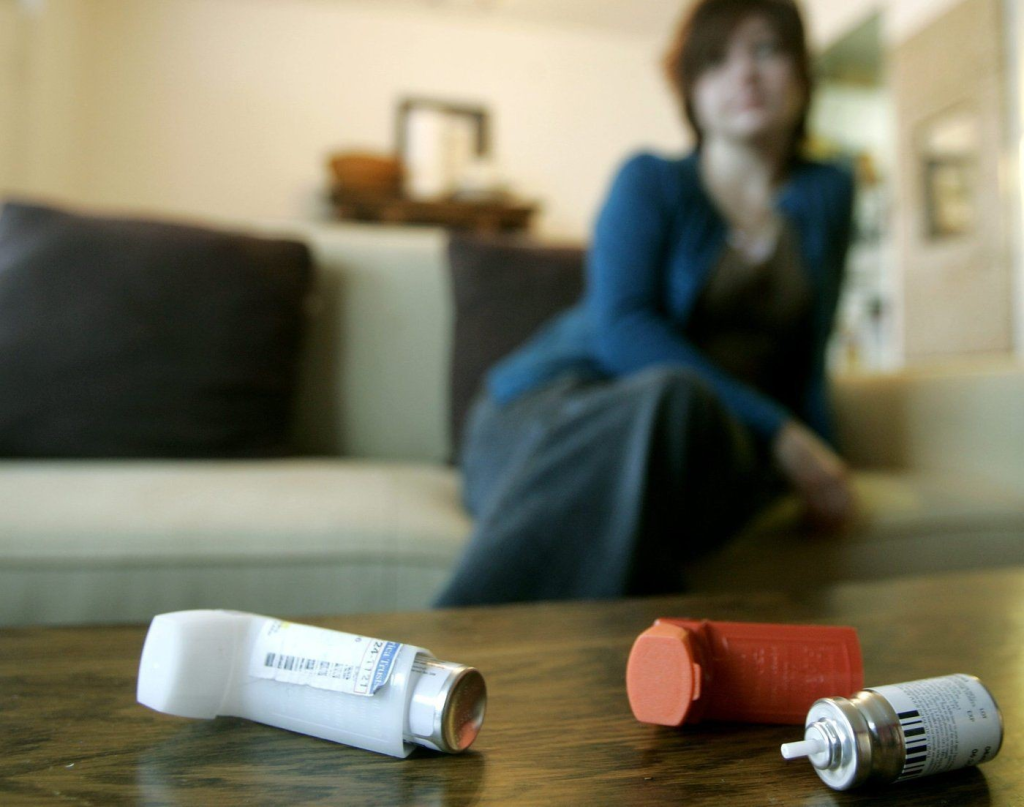
Isabelle Giroux, a pharmacist at IUCPQ, points out that there are different types of inhaler devices. The L-shaped ones have a plastic component and a small canister that pressurizes the medication. “This causes it to disperse. The gas contained in the canister is an HFA (hydrofluoroalkane) propellant. These gases are up to 1,300 times more polluting and powerful than CO2,” explains Giroux.
The gas contained in the pumps is therefore a high emitter of GHGs. “On a global scale, it is estimated that approximately 18 million metered-dose inhalers are prescribed each year. This will release up to 13 billion tons of CO2 equivalent into the environment,” says Giroux.
She urges the public not to throw their metered-dose inhalers in the trash, as gas will continue to escape into the environment. People can return them to their pharmacy. And the impact is significant when they are recycled properly. According to the Cascades network, which promotes the implementation of sustainable health practices and policies in Canada, when recycled properly, one pump saves eight liters of gasoline.
One aspect of the Inhaler Project set up at CHU Sainte-Justine is its metered-dose inhaler recycling program in the hospital. Since 2023, both professionals and patients have been able to deposit pumps in designated bins. The company Go Zero collects and recycles the various components of the device.
Changing prescribers’ habits
Dr. Sze Man Tse also points out that alternative treatments are less polluting and that the choice of inhaler should be a joint decision between the healthcare provider and the patient.
She refers in particular to dry powder devices that do not use propellant gas. “It’s a very fine powder, but not all children are able to take it. Generally, children aged 8 to 10 and older have the right technique to do so, but younger children are usually not able to use these dry powders,” says the pulmonologist.
Isabelle Giroux believes that doctors need to change their prescribing habits and opt for less polluting alternatives when there are no contraindications for the patient. According to the pharmacist, prescribers do not necessarily consider the fact that metered-dose inhalers are very harmful to the environment.
The IUCPQ has also developed a new approach to the selection and use of inhaled medications. In respiratory physiology, staff now install a spacer between the device and the patient (and clean the device safely). “We try as much as possible to maximize its use,” summarizes Giroux.
“This has led to some really interesting reductions. Over the course of a year, we’ve reduced the number of inhalers by 5,000. In terms of GHG reduction, that’s 14 times the circumference of the planet. And that’s just my hospital, in just one year,” explains the pharmacist.
At CHU Sainte-Justine, following a survey of professionals, it was realized that people were very concerned about climate change, but lacked the knowledge to implement concrete actions that could reduce their carbon footprint.
The hospital is currently developing training and tools to facilitate prescriptions.
Dr. Sze Man Tse and pharmacist Isabelle Giroux both pointed out that environmental initiatives of this kind are currently local projects. They would like to see a national directive to give them the freedom to truly reduce the carbon footprint in the healthcare system.
—
The Canadian Press’s health coverage is supported by a partnership with the Canadian Medical Association. The Canadian Press is solely responsible for this journalistic content.
–This report by La Presse Canadienne was translated by CityNews