Challenges to the Boulet law: unions demand compensation
Posted December 2, 2025 5:37 pm.
The CSQ and the Alliance du personnel professionnel et technique de la santé et des services sociaux (APTS) are demanding that the Quebec government be required to pay them damages, due to the law that allows it to end a labour dispute and impose arbitration.
In its challenge to the constitutionality of the law, the Centrale des syndicats du Québec (CSQ) is asking the Superior Court to force Quebec to pay exemplary and punitive damages “because of the unlawful and intentional infringement of the fundamental rights of the employees” it represents.
APTS is also asking the Superior Court for punitive damages, the amount of which has not yet been determined, “due to the intentional infringement of freedom of association.”
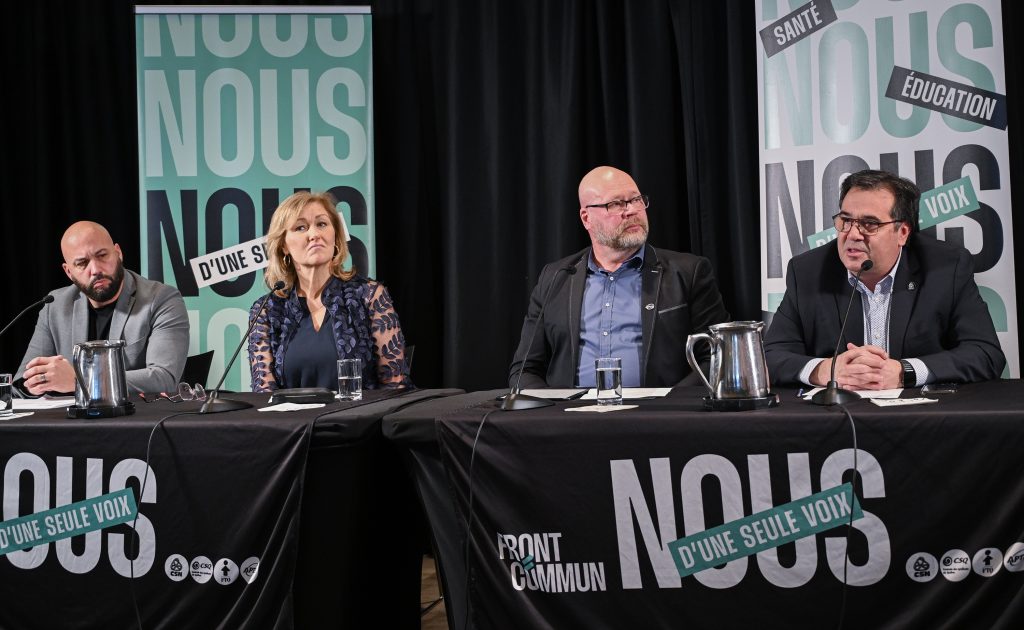
The CSQ and the APTS are among the five union organizations that are challenging the “Act to give greater consideration to the needs of the population in the event of a strike or lockout”.
The CSN, FTQ, and CSD are also filing their own petition. Generally, the unions are asking the Superior Court to declare the law, adopted last May but which only came into effect on Nov. 30, unconstitutional, invalid, and inoperative.
This law also establishes the principle of services “ensuring the well-being of the population” in addition to essential services. These are “the minimum services required to prevent the social, economic, or environmental security of the population from being disproportionately affected.”
The unions criticize this notion. “The legislator is opening the door here to an analysis based on the risks and disadvantages of a strike, rather than on the real danger to the life, health and safety of the population,” writes the FTQ in its request.
Minister’s discretionary power
The unions are also contesting the broad discretionary power that the law grants to the Minister of Labour. “It gives the Minister unchecked discretionary power, applicable almost at any time and indefinitely, to limit the scope or duration of strikes, and this for all workplaces in the province,” the CSQ wrote in its application.
“This discretionary power to suppress the right to strike destabilizes the balance of power in favour of employers, since this provision favours a wait-and-see position on the part of the latter, who may be reluctant to make concessions during negotiations, in the hope that the minister will intervene, end the strike and order arbitration of the dispute,” denounces the APTS in its request.
The CSQ concludes that “the power conferred by the Act is equivalent to the implementation of a system of automatic issuance of special laws ending labour disputes, but without the democratic safeguards accompanying the usual legislative process. The minister acts alone and according to his own perspective, without the need for public support or the benefit of parliamentary review and the amendments that may result.”
The unions base their challenge on the 2015 Saskatchewan decision, when the Supreme Court of Canada affirmed that the right to strike must enjoy constitutional protection.
“The mechanisms created in the Act contravene, on their face, the teachings of the Supreme Court and international law on freedom of association,” argues the CSN in its request.
The Minister of Labour, Jean Boulet, has always maintained that his law was only intended to take greater account of the needs of the population in the event of a labour dispute.
He also stated that any ministerial interventions in conflicts would not be frequent and would be motivated by the fact that a population would be disproportionately affected, particularly vulnerable people.
–This report by La Presse Canadienne was translated by CityNews