No regrets, says Amir Khadir after suspension for treating Lyme disease with antibiotics
Posted December 4, 2025 4:55 pm.
Former Québec solidaire MNA and physician Amir Khadir does not regret treating his patients with Lyme disease with antibiotics over an extended period of time. Khadir is considering taking steps with his lawyer to try to reduce the six-month suspension imposed on him Wednesday by the disciplinary council of the Collège des médecins du Québec (CMQ).
Khadir wants to appeal the council’s decision, seeking a one-month suspension rather than six. He did not provide further details, indicating that his lawyer is out of the country this week.
It should be noted that Khadir pleaded guilty to all 12 counts of the complaint filed on the first day of the hearing before the disciplinary board on Oct. 28. It should also be noted that no complaints were made by Khadir’s patients.
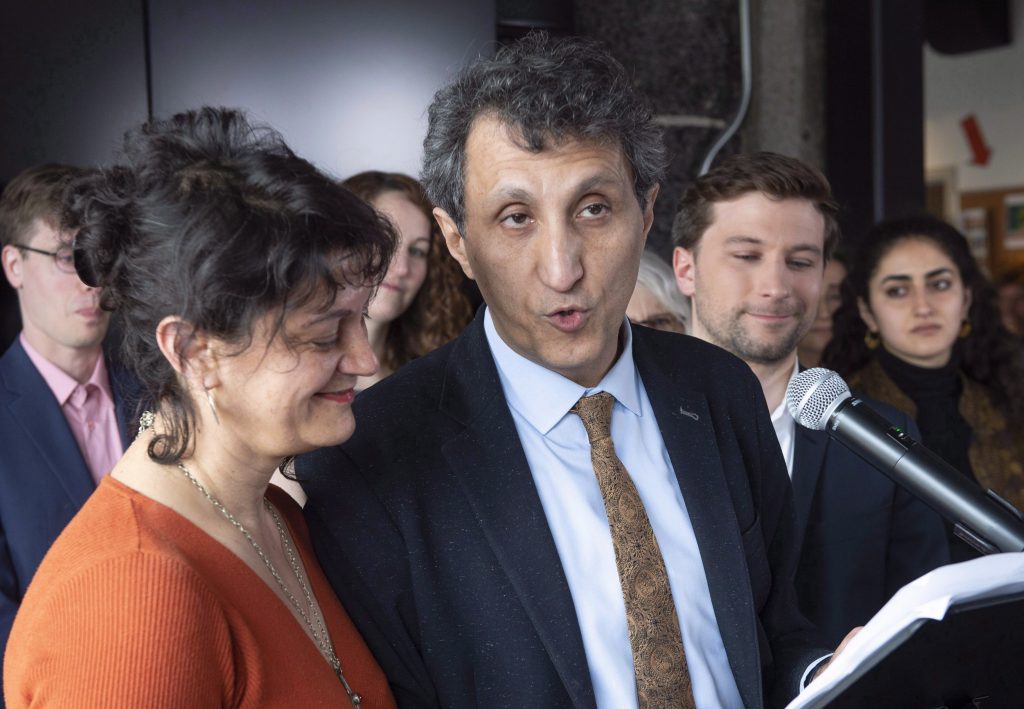
Khadir was surrounded by a group of people suffering from long COVID during a press conference on Thursday in Montreal. The patients are concerned about his disbarment because he is one of the few doctors in Quebec who treats people with long COVID. The waiting list for this type of care often exceeds two years.
Family doctor Caroline Grégoire knows this all too well. She has had long COVID since 2020 and also suffers from myalgic encephalomyelitis. “In Quebec, despite the scale of the phenomenon, access to specialized care remains extremely limited,” she laments. “There are only a handful of doctors with real clinical expertise in long COVID. Among them, Khadir plays an essential role.”
Grégoire says that a doctor with this expertise in the Sherbrooke area will be retiring very soon. In the Quebec City area, another doctor reportedly has a waiting list of more than two years. “This scarcity of expertise leaves thousands of people without a clear care pathway and without appropriate clinical support. And we feel this gap in the system, this lack of human resources and structure, very concretely on a daily basis,” says Grégoire.
At a press conference, the Quebec Lyme Disease Association (AQML) defended Khadir. It pointed out that many of the patients he has treated have been supported by the AQML and have reported real improvement, sometimes even a return to an almost normal life.
The AQML has made clear requests to the health minister. It wants him to ensure that patients with Lyme disease have real access to care; to encourage an approach based on informed medical decisions shared between the physician and the patient when solutions are limited and slow to emerge; to put in place the necessary frameworks to support research; and to allow patients access to clinical trials.
‘Of course I don’t regret it’
When asked if he regretted prescribing antibiotics for more than 28 days despite a commitment to the CMQ to stop this practice in 2020, Khadir replied, “Of course I don’t regret it.”
He emphasized that he did not give experimental treatments. “I can’t regret something that is based on science,” he commented.
Khadir asserts that his approach with his patients is an informed decision on their part, “taking into account the limits of what we know, the scientific gaps, and weighing the benefits and risks.”
According to his account, patients arrive at his office after having been thoroughly investigated for various diagnoses. They are often “at the end of their rope” and “their financial resources,” says Khadir.
Typically, when patients consult him, they are on “lifelong medication that leaves them completely frozen and unable to function” because there are no other treatments available to them, says the doctor.
“Under these conditions, imagine what the informed decision of patients is? Instead of living my life in misery and being numb to doing anything, and seeing myself sink, I’m going to take the risk of maybe having a little diarrhea, a little cramping,” says Khadir, referring to the symptoms of prolonged antibiotic use.
For him, it is a “misconception” to think that the impacts of long-term antibiotic use outweigh the benefits for the patient. “These are completely wrong assumptions,” he says.
The 2020 agreement to discontinue this treatment was to end when a formal research protocol on prolonged antibiotic treatment for chronic Lyme disease was put in place.
“What I regret is not having prioritized things, not having set up the research framework so that these problems wouldn’t arise. But fortunately for us, science now tells us that all options are open. I will repeat this a fifth time, including [prescribing] prolonged antibiotics for patients in whom there is a strong suspicion that the persistence of the bacteria is causing symptoms. Will all patients respond? No. But in any chronic disease, if you have a treatment that works, even if it’s only for a third of patients, it’s a great success,” argued the infectious disease microbiologist.
“That being said,” he continued, “antibiotics are certainly toxic if you give too much of them, especially if they are not useful. Anything that is not useful is poison. So, it’s always a question of weighing the risks and benefits,” explained the doctor.
He reiterated that he did not intend to repeat this treatment until he had all the necessary authorizations.
—
The Canadian Press’s health coverage is supported by a partnership with the Canadian Medical Association. The Canadian Press is solely responsible for this journalistic content.
–This report by La Presse Canadienne was translated by CityNews