Beams of light over Montreal as city marks Dec. 6 Polytechnique anniversary

Posted December 6, 2025 5:24 pm.
Last Updated December 6, 2025 10:40 pm.
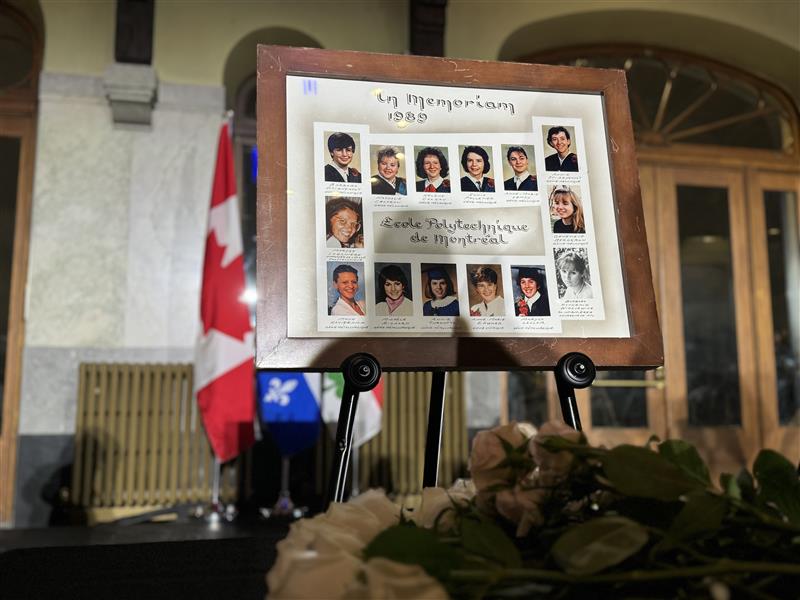
Beams of light pierced the sky above Mount Royal on Dec. 6, offering a solemn tribute to the 14 women killed in the 1989 École Polytechnique shooting — a tragedy that remains deeply rooted in Montreal’s collective memory more than three decades later.

Luminous tribute at Kondiaronk lookout
Montrealers gathered at the Kondiaronk lookout, in front of the Mount Royal Chalet, as the annual light installation illuminated the night.
The City of Montreal, in collaboration with the Comité Mémoire and Moment Factory, lit the beams for the 12th consecutive year to honour the victims of the anti-feminist attack.
At 5:10 p.m. — the moment the first shots were fired — the beams rose one by one, each appearing a few seconds apart as the victims’ names were read. A 15th beam shone in memory of all victims of femicides.
Family members, friends, survivors and dignitaries attended the ceremony, including Prime Minister Mark Carney and Montreal Mayor Soraya Martinez Ferrada.
The crowd stood in silence, observing a minute of reflection as the sky brightened above them.
The ceremony closed off with a deposit of 15 roses – where later a teary eyed Mark Carney acknowledged there needs to be progress in terms of laws.
“Yes we’ve made progress, we’ve made progress on gun control, we’ve made progress in other respects but we haven’t made enough — I recognize that, my government recognizes that,” he began to say.
“We have to make more progress and we are with legislation on bail, and intimate partner violence is something we intend to move on,” added the Prime Minister.
Remembering the violence of 1989
The events of Dec. 6, 1989, remain among the darkest in Canadian history.
Fourteen women were killed and 14 others injured in an act of targeted, gender-based violence that shook the country and continues to shape national conversations about misogyny and safety.
“There’s a lack of policies around weapons until now and there’s a lot of sexism that’s prevalent in engineering until today,” said Katherine Soad Bellini, a graduate in engineering from Concordia University, who attend the ceremony as a show of support for Serge St-Arneault, the brother of Annie St-Arneault who lost her life in the massacre.

Polytechnique remembers the 14 women whose lives were cut short on Dec. 6, 1989:
- Geneviève Bergeron, 21 — Mechanical engineering student
- Maryse Laganière, 25 — Finance Department employee
- Hélène Colgan, 23 — Mechanical engineering student
- Maryse Leclair, 23 — Metallurgical engineering student
- Nathalie Croteau, 23 — Mechanical engineering student
- Anne-Marie Lemay, 22 — Mechanical engineering student
- Barbara Daigneault, 22 — Mechanical engineering student
- Sonia Pelletier, 28 — Mechanical engineering student
- Anne-Marie Edward, 21 — Chemical engineering student
- Michèle Richard, 21 — Metallurgical engineering student
- Maud Haviernick, 29 — Metallurgical engineering student
- Annie St-Arneault, 23 — Mechanical engineering student
- Barbara Klucznik-Widajewicz, 31 — Nursing student, Université de Montréal
- Annie Turcotte, 20 — Metallurgical engineering student
Their names — spoken aloud and carried into the sky by narrow columns of light — anchored the ceremony in both memory and purpose.
A symbol of resilience
Reaching nearly two kilometres above the city, the installation has become a defining symbol of remembrance.
The beams were visible across Montreal, offering not only a tribute to the victims but also a quiet expression of resilience — a reminder that the city remembers, mourns and refuses to forget.