Quebec Bar Association: The CAQ “compromises the protection of fundamental rights”
Posted December 10, 2025 9:12 am.
The Quebec Bar Association argues in its brief submitted Tuesday evening to a parliamentary committee that the CAQ government’s proposed constitution compromises “the protection of fundamental rights.”
The professional order representing lawyers thus criticizes Bill 1 for undermining the independence of the courts, muzzling civil society organizations, compromising the right to abortion and “weakening the very architecture of fundamental rights”, as can be read in the nearly 40-page document.
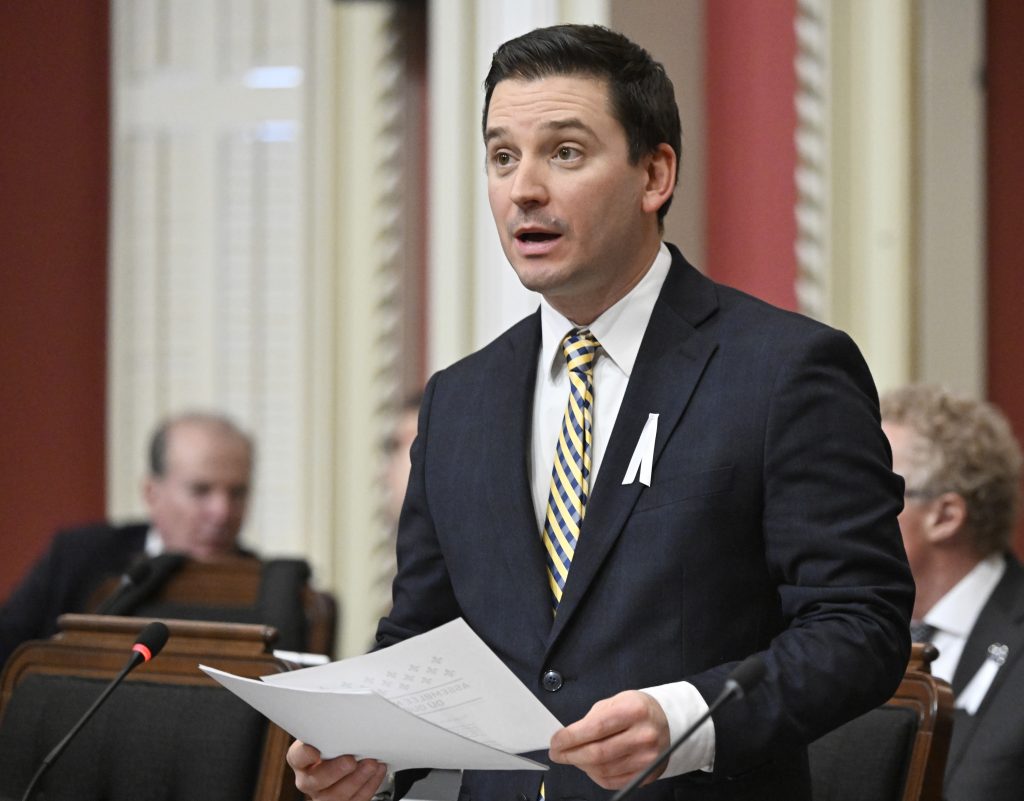
Tabled in early October by Justice Minister Simon Jolin-Barrette, the controversial draft Quebec constitution aims to prohibit organizations from using public funds to challenge laws considered fundamental to Quebec, such as the law on French as the official language of Quebec, and the law on state secularism.
“Hundreds of organizations serving civil society would be silenced,” the Bar Association fears regarding the ban that would be imposed on organizations.
The legislative proposal also enshrines women’s right to abortion, which has sparked a wave of opposition to which the professional order is also adding its voice.
“The current state of the law adequately protects women’s rights and there is no legal vacuum,” the memorandum reads.
“Any new legislation or legislative amendment to reaffirm the right to abortion by name carries risks, the main one being that it could open the door to possible limitations on this right,” states the document, which was written with the contribution of numerous legal experts.
“In short, the risks involved outweigh the benefits of a law or legislative addition to reaffirm the right to abortion.”
The Bar Association is equally strict regarding fundamental rights.
He believes that the hierarchy introduced in the bill will weaken them. He sees it as a “competition between collective and individual rights” that would favor “the former at the expense of the latter.”
He is concerned, among other things, that the Quebec Charter of Rights and Freedoms would have to be interpreted “in harmony with the collective rights of the Quebec nation” and that the courts themselves would have “the obligation to reconcile individual rights and collective rights.”
The Bar Association argues that in several respects, the draft constitution “undermines the independence of the courts,” notably by creating a Constitutional Council, whose members would be appointed by two-thirds of the National Assembly, to give opinions on the interpretation to be given to the eventual constitution – and which would compete with existing courts.
The Constitutional Council would therefore be “political in nature” and composed of members with “inadequate qualifications”, the Bar Association denounced.
Finally, the professional order deplores that “the absence of mention or consideration of the constitutional rights of indigenous peoples creates legal unpredictability and compromises respect for the constitutional principle of reconciliation.”
The bill will be subject to very long consultations in parliamentary committee, the longest of the current legislature, since no fewer than 211 interlocutors will be heard.
Hostilities between the Bar Association and the Legault government had already been well underway for some time.
Last week, Jolin-Barrette himself called on the Bar Association to be more nuanced.
It was unprecedented for a Minister of Justice in Quebec to attack the professional order of lawyers in this way so directly.
The minister criticized lawyer Marcel-Olivier Nadeau for comparing Quebec to authoritarian regimes, such as North Korea and the Union of Soviet Socialist Republics (USSR), the communist state established in place of the Russian Empire from 1917 to 1991.
Nadeau had said that he wanted to “reframe the debate,” not on whether Quebec is becoming a dictatorship, but rather “to what extent we are prepared to defend a strong rule of law.”
According to the Bar Association, Quebec is a Western state threatened, like other Western states, by the rise of populism.
“In this sense, we must not tolerate any authoritarian drift that could shake the foundations of the rule of law,” he warned.
A strong rule of law is a state in which freedom of expression is strong, freedom of association is strong, the right to access the courts is strong, and that is what is threatened by the government’s legislative proposals, he summarized.
A previous version of this text stated that the members of the Constitutional Council would be appointed by the government. They would be appointed by two-thirds of the National Assembly.
–This report by La Presse Canadienne was translated by CityNews