Poutine, tourtière, ragoût: how did these dishes become traditional?
Posted December 21, 2025 11:41 am.
Last Updated December 21, 2025 11:42 am.
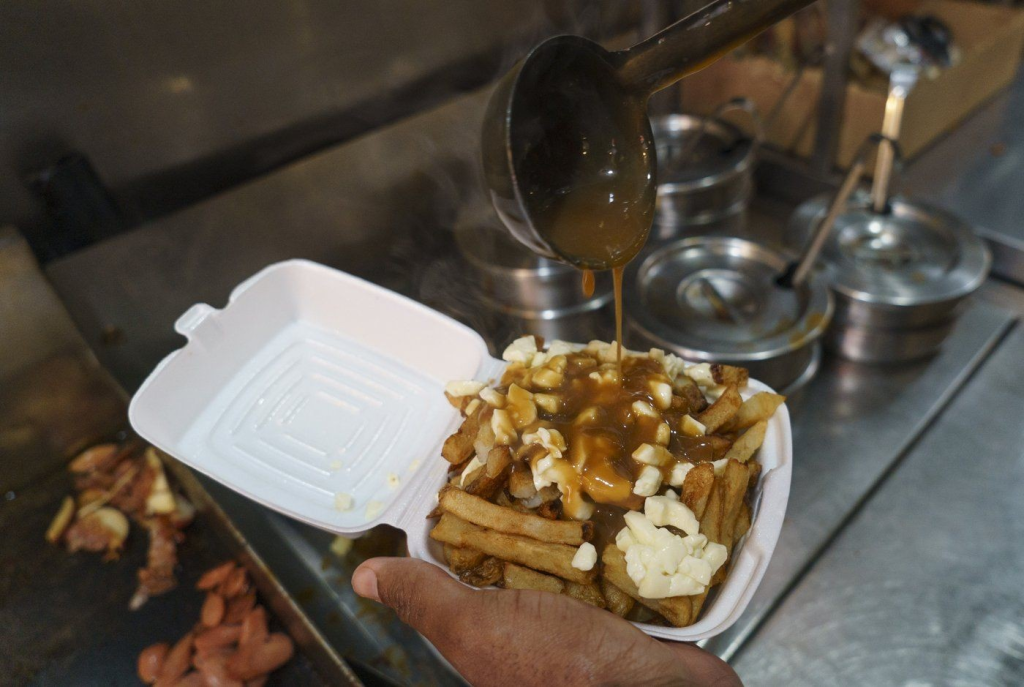
Poutine, tourtière, and meatball stew: while these dishes have always been part of Quebec’s culinary landscape, they have only recently come to be considered traditional dishes, according to a doctor of urban studies.
“Traditional cuisine wasn’t talked about at first. Traditional cuisine came later, perhaps at the turn of the 2000s with the emergence of nouvelle cuisine in Quebec,” explains Gwenaëlle Reyt, who completed her thesis on Quebec restaurants and food identities at the University of Quebec in Montreal (UQAM).
Reyt pored over tourist guides published in Quebec and Canada as well as abroad, gastronomic guides, and articles from English- and French-language Montreal daily newspapers between 1960 and 2017. As part of her research, the doctor focused more specifically on Montreal restaurants.
“Even if the name changes, the dishes that are recognized or associated with these establishments are pretty much the same throughout the period. We’re talking about tourtières, paws stew, meatball stews, maple ham, and pea soup,” she says. “So what’s interesting to see is that these dishes were present from the beginning, but they actually became traditional.”
Reyt points out that this phenomenon is called the construction of tradition in the humanities, as dishes that were once described as “Quebecois” became “traditional Quebecois.”
For example, the doctor of urban studies says she does not know when people really started eating poutine, but that in the 1990s, this dish began to be identified and appear on restaurant menus. The same is true for pouding chômeur and pâté chinois in the 1980s.
By consulting tourist and gastronomic guides, Reyt sought to find restaurants that were described as “Quebecois.” In the 1960s, they were referred to as “French Canadian” restaurants. The way traditional Quebec culture was represented changed with the Quiet Revolution.
Before the Quiet Revolution, restaurants that claimed to serve Quebec cuisine drew on the imagery of New France. At Les Filles du Roy restaurant in Old Montreal, for example, the waiters were dressed in period costumes and the establishment offered a themed decor.
“We really played on this slightly folkloric aspect, but it was aimed at tourists to help them discover this history, this kind of authentic place that corresponded to the myth we had at the time of what it meant to be Quebecois, to be French Canadian,” explains Reyt.
“New places emerged throughout the 1980s where, suddenly, with the Quiet Revolution, we detached ourselves from this identity that was truly linked to our French origins and adopted a more North American, more contemporary, and also more urban outlook,” she continues.
Revaluing traditional cuisine
Originally from Switzerland, the researcher was surprised by the lack of interest, or even pride, in Quebec cuisine among the province’s population when she arrived in Quebec.
“When I arrived in Quebec, I naturally asked what traditions and dishes I should try to discover Quebec’s culinary culture and if there were any restaurants where I could sample these specialties. I quickly realized that this wasn’t such an obvious question,” she says.
Reyt said that people were hesitant, and sometimes even surprised by her request, as if Quebec cuisine were not interesting.
“It made me wonder, because Quebec is a region where culture is strongly expressed through language, literature, and music. I didn’t understand why this identity was not expressed through its cuisine.”
However, Reyt noted that the emergence of new Quebec cuisine at the turn of the 2000s is reflected in restaurants such as Au Pied de Cochon, which are revamping and gourmetizing traditional cuisine. Le Pied de Cochon, for example, is known for its foie gras poutine. The researcher pointed out that La Binerie Mont-Royal, an establishment founded in 1938, is also one of the most iconic restaurants in Quebec cuisine.
The researcher hopes that people will take away from her work that identity is not something that is fixed in time.
“Identity, what makes us recognize ourselves in a cuisine, is what we say about it and what we do with it. Identity is a discourse, something that evolves and changes over time,” she said.
“If we want to assert ourselves through our cuisine, it’s up to us to turn it into a discourse that we can rally around.”
–This report by La Presse Canadienne was translated by CityNews