Quebec challenging ruling on random police traffic stops at Supreme Court of Canada
Posted January 19, 2026 10:52 am.
Last Updated January 19, 2026 5:47 pm.
The Supreme Court of Canada started hearing a case Monday about whether it’s constitutional for police to make a random traffic stop without reasonable suspicion the driver has committed an offence.
The decision by the country’s top court would have profound implications on policing in Canada.
“Obviously this case is about Quebec. It’s about a specific Quebec statute. And so this ruling will really be targeted and impact that Quebec law,” explained Harini Sivalingam, the director of the equality program at the Canadian Civil Liberties Association (CCLA). “But it does have the potential to have a significance across Canada because a lot of these type of powers also exist in other provinces in their statutes.
“And so those jurisdictions will have to evaluate and ensure that their laws are Charter compliant and don’t violate rights as the Supreme Court of Canada, if it were to uphold the Quebec Court of Appeal decision and strike down these powers that have been unconstitutional.”
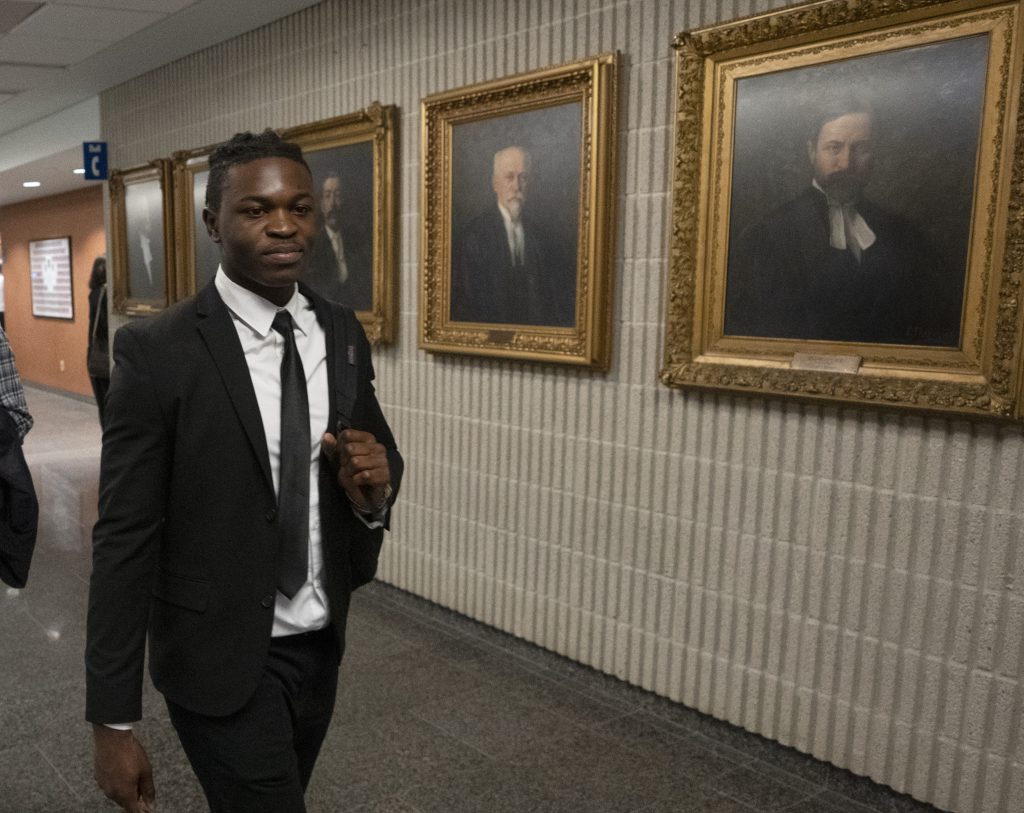
The case involves Joseph-Christopher Luamba, a Montrealer of Haitian descent who said he had been stopped by police nearly a dozen times without reason, including several times when he was behind the wheel, beginning shortly after he got his licence in 2019. None of the stops resulted in a ticket.
Luamba and the CCLA went to court to challenge the power of police to stop drivers without a reasonable suspicion that an offence had been committed.
“Joseph-Christopher Luamba courageously took this case on with his counsel,” Sivalingam said. “And I think it was important because it highlighted he was subjected to numerous police stops, arbitrarily detained at the roadside, and it affected him. It affected him personally. It is inhumane, degrading to be constantly surveilled and stopped by the police when you have done nothing wrong.”
Quebec Superior Court Justice Michel Yergeau sided with Luamba in October 2022, saying racial profiling exists and that it’s a reality that weighs heavily on Black people. The ruling concluded article 636 of the province’s Highway Safety Code violated articles seven and nine of the Canadian Charter of Rights and Freedoms.
The Quebec government appealed the ruling, arguing it deprived police of an important tool to stop crime.
“The way I’m interpreting it is that they’re sticking by their policy of not recognizing systemic discrimination,” said Alain Babineau, the director of racial profiling and public safety at the Red Coalition. “I think the use of 636 has become systemic among police forces, not only in Quebec, but across Canada. But Quebec in particular, because they refuse to recognize the existence of systemic racism, discrimination, they have to pursue this avenue all the way.
“In this province, I mean, over the last, I guess, almost 10 years that I’ve been involved in community advocacy, I’ve seen tons of cases where 636 was used as a pretext really to stop Black drivers to further a criminal investigation on the premise that they were potentially up to criminality.”
The Court of Appeal upheld Yergeau’s decision in 2024 and gave the provincial government six months to make the necessary changes to the Highway Safety Code.
‘Deterrent factor’
A lawyer for the Quebec government argued Monday that the lower-court decisions deprive police of that crucial tool to enforce road safety rules.
“There is a deterrent factor in routine verification,” Michel Déom said. “If a person knows they can be intercepted at any time to verify their driver’s licence, that has an effect.”
Déom said the law allowing random stops doesn’t need to be overturned just because some officers carry out “illegal interceptions” based on prejudice.
“Stopping a driver for verification purposes other than to ensure road safety is contrary to the rule of law and constitutes an illegal interpretation,” he said. He noted that Quebec has acknowledged the issue of racial profiling among officers and put measures in place to counter it.
Quebec’s Ministry of Justice told CityNews it would not comment “out of respect for the judicial process.”
But the CCLA told Canada’s highest court that police stops aren’t random at all and disproportionately affect Black drivers.
“I want to be clear, there’s nothing random about these stops,” said Sivalingam. “We’re not talking about a structured program to check sobriety. What we’re talking about is a police power that just enables anyone, at any time, anywhere to be subjected to what we feel is an unconstitutional stop by police.”
Luamba’s lawyer agreed, telling Canada’s highest court that police stops aren’t truly random; he said they are “arbitrary” and disproportionately affect Black drivers and violate their rights.
“The evidence is clear, racial profiling exists,” Luamba’s lawyer Mike Siméon said Monday. “The power of random interception is applied in a non-random way. Firstly, so it’s not random, it’s applied arbitrarily to a segment of the population.”
He said the stops have led to what he called a “systemic violation of the fundamental rights of thousands of Canadians” and of Black men in particular.
“A young Black man that hasn’t been stopped in a purely random way in their life — that’s an oddity, something almost unheard of,” he said.
Support for random traffic stops
One group hoping the Quebec government is successful is Mothers Against Drunk Driving (MADD) Canada. It says random traffic stops are more effective at limiting impaired driving.
“Our fear is that if truly random stops are struck down, there will be a reduction in the deterrent impact of police enforcement, that this will lead to increased levels of impaired driving and that will in turn lead to increased injuries and death related to alcohol and drug impaired driving,” said Eric Dumschat, MADD Canada’s legal director.
“There’s a 2007 study from south Australia that looked at the effectiveness of fixed checkpoints versus mobile stops. And the evidence in that study shows that mobile stops yielded a driver detection rate six times higher than stationary checkpoints overall. And it’s even higher in rural areas where mobile patrols detected impaired driving at a rate 11 times higher than stationary checkpoints. So if you were to just move to stationary checkpoints, you would be missing a considerable amount of impaired driving.”
The Supreme Court is being asked to weigh in on whether stopping drivers with no apparent reason violates the Charter, and whether the Quebec judges made an error when they overturned a 1990 Supreme Court decision that upheld the practice of random stops.
The high court ruled in the R. v. Ladouceur decision that random stops were the only way to determine whether drivers are properly licensed, whether a vehicle’s seatbelts work and whether a driver is impaired. But Yergeau wrote it was time for the justice system to declare that the power to stop vehicles at random violates certain constitutional rights, and is obsolete and inoperable.
While lawyers present their arguments at the Supreme Court, a new interactive tool called the “Red Map” allows citizens to document and share their traffic stops, police interactions and police-issued tickets in Quebec for the public to see.
The map was recently launched by the Red Coalition, which argues random traffic stops have had a negative psychological impact on the Black community.

“It’s demeaning,” said Babineau. “I don’t know if you’ve been stopped by the police before, either while walking or on the road. But I mean, it’s intimidating. It’s a shock to the system, obviously. But the impact that it has on the community at large is huge. They lost the trust of police agencies, and knowing that any time they go behind the wheel of a vehicle, there’s a strong possibility that they will be stopped for absolutely no reason, it’s feeling like you’re being treated like a second-class citizen.”
The hearings at the Supreme Court are scheduled to conclude Tuesday, but a decision could take weeks or months.
–With files from The Canadian Press