Adapting infrastructure to changing climate can save billions: study
Posted February 9, 2026 8:28 am.
Last Updated February 9, 2026 4:33 pm.
A study published Monday by the Canadian Climate Institute suggests that taxpayers could potentially save up to $10 billion a year in infrastructure costs if governments implement effective measures to adapt to the extreme heat and heavy rainfall caused by climate change.
If there is one lesson to be learned from the Canadian Climate Institute’s latest study, it can be summed up in a few words: prevention is better than cure.
The report published Monday morning argues that Canadian taxpayers will pay a high price, up to $14 billion a year, if governments fail to adapt public infrastructure to climate change or delay doing so.
On the other hand, an investment of approximately $3 billion per year in climate change adaptation could result in long-term savings of $5 to $10 billion each year.
“Canadians are caught in a vicious cycle: aging infrastructure and increasing climate risks that are already disrupting our daily lives. This is not a problem for tomorrow; it is a reality for today. Research is clear: adapting public infrastructure will save Canadians billions of dollars in the long term,” wrote Rick Smith, president of the Canadian Climate Institute, in a press release.
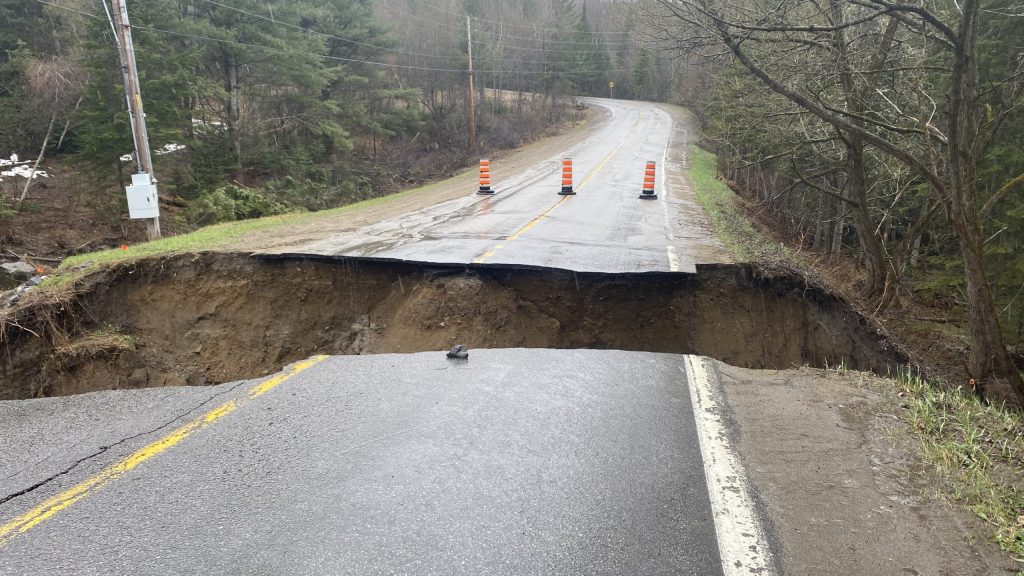
A significant portion of the country’s infrastructure—bridges, roads, schools, transportation networks, to name a few—is already in poor condition or deteriorating after decades of underinvestment, the report notes.
According to the study, approximately 65 per cent of the country’s infrastructure was built before 1985 and 85 per cent before 2015, when “climate change began to be incorporated into design standards.”
However, climate change will only accelerate the damage and deterioration of all public infrastructure, according to the study entitled “Prepare or Repair: How climate-proofing public infrastructure pays off.”
Without adaptation, infrastructure costs “will reach $14 billion per year by 2050 and $19 billion per year by 2085 in the most likely scenario,” according to the Institute.
The researchers point out that these figures represent only a fraction of the actual costs, as the study’s authors focused on the impacts of a limited number of climate phenomena, namely extreme rainfall, heat stress, and certain types of flooding.
However, other significant climate stressors, such as forest fires, permafrost thaw, coastal erosion, and drought, “could not be quantitatively modeled in this study due to the limitations of modeling approaches.”
Costs to be borne by municipalities
Governments, and municipalities in particular, will have to absorb the costs caused by extreme heat and heavy rainfall, regardless of the scenario.
“Today, municipalities own more than 60 per cent of essential public infrastructure but receive only 10 per cent of government tax revenues.”
Cities therefore have limited financial capacity to maintain or replace their infrastructure.
However, between 2025 and 2100, municipalities will have to bear 72 per cent of total climate-related infrastructure costs, or approximately $10.9 billion per year, in a no-adaptation scenario, according to the study.
“Infrastructure owned by provinces and territories will account for approximately 26 per cent of climate-related costs, or about $4 billion per year, while infrastructure owned by the federal government will account for approximately 2 per cent, or $200 million per year,” the study states.
Transportation and water systems are expected to face the highest cost increases.
Damage to the economy
Infrastructure that is not adapted to climate change will cause problems that go far beyond repair costs.
Failing infrastructure slows supply chains, disrupts essential services, and reduces productivity, the study notes.
For example, “when flooding in British Columbia in 2021 eliminated major highways and rail corridors, the movement of goods in the province was disrupted, resulting in an estimated $2.5 billion in business losses and an additional $800 million to $1.4 billion in lost revenue and productivity.”
Rural and remote communities are often exposed to higher risks, while small municipalities generally have fewer financial and technical resources.
Without rigorous planning, adaptation outcomes will be uneven, the report warns.
Prevention rather than cure
The study shows that “proactive adaptation,” i.e., “upgrading infrastructure before it reaches the end of its useful life or a major rehabilitation point,” offers lower net costs than reactive adaptation.
In a favorable scenario, where the government invests approximately $3 billion annually in “proactive adaptation,” the analysis shows that Canadians could save $5 to $10 billion annually through 2100.
Thus, such an annual investment “would prevent most of the damage to infrastructure caused by rising temperatures and heavy rainfall.”
Solutions
According to the Canadian Climate Institute report, infrastructure resilience in the face of climate change in Canada requires the following six resolutions:
- Ottawa should “increase funding for infrastructure adaptation and modernize the financial tools available to municipalities and other infrastructure owners.”
- The government must “plan, operate, maintain, and renew public infrastructure so that it continues to function safely and reliably in future climate conditions.”
- It is also necessary to “strengthen climate risk data and mapping at the national level.”
- The government must also “accelerate the updating of infrastructure codes and standards so that new and renewed infrastructure is built to withstand climate change.”
- It is necessary to “ensure that all public infrastructure spending systematically takes climate risks into account and helps infrastructure owners reduce their long-term vulnerability.”
- Finally, leaders must “adapt programs to support the most vulnerable communities and critical infrastructure.”
Methodology
As part of its study, the Canadian Climate Institute claims to have applied “the infrastructure deterioration model developed by environmental consulting firm WSP.” This model has been used in Ontario and Quebec in studies conducted by the Office of Financial Accountability of Ontario and the Union of Quebec Municipalities.
The researchers also used a “comprehensive national dataset on infrastructure assets.”
–This report by La Presse Canadienne was translated by CityNews