The SAAQ knowingly lied to the public for years, says Gallant
Posted February 16, 2026 6:48 am.
Last Updated February 16, 2026 10:01 pm.
The Société de l’assurance automobile du Québec (SAAQ) “lied” to government authorities by providing them with “misleading,” “deceptive,” and “hypocritically reassuring” information in order to “conceal” the increased costs of its digital transformation.
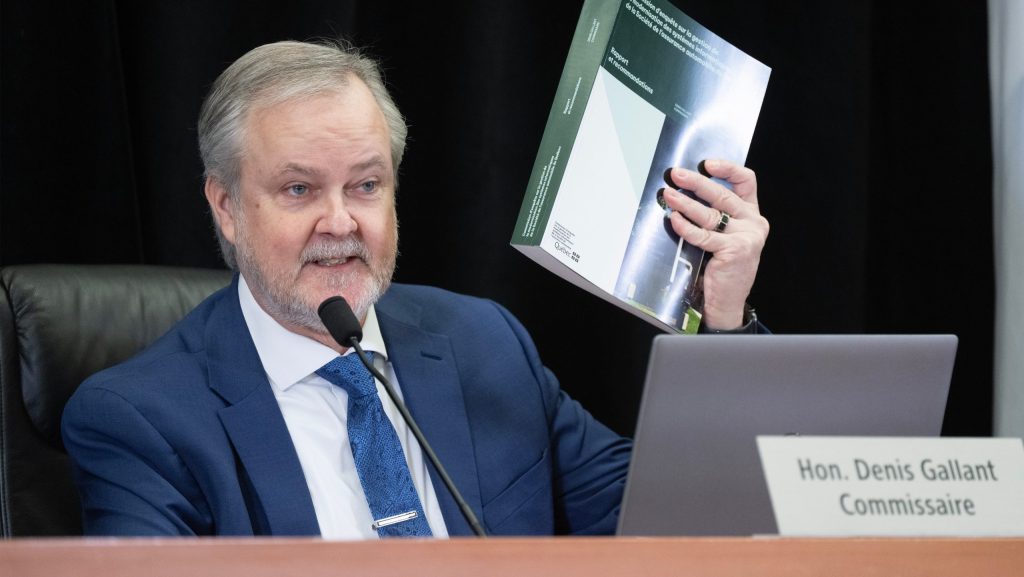
This is one of the main conclusions of the 586-page report presented Monday by Judge Denis Gallant, who chaired the public inquiry into the SAAQclic fiasco.
“The Commission concludes, based on particularly significant evidence, that the deceptive information disseminated by the SAAQ was not the result of careless errors, but rather a conscious action aimed at hiding the total cost of the program from parliamentarians and the government—and therefore from the public,” the report states.
RELATED: Quebec government looking into ‘legal options’ against ‘SAAQ executives who lied’
Speaking to reporters gathered in Quebec City, Commissioner Gallant insisted that the SAAQ management had “deliberately lied throughout this entire affair.”
“What can we recommend in a case like this? It’s difficult to recommend transparency and honesty, since that should be the absolute standard for people working in the public administration,” he emphasized.
Legault’s office knew as early as 2023
However, the “lies” ended in 2023 with the arrival of the new president and CEO, Éric Ducharme, and the government was given the straight story, the commissioner points out.
In June 2023, Ducharme presented to the then Minister of Transport, Geneviève Guilbault, “the status of the contract with the LGS/IBM Alliance and the Crown corporation’s desire to enter into a second amendment.” It should be noted that Guilbault has always maintained that she was not aware of the cost overruns until February 2025.
Then, in August 2023, it was the turn of the communications director and an advisor to Premier François Legault to be alerted. “In short, several government representatives were informed in 2023 of the SAAQ’s decision to increase the value of the contract with the Alliance,” Gallant writes in his report. However, he specifies that the information provided “did not trace the history of the costs.”
“This change in attitude on the part of the Crown corporation did not prevent members of the government from claiming that the cost overruns had been hidden from them,” he points out.
Visiting Montreal on Monday, Legault defended himself by stating that his government had never been informed, prior to February 2025, that the total cost of the project would rise to $1.1 billion. “I’m not saying the government was perfect. We could have been more suspicious, asked more questions,” he conceded. He said he asked his teams if “legal action” was possible “against the SAAQ executives who lied to our government.”
It was the CAQ government that “lied to Quebecers from at least 2023 onwards about its knowledge of cost overruns and how this project had gotten out of hand, and that’s serious,” said PQ MNA Pascal Paradis at a press conference, expressing doubt that Guilbault could remain in the cabinet.
For his part, Liberal MNA Monsef Derraji said he was particularly surprised to learn that between 2020 and 2022, the Ministry of Finance received explicit information about what was going on at the SAAQ.
He also criticized Guilbault’s predecessor, François Bonnardel, who received incomplete information in 2021, and former Minister of Cybersecurity and Digital Technology Éric Caire, who, according to the commission, “will be very little involved in monitoring the financial aspect of the project, or even lose interest in it altogether.” “They are all responsible,” he said.
Guilbault has consistently maintained that she only became aware of the cost overruns in February 2025.
“The report also indicates that information on the project’s costs was provided to my office and me starting in the summer of 2023,” Guilbault wrote on X Monday afternoon. “It’s important to understand the context: at that time, we were still managing a crisis regarding services provided to the public, and the government’s entire focus was on restoring normal operations and adequate services at the SAAQ.
“That’s why, two years later, when I was asked about it during my testimony before the Commission, I gave the absolute truth: I have no concrete or specific recollection of a meeting during which we discussed the project’s costs, nor of any documents being sent by email, primarily because I was juggling constant public and media pressure regarding the quality of services, which Quebecers were rightfully eager to see restored.
“As I also stated during my testimony, and I reiterate: I do not deny that a meeting took place. This distinction is extremely important. Above all, the Commission does not question my testimony, nor my credibility in this regard.”
The Secretary General of the Government, Dominique Savoie, was informed of the costs in March 2023, while Premier François Legault’s director of communications and one of his political advisors received the full details in August of the same year.
“In short, several government representatives were informed in 2023 of the SAAQ’s decision to increase the value of the contract with the Alliance,” writes Denis Gallant, who specifies that “the information provided regarding the contract amendments with the Alliance did not, however, provide a complete history of the cost increases.”
Too big, too fast
The Gallant report traces the history of a digital project that was “too broad, too ambitious” and developed “too quickly.” Governance was ‘centralized’ around vice president of information technology Karl Malenfant, a man with a “strong personality.” A “determination to complete the program at all costs” took hold at the SAAQ. Furthermore, the Crown corporation did not ensure that an integrated management software package (ERP) was the appropriate technological solution. Its contractual model ultimately “encouraged cost overruns.”
A “hold-up,” accused Québec solidaire MNA Haroun Bouazzi in a press scrum. “We have all been victims of a ‘hold-up’ because $1 billion has been spent. (…) The money went somewhere, it went to the private sector, and we never talk about it enough,” he said.
“Karl Malenfant himself testified that financial considerations were secondary for him and that he was not particularly concerned about the project’s cost,” the report notes.
“Surprisingly,” in 2020, SAAQ management was satisfied with the agreement reached with the Alliance to resolve the 800,000-hour issue. However, this agreement reduces the scope of the project and increases the SAAQ’s investment to $682 million. We are currently in phase 2 of the work, which notably concerns the issuance of driver’s licenses. This phase differs from the previous ones due to the immense amount of work it requires to customize the ERP system.
“Very soon after its launch, … delivery 2 is encountering numerous obstacles that suggest it will become a financial drain for the SAAQ,” the commissioner points out.
He notes that in March 2021, “despite the events of 2020 regarding delivery 2, the reporting to the National Assembly’s Committee on Public Administration shows indicators that are all positive.” He also notes the “discreet” role of the Minister of Cybersecurity, Éric Caire, in the matter, even though his colleague, François Bonnardel, attempted to “raise his awareness.”
The launch of SAAQclic will finally take place in total chaos, in February 2023. “The consequences are major, ranging from the slowing down of work tools to unjustified arrests and detentions, due to the inaccessibility of SAAQ systems to police services.”
“The program was too large, too ambitious, and was pushed to be implemented too quickly,” Gallant said.
“The program’s governance was too centralized, and its leadership wanted to complete it at all costs.”
26 recommendations
Gallant believes that the SAAQ’s “setbacks” should prompt Quebec to improve its management of digital transformation projects.
He recommends, among other things, the creation of a “centralized entity specializing in the digital transformation of the government,” a “Tiger Team,” to quickly address the “lack of government expertise.”
The Ministry of Cybersecurity and the Quebec Centre of Excellence for Digital Technology do exist, but they “lack a structuring influence on decisions,” argues the commissioner, who wants this new entity to be granted “stable, predictable funding adapted to the evolving nature of the task.” According to him, the government will have to require public bodies to use it for their digital transformation.
The commissioner concludes with this observation: “The lessons learned from failures can only be based on one categorical imperative: the honesty of all public actors.”
–This report by La Presse Canadienne was translated by CityNews