Helping prevent sexual violence in Quebec higher education: ‘On s’écoute’ campaign in new phase
Posted February 26, 2026 1:58 pm.
Last Updated February 26, 2026 4:09 pm.
“I know it’s not really sexy to talk about prevention, education, but that’s our main goal here,” explained Léa Clermont-Dion, the founder of the “On s’écoute” campaign, aimed at preventing sexual violence in higher education across Quebec — and on Thursday, the project launched its third phase: addressing the links between masculinist discourse and the normalization of sexual violence.
“Sometimes we need to prevent,” she added. “And not only react.”

The Concordia University affiliate professor with over 60,000 Instagram followers dedicates her research to the prevention of gender-based violence, and more.
She has given over 300 lectures worldwide, is an author, and directs documentary films.
One of the “major” reasons she began “On s’écoute” back in 2024 was based on personal experience.
“As myself as a sexual survivor, I was involved in that cause since like 10 years,” she said. “So that was natural to me to, I would say, to act and to do this project with this ideology.”
From an awareness‑raising video to a training program, and video capsules featuring local public figures, the project is supported by the Ministry of Higher Education. It is part of the province’s “Action Plan to Prevent and Counter Sexual Violence in Higher Education.”
“First of all, we have to say that masculinism is not feminism. It’s a counter movement that disqualifies feminism and women’s rights,” she explained. “I would say that masculinism also attacks. So women’s rights and also feminism.”
“We give tools to teachers, to parents to navigate with those questions and to address it,” she added. “And the campaign targets also youth, so young people in Canada, in English and in French.”
According to a 2025 province-wide study from the “Chaire de recherche sur les violences sexistes et sexuelles en milieu d’enseignement supérieur de l’UQAM,” 75 per cent of Quebecers between 15 and 25 years old believe myths that undermine the credibility of women who are victims of sexual assault.
“It’s a major study, and this study leads to our campaign because we realize that young people that trivialize sexual violence were maybe influenced by masculinist discourses,” Clermont-Dion said.
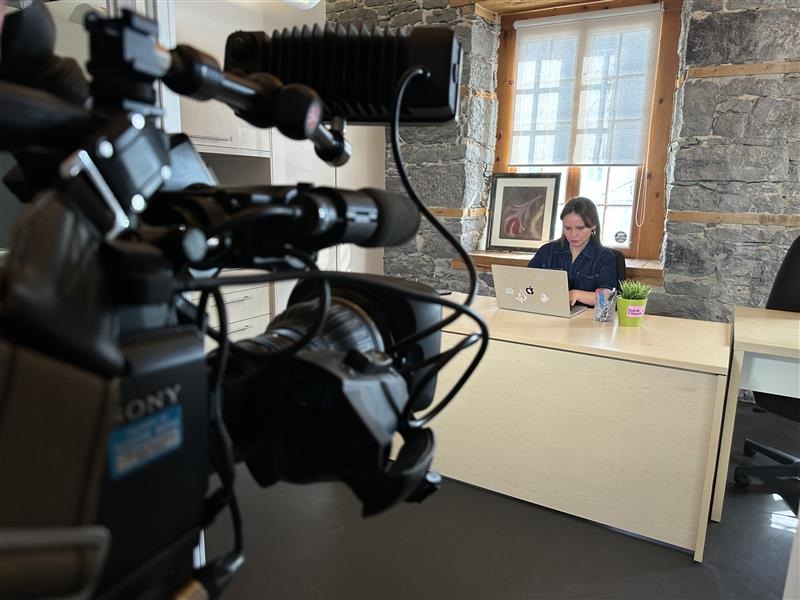
The third phase of the campaign also takes aim at alpha male influencers who are spreading a message that trivializes sexual violence, said Clermont-Dion, who is urging the government to prioritize the issue as a growing concern.
In a large-scale survey of people at six Quebec universities, one in three reported experiencing at least one form of sexual violence since they started classes, committed by another person at the school.
Clermont-Dion says alpha male influencers are also becoming more prominent in public discourse; although, there is not yet any empirical data in Quebec showing whether young people are buying into the messaging.
“This is because it has not been a government priority to study this issue in recent years, so we rely on data from elsewhere,” Clermont-Dion said in an interview with the Canadian Press.
“However, through our work at the university and elsewhere with research groups, we see a proliferation of masculinist influencers who target or end up in the digital ecosystem of young Quebecers. Yes, there is an increase in masculinist influencers who are more mainstream.”
For those who study what is known as the manosphere subculture, she said one thing is clear: there is a rise in the normalization of masculinist discourse. “The more masculinist discourse trivializes sexual violence, the less victims will want to seek help, ask to be heard, or try to find processes that suit them,” Clermont-Dion said.
She noted there are “one-stop shops” in junior colleges and universities for victims of sexual violence who want an alternative to criminal proceedings to file a complaint.
“We can’t say that everyone who subscribes to masculinist discourse is violent,” Clermont-Dion said. However, the consequences of sexual violence are minimized and there is a tendency to denigrate the #MeToo movement. Clermont-Dion has concerns about the impact this may have, especially on young people’s intimate lives.
Influencers get their message across to young people by convincing them they have something to gain from it.
“In recent years, we have seen influencers who are more like coaches: sports coaches, life coaches. So, the goal is to provide a lifestyle or guide for men who want to empower themselves through sports,” said Clermont-Dion.
The influencer will first attract fans who like their content. Then, the influencer will convey masculinist messages to them. “There are also other types of influencers who are perhaps more focused on how to make money,” Clermont-Dion said.
Also popular are so-called seduction coaches. “They tell young men how to seduce women. And in this type of discourse, they tell these young men, ‘You shouldn’t be with a girl who has had more than five boyfriends.'”
Clermont-Dion says this creates a double standard that encourages people to judge women more harshly than men, but it can strike a chord with young people who are looking for life advice.
Andrew Tate, a popular influencer whose videos have been viewed billions of times, touches on all three categories of coaching (sports, money, seduction). His controversial opinions can therefore gain traction with many people, such as when he suggested that marital rape should not be considered rape because there is consent within the couple.
Sexual assault is a criminal offence in Canada.
Clermont-Dion points out that people on social media are all the more vulnerable to masculinist misinformation because news content is blocked on these platforms. She gives a concrete example of misinformation circulating in the manosphere: videos claiming that menrisk being emasculated if they drink tap water because women urinate in the water, and therefore tap water contains estrogen.

Addressing sexual violence and consent in general terms was the first phase of the campaign, followed by sexual violence in sports settings within higher education.
The campaign’s resources are accessible through the “On s’écoute” website.
“With ‘On s’écoute’, we prevent,” Clermont-Dion explained. “We’re in a dialogue with youth, and they gave us hope.”
-With files from The Canadian Press