CAQ leadership race: Fréchette, Drainville clash on 3rd link, reducing bureaucracy at first debate
Posted March 21, 2026 9:04 am.
Last Updated March 21, 2026 5:00 pm.
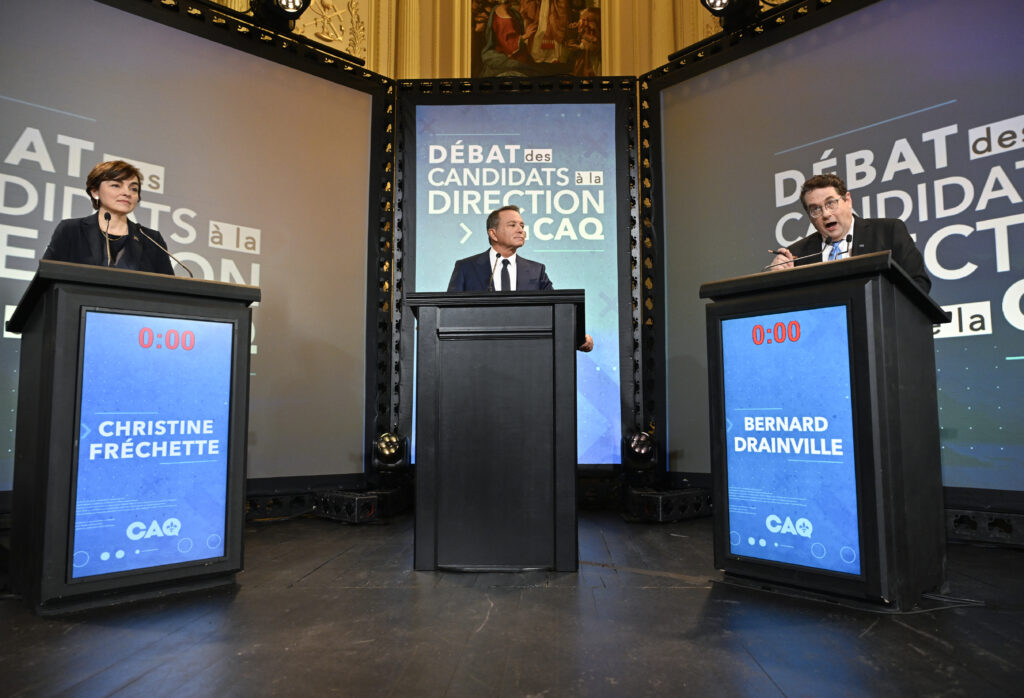
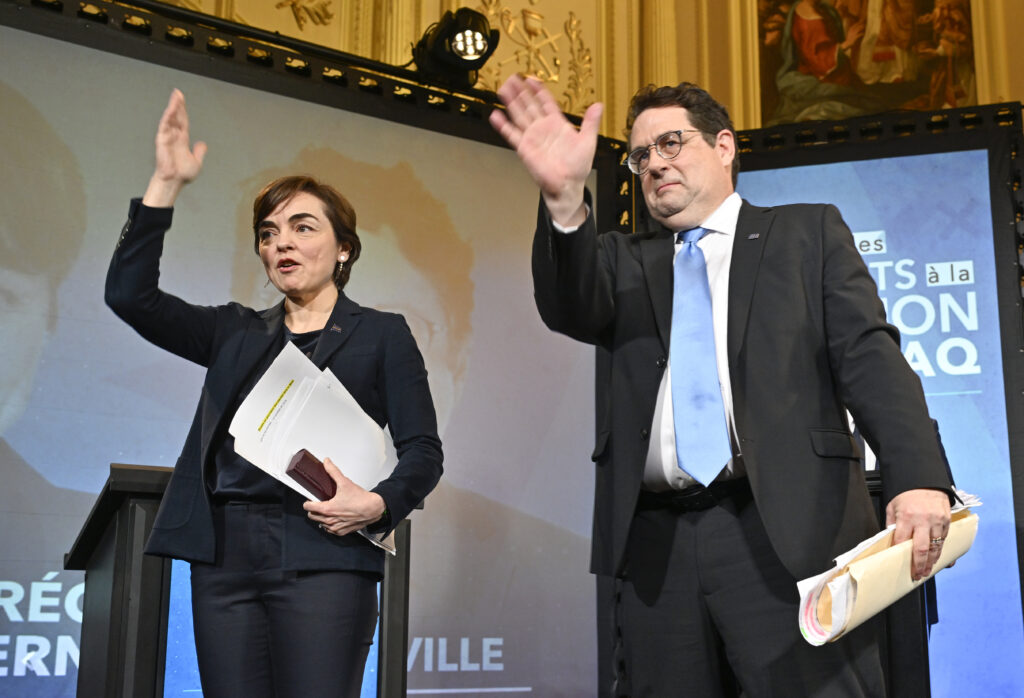
The two candidates vying to succeed François Legault, Christine Fréchette and Bernard Drainville, clashed on their approaches to public infrastructure, energy policy and role of the state during the first debate Saturday in Quebec City.
The event at Espace Saint-Grégoire was attended by about 300 people.
The candidates for Coalition Avenir Québec (CAQ) leadership went head-to-head on economy, public finances, infrastructure, transportation, regional development, and Canada-U.S. relations.
The debate also so broad agreements on reducing bureaucracy and increasing the role of private sector.
Political analyst Karim Boulos said with Fréchette having a clear lead over Drainville, the candidates may not want to take risks.
“At this point, whoever wins this leadership race is going to have to work with the other person’s supporters,” Boulos said. “The last thing Madame Fréchette wants to do for Mr. Drainville is to alienate members of the CAQ.”
“Mr. Drainville is trailing,” Boulos continued. “He has to show that he is ready to work with whoever, because if the election were to happen today, he would lose.”
Third link sparks heated exchange
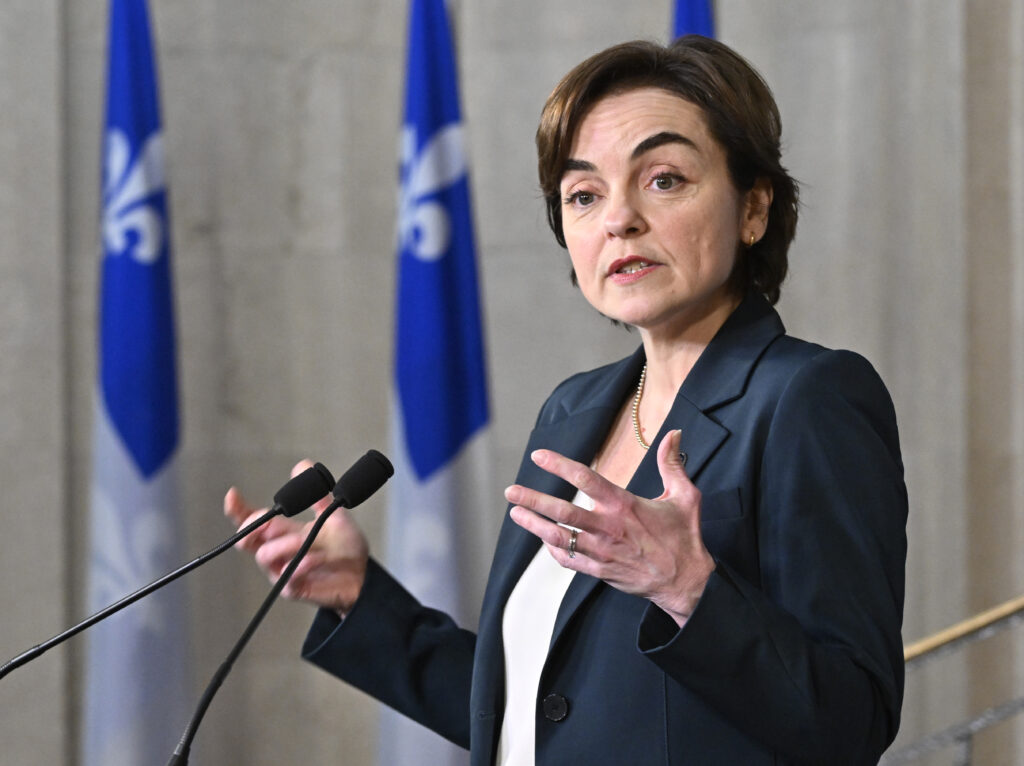
Fréchette accused her rival of advocating for a route that no one wants just to satisfy his “ego.” Drainville retorted that his opponent should be honest and admit that she doesn’t really want to carry out the project. She said the cost of the controversial project could be used to build 325 schools.
“To sum it up: I’m going to do it, and Christine is putting it on ice because she’s imposing so many conditions that it won’t happen,” Drainville said.
Fréchette is proposing a third link project further east than the current corridor in partnership with the private sector.
“I called people to consult them, and I was quickly told that he had never been contacted, not even in Lévis. (…) When I made those calls, I realized one thing: no one supports the route you’re proposing. So it’s important that we listen to these people. We choose the route for them, for the people who live here—not for you, not for your ego,” retorted Fréchette.
“You have to realize that the $11, $12, or $13 billion we’re going to pour into this project, based on your proposal, is equivalent to what? 325 schools. Are we really willing to trade 325 schools that could be built in Quebec to fund the third link—which nobody wants along its current route?” Fréchette added.
Despite the heated exchange on the stage Boulos said the third link is closely tied to the CAQ.
“Regardless of who wins, this is something that they’re going to have to deliver on,” he said.
Housing affordability
Amid the housing crisis in the province, Fréchette said she will reimburse the Welcome Tax to first-time homebuyers.
“That means thousands of dollars going directly into the pockets of young people who want to become homeowners,” Fréchette said.
Drainville said reimbursing the Welcome Tax won’t solve the problem of affordability as home prices were inaccessible. Under his government, the province will loan the down payment to help people to afford a home, Drainville said.
Managing deficit, public projects
Both candidates said the government bureaucracy had grown too big in the recent years and promised to make cuts to avoid scandals and cost overruns like SAAQclic.
“We’ve added layer upon layer upon layer of bureaucracy,” Drainville said. “Honestly, the Quebec government has become so cumbersome, so bureaucratic, that it no longer surprises us that we’re no longer able—or at least very often unable—to see IT projects through to completion.”
Fréchette agreed, adding that, “We have hired far too many people in recent years. We need to refocus on our core missions and work to reduce the size of the government.”
Fréchette said that IT projects requiring specialized skills need to be centralized. “We need to centralize that expertise, to ensure we control the entire government apparatus when it comes to information technology. That way, we’ll be much better protected from dangerous or threatening external interference.”
For his part, Drainville said he would make reducing the deficit an “obsession” and said he would eliminate permanent positions and put in place measures to fire underperforming officials.
Fréchette said eliminating permanent positions can be arbitrary and that she would focus on improving the work culture in the bureaucracy. She also pitched using technology to bring efficiency in governance.
“The government apparatus needs to be controlled at the information technology level,” she said.
Drainville also promised that, if he became premier, he will reduce the size of the cabinet of ministers to 20. Fréchette, said while she agreed with reducing the cabinet size in principle, she won’t commit to a specific number.
Trade relations with U.S.
Fréchette said there is a need to diversify trade, while acknowledging that the U.S. will continue to remain the main trading partner for Quebec and Canada.
“We also need to work on diversifying our markets because we can’t remain so dependent on the U.S. market,” Fréchette said. “That puts us at risk, puts our businesses at risk, and our economy as well.”
Drainville said he would work with other partners such as governors and big city mayors in the U.S. to help during the upcoming renegotiation of the Canada-U.S.-Mexico free trade agreement.
“The Americans need our aluminum, they need our lumber, they need all sorts of products, so we need to reach out to these allies and use them to our advantage in the negotiations we’re going to have with Mr. Trump,” he said.
Economy and attracting investments
Both candidates said they saw an increased role for private sector in areas like public transit and other infrastructure projects.
Fréchette acknowledged that the government’s approach to investments such as Northvolt and LION electric needs to change. She said that loans and financial incentives to such projects should be based on achievement of specific targets like the number of jobs created, quality of those jobs, etc.
Drainville accused Fréchette of being a “interventionist” in the economy during her time as the Quebec minister of economy. He said he would rather focus on cutting the regulations in order to spur entrepreneurship.
Energy policy
Another notable moment of the debate was when Drainville accused Fréchette of opening doors for fracking which he said will pollute the province’s water systems.
“No to fracking. If you ask me to choose between water and gas, I’ll always choose water,” he said.
Fréchette said that she will not move forward with her fracking proposals without consultation with Quebecers. She added that the geopolitical situation has changed since CAQ banned fossil fuel extraction.
“The war in Iran gives us pause for thought,” she said. “But this isn’t an unconditional ‘yes.'”
Drainville also pressed Fréchette to commit to using Quebec energy for local industries like mining projects rather than data centres.
Fréchette said that data centre projects may be necessary in light of the Cloud Act in the U.S. which gives the U.S. government access to data held by American companies.
New CAQ leader chosen next month
Montrealers told CityNews that who became the new CAQ leader and the next premier of Quebec for a few months was largely a formality.
John Gilkison said, “I think they’re dead in the water.”
“They’re already losing in the polls, you get somebody that’s never been there before its a last ditch effort,” Gilkinson added. “We don’t vote people in, we vote people out, that’s Canada.”
Karine Milliard said the debate was a matter of procedure. “That’s just the way it is; we don’t have a choice—that’s the procedure,” Milliard said.
A second debate is scheduled for March 28 in Laval, where the two candidates will have another chance to make their pitch to CAQ voters.
“I think by the second debate, it’ll be a chance to distance themselves a little bit from Mr. Legault,” Boulous said. “You’ll hear that ‘unlike my predecessor, we will do things in this matter, this fashion.'”
Just before the debate began, Treasury Board President France-Élaine Duranceau expressed her support for Fréchette.
“We also share the same vision of a more efficient government, focused on its core missions—a government that fully leverages its tools, particularly public contracts, to support our small and medium-sized businesses and our economy,” she wrote on X Saturday morning.
The CAQ has just under 20,600 members who will be eligible to vote for their next leader. The deadline to become a member and be eligible to vote in the leadership election was March 13.
The new CAQ leader will be announced April 12.
–With files from The Canadian Press