Montreal mayor says city to provide police with body cameras and give them new powers
Posted August 21, 2026 10:14 am.
Last Updated August 21, 2026 2:07 pm.
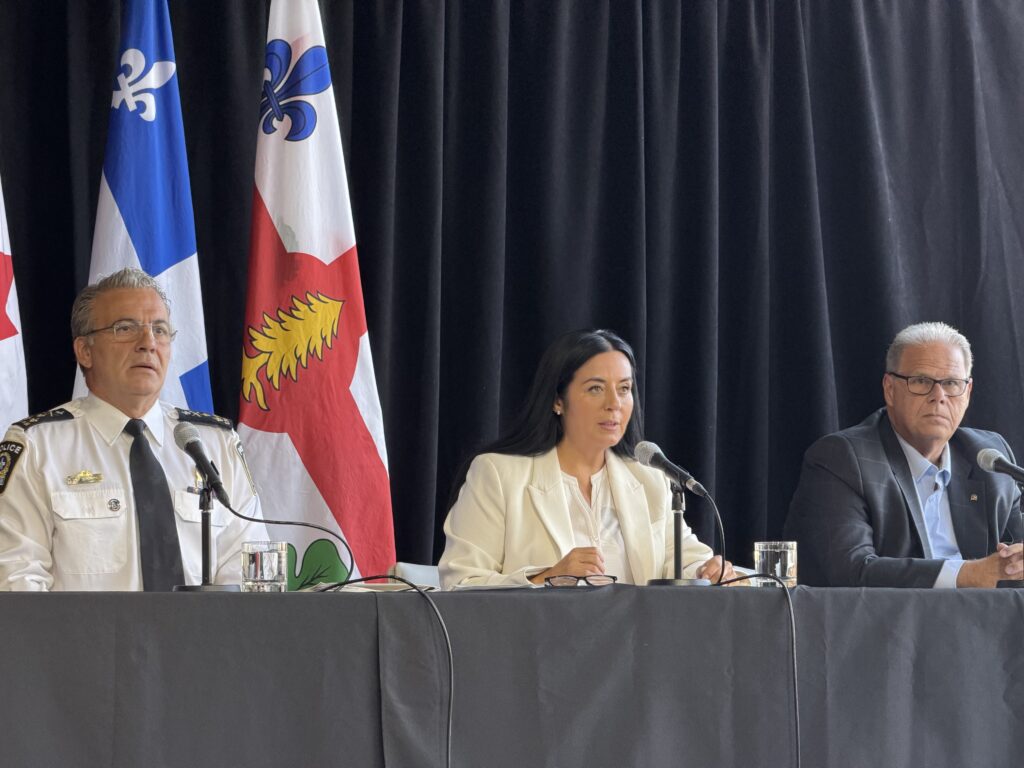
Montreal Mayor Soraya Martinez Ferrada says police in the city will soon be equipped with body cameras as well as new powers to do their job.
Both measures are aimed at addressing some long-standing concerns about recent altercations between police and civilians as well as new allegations about police misconduct that rocked a station in a multicultural neighbourhood in the northern part of the city, the mayor said at a news conference.
Speaking alongside the city’s police chief and the head of the police brotherhood, Martinez Ferrada said the city plans to adopt a new bylaw banning insults toward city employees, including police.
If adopted, the bylaw could give police new powers to issue fines for someone who insults them or another municipal employee. Such rules are in place in municipalities including Quebec City, Sherbrooke, Que., and Laval, Que.
As part of a slew of measures, the city said it will create a voluntary registry of private security cameras allowing citizens and business owners to can sign up to share footage to help with police investigations. The city will also ask the public safety commission to review the traffic stop practice by police.
Boosting accountability
About 3,500 police officers and 600 patrol vehicles will be fitted with cameras to boost safety and accountability during interactions with the public.
The news comes two months after police dismantled a 16-member patrol unit at a station in the Montréal-Nord neighbourhood, following allegations of criminal behaviour and misconduct.
Civil liberties groups have advocated for with body cameras amid concerns about police brutality.
“We made a campaign pledge to strengthen Montrealers’ sense of safety,” Martinez Ferrada said. “These new measures—including body-worn cameras, which our police officers have been awaiting for many years—will be implemented in collaboration with all stakeholders and will protect both police officers and the public.”
Martinez Ferrada’s administration earmarked $40 million for police cameras in its first budget.
Quebec Internal Security Minister Ian Lafrenière said the changes by his ministry would facilitate the roll out of the program, in a post on social media.
“We have already revised the police policy governing their use. We will work with the City of Montreal and the SPVM on next steps,” the minister said.
The Red Coalition says accountability for abusive or threatening behaviour toward police officers must go both ways, emphasizing that police officers are also bound by Québec’s Code of Ethics.
The organization plans to encourage citizens who believe they experienced misconduct to come forward, document complaints, identify patterns and demand greater accountability.
“We cannot create a stronger standard of respect for citizens dealing with police while accepting anything less from police dealing with citizens,” said Joel DeBellefeuille, Executive Director of The Red Coalition. “If we are going to talk about insults, intimidation, respect and acceptable behaviour during police interactions, then that conversation must go both ways. The law already establishes standards for police officers. We intend to make sure those standards receive the attention and accountability they deserve.”
Insult bylaw
Martinez Ferrada stressed the bylaw is not meant to shield the city from criticism.
“Montrealers have every right to criticize the city, challenge our decisions, and hold us accountable. It is part of our democracy,” she said. “The bylaw is about protecting the people who serve Montreal every day.”
A debate around banning insults against police in Montreal was sparked in March after videos of a man insulting a police officer with a barrage of misogynistic comments went viral. The man was charged with defamatory libel under the Criminal Code in July and pleaded not-guilty.
Police Chief Fady Dagher said on Friday that “freedom of speech is not absolute.”
“You can’t just say whatever you want whenever you want,” he said.
“At the SPVM we welcome the interaction of body-worn camera as an important step in the evolution of our practice,” said Dagher .”The body cameras, it’s not a miracle response, but it’s one of the tool that’s going is going to bring much more transparency in the way we work.”
Lawyers and civil rights groups have said they worry that adopting such a bylaw could lead to abuses of power by police. They also say it could encroach on Charter rights like freedom of expression, dignity and privacy.
“I know that is something that worries many community organizations and racialized people,” said Martinez Ferrada. “We will monitor this very closely.”
A spokesperson for Montreal police said in an email that its legal affairs department will “conduct a detailed analysis of the regulation and provide guidance to police officers on its implementation.”
According the City, the number of reported incidents of “incivility, aggression, threats, and violence” against the municipal employees increased by 263 per cent between 2019 and 2025.
“Women are particularly affected by this behavior, as they hold many front-line positions interacting directly with the public,” the City said, adding that more than a third of the officers in SPVM were women.
The Canadian Press reported in June that police in Quebec City hand out hundreds of these fines each year, and typically issue multiple fines per day.
A spokesperson for the mayor’s office did not confirm whether those who break the bylaw could be fined or how much the fines would be, saying it will be debated at council. The mayor said a motion will be tabled at the next council meeting, scheduled for Monday, and adopted in September.
“I’ve had many conversations with the government of Quebec in the past few months,” said Martinez Ferrada. “They have changed the practice of police officers a few weeks ago that actually allows me today to buy equipment for the police officers in order to equipment with cameras.”
Yves Francoeur, the head of the brotherhood, said the goal “is not to hand out fines” but to “prevent violations of dignity and to avoid violent verbal escalations.” The brotherhood has been advocating for such a rule for over a decade.
“(Quebec City police) told us the only tickets that they give are to Montreal citizens because the Quebec citizens know right now that there’s a bylaw and they have to act correctly,” he said.
Lafrenière also reacted to the City’s plans for the bylaw.
“I commend the City of Montreal’s initiative to enact this bylaw prohibiting insults against municipal employees,” he said. “Citizens have reacted strongly to past incidents in which police officers were insulted.”
Rebuilding public trust
Martinez Ferrada and Dagher both said they are dedicated to rebuilding trust between police and Montrealers through the new bylaw and by starting to roll out body cameras within a year.
Police work is becoming increasingly complex, said Dagher, and that cameras “help objectively document police intervention, police interaction and promote a better understanding of events.”
“We have observed in recent years an increase in situations that are more social, in nature than criminal,” he said.
The Quebec coroner released a report earlier this week urging Montreal’s police service to adopt body cameras after the death of 29-year-old Abisay Cruz. The report said police and witness accounts of officers’ behaviour leading up to Cruz’s death differed significantly and that cameras would increase accountability.
Martinez Ferrada’s administration earmarked $40 million for police cameras in its first budget. But the mayor has said she needed co-operation from the provincial government to ensure footage can be submitted as proof in court.
She said Friday’s announcement aims to pressure the government to move on the issue.
When asked if she believes body cameras will be enough to restore public trust in police, the mayor said “the answer is no.”
“There’s much work to be done and many conversations to have,” she said. “This is one of the tools, but this is not the magic tool … It’s going to take time.”
— With files from The Canadian Press