Quebec education sector is calling for a national conference on education
Posted August 25, 2026 11:00 am.
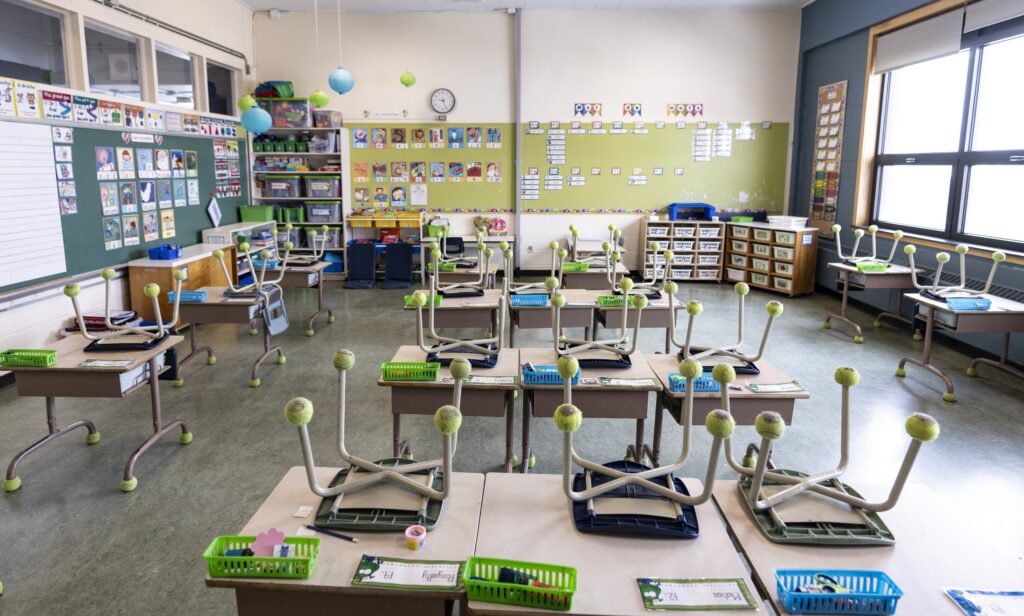
Regardless of which party forms the next Quebec government, it will have to organize a general assembly on education, or at the very least “a major reflection”, demand the main stakeholders in the education sector.
This is the wish expressed by the Quebec Federation of School Administrators (FQDE), the Federation of Teachers’ Unions (FSE-CSQ), the Federation of Private Schools (FEEP) and the Autonomous Federation of Education (FAE) as the provincial elections of October 5 approach.
The FQDE believes this issue must be a top priority for the next government. According to them, the time has come to have “a real, in-depth discussion on pedagogy in 2026,” 30 years after the last Estates General on Education.
Its president, Francis Côté, points out that, since then, “this is the field that has probably changed the most in our society with the advent of technology, new customer needs and different educational trends.”
He believes that “we are really due for a general assembly to truly assess the situation in our education system,” particularly regarding “the content of programs, school adaptation, the management of intervention plans and the ratings of student difficulties.”
“We need a real reset, a real reassessment, but not by pulling in different directions. If parents, management, and unions each pull in their own direction, we won’t get anywhere. We need to have a real discussion about the current issues, the needs of our clients, what isn’t working, and how we can make significant changes that will improve the system,” says Côté, adding that the next government will have to have “the courage to bring everyone to the same table.”
For his part, the president of the FSE, Richard Bergevin, prefers the term “major reflection”, because “the Estates General of the 1990s had bad press”.
He does, however, share the FQDE’s opinion. “We want the whole of society, not just the school system, to examine our education system. Thirty years later, we need to revisit important fundamental questions,” argues Bergevin, who hopes that the government will then commit to implementing concrete solutions.
The FEEP also considers that a general assembly is “necessary”, but its director general, Vickie Viens, specifies that “the subject must be clearly identified, because it should not become a political issue; it must be an issue focused on the success of students”.
The FAE also supports holding such an exercise. However, its president, Mélanie Hubert, expresses some reservations.
“We don’t want this to be used as an excuse for inaction while we wait for the report and recommendations. It cannot be an answer or an excuse for not acting now. There are problems that we have been denouncing for a long time, and we must tackle them now,” she insists.
Priority projects
The lack of predictability in funding is the main problem raised by stakeholders in the education sector.
The FAE hopes the next government will present “a long-term vision, not a snap decision based on emergencies and media crises.” Hubert believes that “this is the key to ensuring predictable and continuous services.”
The FSE shares this view. “That’s often where the problem lies,” notes Bergevin.
“We can’t just say: the economy is doing badly, we cut services, or the economy is doing well, we restore more services. The education system needs to be outside of these phenomena,” he insists.
This is also the FQDE’s “number one priority.” “It’s really important. We’re having trouble recruiting teachers, staff, school administrators, and professionals. Budgetary predictability is needed to ensure the stability of the education sector,” explains Côté.
The staff shortage is, in fact, one of the FSE’s major concerns. Bergevin acknowledges that “there is no magic wand that would make us never lack teachers again,” but according to him, “there are solutions that must be implemented, that must be systemic, sustainable, and well-funded year after year.”
The federation he represents has identified professional integration and support for new teachers as “the measure that would be the most beneficial”.
Another crucial issue for the entire school community is the rise in violence.
For the FSE, this is the most urgent problem to address. It proposes that the public health department launch an investigation to document the extent of the phenomenon and then submit recommendations to the government.
“Political parties must agree to quickly find solutions to the problems that are experienced daily in schools and that affect both students and staff,” says Bergevin.
The FAE has also noted a rise in violence, particularly since the COVID-19 pandemic.
“We can clearly feel a difference between before and after the pandemic. It has taken on proportions that no longer make sense,” laments Hubert, who is worried that the scourge will affect the success of students.
This issue is a concern for the Federation of Teachers’ Unions. According to them, one of the most significant shortcomings of the education system is that too many students continue their studies without having acquired the necessary skills.
“Unfortunately, students are falling behind year after year, to the point where they can no longer see the light at the end of the tunnel. Political parties must commit to finding solutions, because this is creating future dropouts or students who will not be able to obtain their high school diploma,” denounces Bergevin.
While waiting for changes, schools are applying what the FSE calls an “alternative solution,” namely modifying expectations, which consists of lowering the curriculum requirements for a student with difficulties by adjusting learning targets.
“It’s supposed to be an exceptional measure, but it has become too frequent because it’s free. It sends students down a dead-end road,” says Bergevin.
A working committee has also been set up in recent months to look into the matter.
It remains to be seen what commitments the different parties will make in their electoral platforms.
–This report by La Presse Canadienne was translated by CityNews