PQ referendum plans ‘disconnected from reality,’ argues Fréchette in second Quebec election debate
Posted September 16, 2026 8:01 pm.
Last Updated September 16, 2026 8:41 pm.
Criticizing the Parti Québécois’ referendum plans was on the agenda for Christine Fréchette in the second Quebec election debate, with her arguing it would destabilize the province and harm its economy.
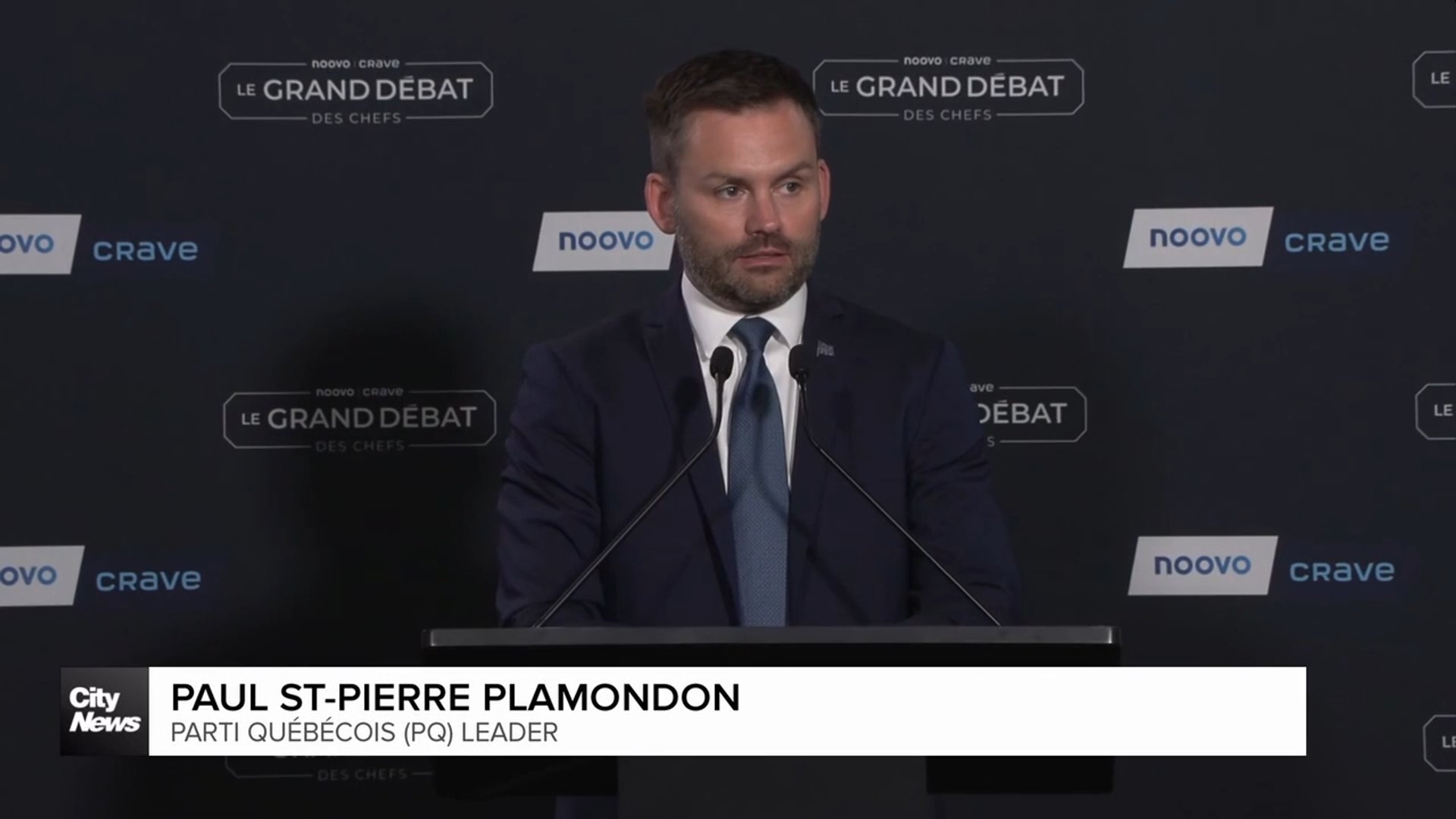
One day after she spent much of the first debate on the backfoot, Fréchette opted to go on the attack in the “Grand Débat des chefs” on Wednesday evening, repeatedly challenging the PQ promise to hold a referendum.
FIRST DEBATE: ‘CAQ waste,’ Fréchette’s record under attack during first Quebec election debate
As early as her opening statement, the Coalition Avenir Québec leader had in her crosshairs the PQ, which has consistently led in opinion polls and is projected to form the next government.
“Tonight and in the days ahead, we must ask ourselves a very important question: is this really the time to add uncertainty with Paul St-Pierre Plamondon’s referendum?” asked Fréchette.
“I will be working on your priorities, while he will be working on planning a referendum. It is not change that he is proposing to you, but a step backward — a return to a Quebec stuck in a referendum debate.”

The Parti Québécois says it would hold a referendum on Quebec independence once U.S. President Donald Trump leaves office, with the sovereigntist party estimating it would cost $130 million. The CAQ, Liberals and Conservatives have said they would not hold a separation referendum, though Fréchette herself has repeatedly declined to say how she would vote in one.
“We still don’t know if Mme. Fréchette is a federalist or a separatist,” Quebec Liberal Leader Charles Milliard said later in the debate. “But we know very well she’s a separatist.”
After her opening statement, Fréchette challenged the PQ during the first “duel” of the evening — a head-to-head exchange between her and St-Pierre Plamondon. The CAQ leader questioned the Parti Québécois’ plan to trigger a referendum while the province is mired in a period of economic uncertainty.
“We want stability, and stability is exactly the opposite of what a referendum leads to,” she said. “I would like to know from Paul St-Pierre Plamondon how he thinks a referendum will impact the cost of living, the instability in Quebec.”
“The greatest source of instability for the next four years would be another four years of a bad government that wastes public funds,” the leader of the PQ retorted.

Speaking to reporters after the debate, Fréchette kept going after the Parti Québécois.
She argued there are serious gaps in the party’s financial framework, notably by omitting the costs associated with possible independence, which she described as “completely disconnected from reality.”
Scandals ‘in packs of six’
Early in the debate, Fréchette and Milliard were in an exchange about raising the threshold for taxable income.
“Wasting money for the CAQ, it’s like you’re shopping at Costco — it comes in bulk and in packs of six: Northvolt, Nemaska, SIFA, SAAQclic, Lion, the Los Angeles Kings,” said Milliard, continuing his line of attack from the first debate by listing a series of fiascos under the CAQ government.
That was one of frequent accusations that Fréchette’s CAQ wasted public money over the last eight years. But the CAQ leader sidestepped the jab and flipped the conversation to the PQ. “Would you agree with me, Mr. Milliard, that a referendum would not help the cost of living because it will create uncertainty, and businesses will not want to invest?
“What I need to know from Paul St-Pierre Plamondon…” Fréchette continued.
“You’re in a debate with me right now,” Milliard interrupted.

‘It doesn’t interest Quebecers’
Milliard and St-Pierre Plamondon later went toe-to-toe on sovereignty, this time when the debate topic actually called for it.
The Quebec Liberal leader argued “nothing justifies reopening this debate.”
“How can we, in the current economic context, think this is a good idea for the future?” asked Milliard. “I’m extremely concerned by the investment, the time we’ll put into this while you say 70 per cent of Quebecers don’t want this.”
“By your own logic, Mr. Milliard, 80 per cent of Quebecers don’t want the Liberal Party,” St-Pierre Plamondon hit back, referencing polling numbers. “Do I tell you to stop sharing your ideas? Obviously not. This is a democracy.”
“The world order is changing,” Milliard said later in the same exchange. “Today in Europe, Mr. (Mark) Carney was there so that the European Union possibly accepts Canada as an associate member. We’re rethinking the order of things, and you want us to leave Canada. It doesn’t interest Quebecers right now.”
“Well I think what interests Quebecers is all the waste in Ottawa while we can’t finance the services we were talking about earlier,” replied the PQ leader. “The Liberal Party’s existed for 150 years, and it’s been 150 years that you’re telling us it’s not the right time to talk about our future.”
Éric Duhaime, leader of the Quebec Conservatives, and Québec solidaire co-spokesperson Ruba Ghazal also got in on the discussion of separatism.
“For me, independence doesn’t mean being against Canada,” said Ghazal. “But if we are independent, we’ll have an even better relationship with Ottawa.”
“The important thing is to strengthen Quebec’s power,” countered Duhaime, who previously voted “yes” in the 1995 referendum. “Unfortunately, a referendum would have the opposite effect.”

Other key topics
Ghazal and Duhaime also debated strategies to address climate change, with Duhaime suggesting Quebec should be exploiting its natural gas resources through fracking to displace other fossil fuels.
The QS spokesperson argued the province should instead be keeping up with other jurisdictions that are growing their clean energy sectors.
On abolishing Santé Québec, which the PQ has promised it would do, Ghazal questioned St-Pierre Plamondon about how long that would take.
“One year? Two years? Three years?” she asked. “We have no time to lose.”
St-Pierre Plamondon said he believes it could be done quickly.

The party leaders were asked if the province should give the children of asylum seekers a spot in subsidized daycares.
Duhaime said they should be barred from access, and that priority must be given to Quebecers. The Conservative leader also questioned how many asylum claimants were fraudulent.
Milliard urged caution given the topic, and said subsidized daycares have not been properly funded.
The PQ and CAQ leaders were asked whether they supported cutting electricity exports to the United States in response to the escalating trade war.
Fréchette said she wouldn’t rule it out, although it wasn’t her first choice. St-Pierre Plamondon said he was “a bit surprised” to hear Fréchette was opening the door to escalate tensions with the United States.
“Me, I’m not in that school of thought,” he said.
The candidates were also divided on the role that the private sector should play in the province’s struggling health-care network.
Both Duhaime and Fréchette said they were in favour of letting patients be treated in the private system without paying out of pocket when wait times grow too long, though Millard accused Fréchette of distancing herself from the public system.
St-Pierre Plamondon challenged Duhaime on his promotion of private care, suggesting doctors will simply “change address” from the public to the private system “while charging 35 per cent more.”
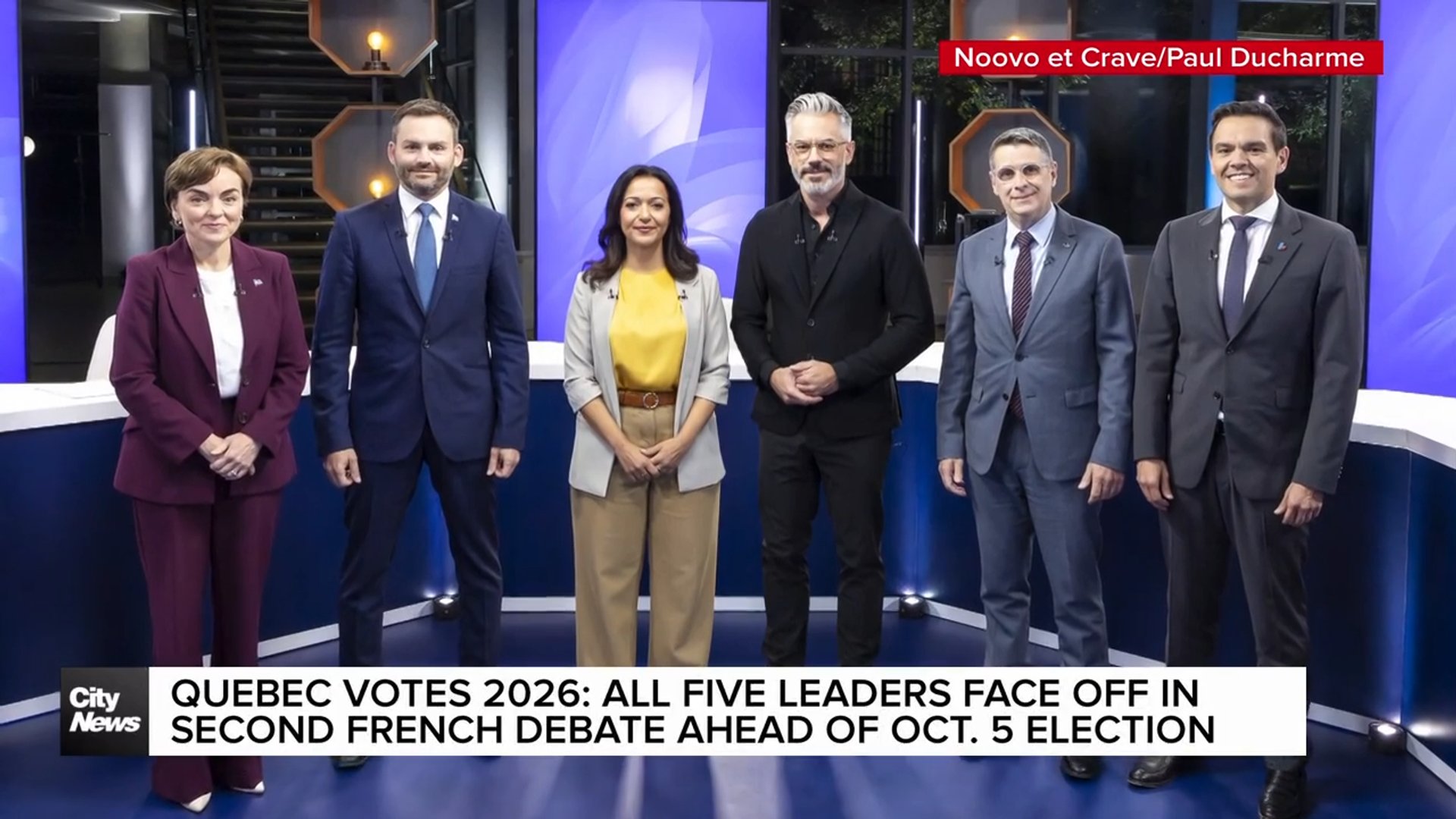
Wednesday’s Noovo-Crave debate, hosted by Michel Bherer, was the second of three – all in French – during this provincial election campaign.
The next debate is Sept. 23, and Quebec voters go to the polls Oct. 5.
–With files from The Canadian Press