Some Alberta separatists say they ‘could learn from Quebec’
Posted October 19, 2026 5:47 pm.
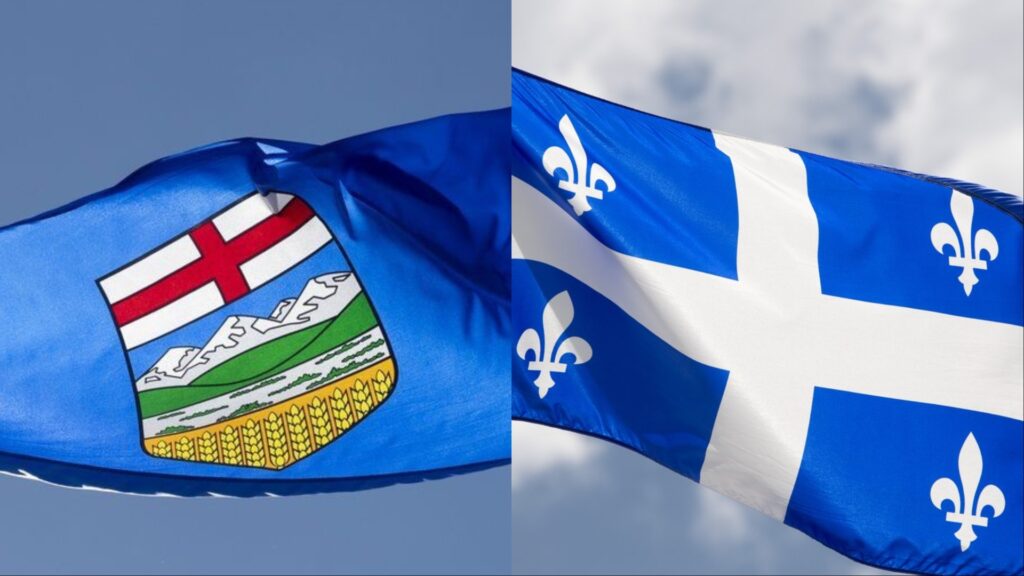
As Albertans head to the polls Monday to decide whether their province should take a step toward a future referendum on separation, some independence advocates are looking east to Quebec.
“We could learn from Quebec,” said Cory Morgan. “They’ve been at this much longer than us.”
Morgan is the Calgary-based founder of Pathway to Independence and has been advocating for Alberta to separate for 26 years.

Morgan says there are lessons for Alberta in Quebec’s decades-long sovereignty movement.
“The bottom line is full provincial sovereignty,” he said. “I think Quebec and Alberta in that sense are natural allies, even if we’re culturally and politically different.”
Albertans are not voting directly on independence Monday. The ballot asks them to choose between Alberta remaining a province of Canada or beginning the legal process required to hold a future binding referendum on independence. The separation question is one of 10 questions being put to voters.
Morgan acknowledges the wording is complicated.
“It is a word salad of a question. It’s not a straight up-down question,” he said.
Quebec’s referenda helped shape the rules
Quebecers voted on sovereignty twice — in 1980 and 1995 — with the second referendum narrowly defeated.
Three years later, the Supreme Court of Canada laid out the constitutional framework that would apply if a province sought to leave the country.
In its 1998 Reference re Secession of Quebec court found a province could not unilaterally leave Canada. A clear majority voting for secession on a clear question would create an obligation for the parties to Confederation to negotiate, but the referendum itself would not automatically result in separation.
“It’s impossible to leave unilaterally,” said Karine Millaire, a law professor at Université de Montréal.
Millaire questions whether Alberta’s vote meets the clarity test established following Quebec’s experience, particularly because Albertans are being asked 10 questions and the separation question does not directly ask voters whether Alberta should become independent.

“I think it’s probably misleading to tell people that they are actually voting on something that could lead to a secession process, because it doesn’t follow the legal framework,” she said.
The legal landscape has also evolved since Quebec’s last referendum, particularly when it comes to the rights of First Nations.
Earlier this year, an Alberta court ruled in a case involving the Athabasca Chipewyan First Nation that the province had failed to meet its constitutional duty to consult before advancing an earlier citizen-led separation initiative.
Millaire says that issue could also have implications for any future Quebec referendum.
“Now we know, and the case law is more clear, that it’s not possible to proceed to move it — and even with a referendum, it’s not possible to have a referendum without involving Indigenous peoples,” she said.
Quebec sovereigntists see major differences
Despite Alberta independence advocates looking to Quebec for lessons, Quebec sovereigntists caution against treating the two movements as interchangeable.
“The two movements are truly distinct,” said Marie-Anne Alepin, president of the Société Saint-Jean-Baptiste de Montréal.

“We want to separate from Canada to preserve our language, our culture and our identity,” she said in French. “Whereas in Alberta, it’s more about seeking even more power within Canada.”
Morgan sees more common ground.
He pointed to Quebec institutions, including its own pension plan and tax collection system, as examples Alberta independence advocates can study while pursuing greater provincial autonomy.
“We need a pension plan. We need to collect our own taxes. We need a provincial police force,” Morgan said. “It’s ironic that we’re always called extreme when we call for these things, even though those are all things that nobody’s ever questioned Quebec having.”
How much support is there for independence?
Despite the attention surrounding the referendum, polling suggests support for actually leaving Canada remains considerably lower than support for using the vote to express dissatisfaction with the status quo.
An Abacus Data survey conducted Oct. 7 to 13 found 68 per cent of eligible voters planned to choose the option to remain a province, compared with 24 per cent choosing the path toward a future binding referendum and seven per cent undecided.
But the poll also found choosing that second option did not necessarily mean supporting independence.
When Abacus estimated how Albertans would vote if asked directly whether the province should become independent, 18 per cent of the electorate would choose independence.
In St. Albert, Thomas Lukaszuk, leader of the pro-Canada Forever Canadian movement and a former Alberta deputy premier, says he isn’t taking the polling for granted.
“I’m not really detracted or swayed in any way by polling because it’s all about voter turnout,” Lukaszuk said.
He says Quebec’s experience also provides Alberta with a warning about the potential economic consequences of prolonged uncertainty over separation.
“There are many lessons to be learned, but the one that really has resonated in Alberta is the devastation economically that Quebec’s flirting with separatism has caused,” Lukaszuk said.
He pointed to major companies that moved their headquarters away from Montreal during past decades and said his organization does not want Calgary or Edmonton to experience something similar.
For Montrealer Shalaka Shah, Monday’s vote brings back memories of growing up in Quebec around the 1995 referendum.
“Even as a kid, I remember feeling the impact on the social fabric,” Shah said. “Sometimes I think that they don’t know what they’re in for, having lived it. And I worry about that, and I worry about our country, but I also think that they’re allowed to feel upset.”
Whatever happens at the ballot box, Morgan says the Alberta independence movement is unlikely to simply disappear.
If his side falls short, he says another referendum should not immediately follow.
“We have to respect the will of the voters, but then have a long-term plan,” Morgan said.