Quebec medical helicopter service completes over 100 missions since summer launch
Posted November 9, 2026 7:08 am.
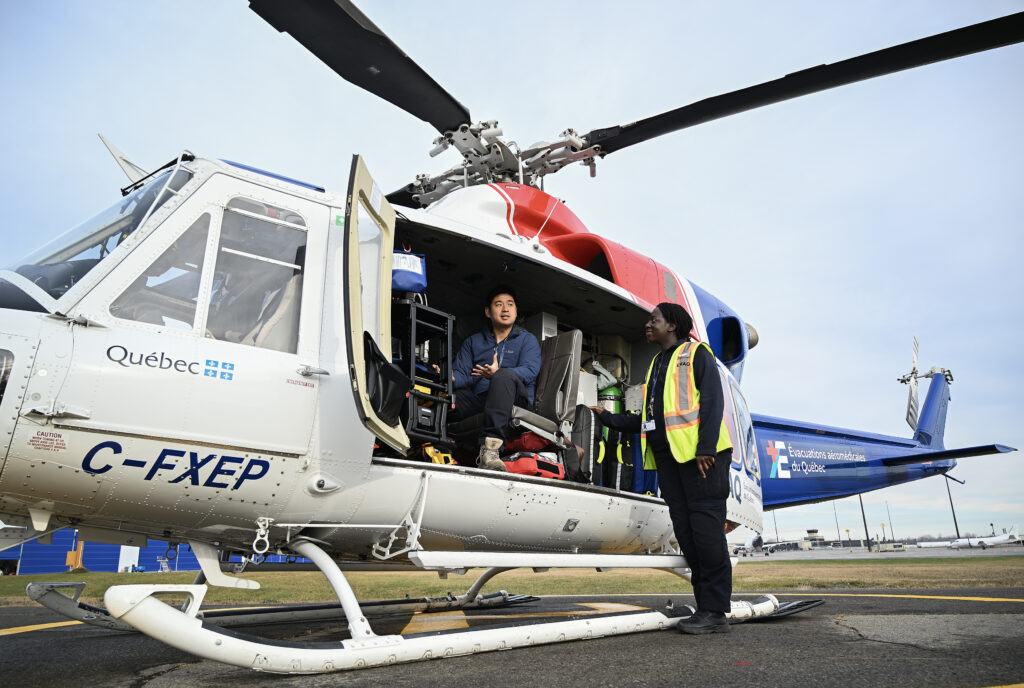
If you are in critical condition and need specialized medical care quickly, you may be transported by helicopter thanks to the new team from the Quebec Aeromedical Evacuation Program (ÉVAQ). Although the service is still in its infancy, the medical interventions have been a resounding success so far.
Quebec is the last Canadian province to establish a public medical helicopter transport system. This mode of transport could save a life that otherwise could not have been saved, says Dr. James Tu, ÉVAQ’s deputy director for medical and helicopter transport services.
“I think this is an essential service that truly fills a need in Quebec. We’re six to seven times the size of France, and we only have ambulances and airplanes. It’s high time we had a third option for patients in rural areas,” comments the emergency physician.
For now, the service targets patients located 75 to 250 km from major urban centers. The goal is clear: to improve survival rates.
In addition, this helps keep hospital staff within the hospital and in the region, rather than having them leave with the ambulance. “We’re already seeing benefits,” says Dr. Tu. “We’re able to free up resources that a hospital would normally have to transfer by ambulance—including a doctor, a respiratory therapist, and a nurse—whom they lose during a five- to eight-hour transfer.”
Dr. Tu says that past missions have gone very smoothly. Many traffic accident victims have had their lives saved thanks to the helicopter’s speed and flexibility. “We’ve been able to keep these patients alive with a ventilator and transfusions right on the helicopter. Because we bring our own units of packed red blood cells to transfuse,” he explains. “Those were really the cases where we saw a real benefit. […] We’d arrive on the scene, pick up the patient, and leave much faster than we would have by road.”
Nurse Kadia Fall adds that there’s always a spare bag, with all the necessary equipment and medications, so they can head out again quickly. “It allows us to always be ready to go,” she says. “We grab a new bag and head out again if there are back-to-back missions.”
As of Nov. 6, 2026, 114 missions had been carried out, including 12 from the Mirabel Airport base, which has been operational since Oct. 19. The other transports were conducted from the base located at Jean-Lesage International Airport in Quebec City, which opened in mid-June.
An in-flight resuscitation room
The dispatch center affiliated with ÉVAQ—which is part of the Québec City University Hospital Centre—handles calls from hospitals requesting helicopter transport, but according to Dr. Tu, hospitals are still largely unaware of this service.
“All the calculations at the dispatch center are done to determine the best mode of transport suited to the patient. It might be an airplane, because an airplane is faster than a helicopter, but this speedster requires more preparation to take off and needs a runway,” explains the emergency physician, adding that an airplane can also cover longer distances.
For each mission, there is a doctor, a nurse specializing in critical care, and two pilots on board the helicopter, with the option to include two additional crew members. “Most of our doctors are emergency medicine specialists and intensivists who are used to managing unstable cases, thinking on their feet, and reacting immediately,” says Dr. Tu.
The crew waits at one of the ÉVAQ stations until a call comes in. It’s the same principle as firefighters waiting for a call at the fire station. When a call comes in, the helicopter can take off in as little as 15 minutes.
Flight time generally ranges from 30 minutes to two hours. The helicopter can travel nearly 600 km on a single tank of fuel, taking into account the reserves it must maintain.
The helicopter is equipped with almost everything you would find in an emergency room resuscitation room. “We have infusion pumps, a portable ultrasound machine that allows us to perform diagnostic tests on board, and a machine that lets us draw blood and analyze the patient’s blood while in flight,” explains Dr. Tu.
Kadia Fall notes that there is also equipment that isn’t always on board. “There are items we add on a case-by-case basis. For example, there are certain very specific medications that we don’t always have on board. As soon as we get the call, we go get them and bring them along in the helicopter,” she explains.
Hospitals with helipads coming soon
Among the challenges of providing care in a helicopter, the emergency medicine specialist cites the cramped space. Staff must work while bent over or on their knees and, above all, organize the equipment so that it is as close at hand as possible.
“There’s also the issue of temperature because the cabin isn’t pressurized like an airplane. […] In a helicopter, as soon as you open the door, you’re exposed to winter weather—if it’s windy—or even in the summer when it’s too hot,” explains Dr. Tu.
However, there are solutions to this problem, such as heated blankets to wrap the patient in and medications on board.
The first phase of ÉVAQ’s helicopter service will span five years. For now, it involves interhospital transport, meaning the helicopter picks up the patient from a regional hospital and brings them back to the airport, where a ground ambulance will transport the patient to the designated hospital.
In the coming months, the helicopter could begin making trips to health clinics, particularly to serve remote Indigenous communities. Eventually, it could land directly at the scene of a car accident, for example.
There are currently very few hospitals with operational helipads in Quebec, but several are under construction, including the helipad at the Hôpital de l’Enfant-Jésus in Quebec City, which could open next year.
—
The Canadian Press’s health coverage is supported by a partnership with the Canadian Medical Association. The Canadian Press is solely responsible for this journalistic content.
–This report by La Presse Canadienne was translated by CityNews