Despite government rollbacks, Quebecers remain committed to Paris climate agreement: survey
Posted November 10, 2026 7:01 am.
As COP31 gets underway in Antalya, Turkey, two new polls show that a majority of Quebecers believe the government must stay the course on Quebec’s climate commitments under the Paris Agreement. The polls also reveal sometimes notable differences between residents of Quebec City and those of Montreal when it comes to combating climate change.
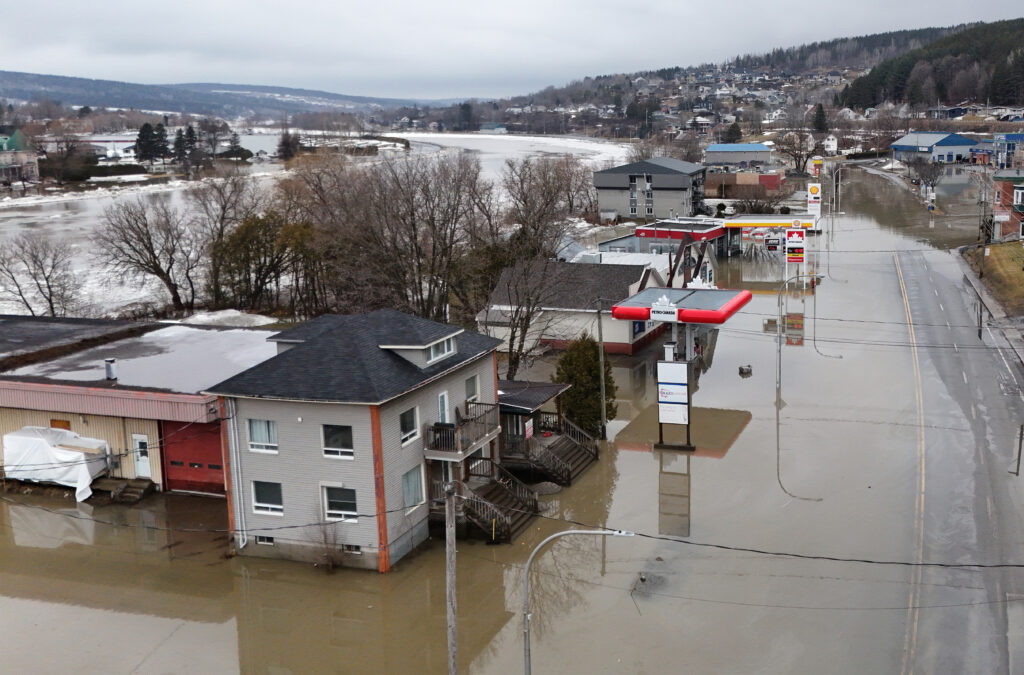
Nearly all Quebecers—90 per cent—believe it is important to adapt Quebec’s infrastructure to cope with climate-related hazards, such as torrential rains or riverbank erosion.
This support exceeds 95 per cent among voters for the Parti Québécois, the Quebec Liberal Party, and Québec solidaire, but stands at 78 per cent among voters for the Quebec Conservative Party.
“On infrastructure, even more so than on any other issue, we see that there is a consensus,” and “clearly, the people of Quebec are making the connection between poor infrastructure and the issue of climate change,” noted Samuel Pagé-Plouffe, director of public and government affairs at Vivre en Ville.
Mapping risks
A vast majority of the population—83 per cent—agrees that the government should “make publicly available information and maps on flood risks and other climate-related risks.”
Although this support transcends political affiliations, it varies by party: it reaches 92 per cent among Québec Solidaire voters, 89 per cent among Parti Québécois voters, 87 per cent among Quebec Liberal Party voters, and 73 per cent among Quebec Conservative Party voters.
It should be noted that the new flood-risk maps were scheduled to be published on the government’s website starting in March 2026.
However, the outdated maps are still currently available online.
Calls for stronger adaptation measures
Seventy-four per cent of respondents agree with adopting “stronger measures to adapt to climate risks” to curb rising home insurance costs “which are becoming more expensive due to increased risks of flooding, wildfires, and extreme weather events.”
Support ranges from 56 per cent among the Quebec Conservative Party’s electorate to 93 per cent among Québec solidaire’s, with 81 per cent among the Quebec Liberal Party’s and 78 per cent among the Parti Québécois’s.
Honour the government’s commitment
According to 71 per cent of respondents, the government must honor the climate commitment unanimously adopted by the National Assembly in the fall of 2025. This motion, introduced by the Parti Québécois, called on the government, among other things, to “not weaken the current GHG reduction targets” and to maintain “the goal of reducing greenhouse gas emissions by 37.5 per cent by 2030 compared to 1990 levels.”
However, last winter, the CAQ government lowered this target, barely three months after pledging not to do so.
Women (77 per cent) are more supportive of upholding the climate commitment reaffirmed by the National Assembly than men (65 per cent).
The poll “shows that the public is calling on the new government to remain consistent with the motion it introduced last year,” Samuel Pagé-Plouffe emphasized in an interview with The Canadian Press.
Restoring the targets
About ten organizations, including Vivre en ville, issued a press release commenting on the two polls. They are calling on the new government to restore climate targets in line with the Paris Agreement. This request is based on the opinion of the Advisory Committee on Climate Change and aligns with that of the Quebec Scientists’ Collective for Environmental Action.
“A climate target is not a mere intention; it is a commitment that the government has made and must honor. By postponing the deadline, the Quebec government has granted itself a right it does not have. You don’t postpone an obligation—you fail to meet it,” wrote Geneviève Paul, executive director of the Quebec Environmental Law Center.
The organizations emphasize that, to meet the climate targets it has set for itself, the government should implement a carbon budget—a tool used in other jurisdictions that the Parti Québécois has pledged to introduce.
“A carbon budget is like a household budget. You set a limit and regularly check to make sure you’re sticking to it, instead of putting everything off until later. Each government must therefore be held accountable for its share of the effort, rather than passing the responsibility on to its successors,” explained Annie Levasseur, a professor at the École de technologie supérieure, in a press release accompanying the two surveys.
Differences between Montrealers and Quebecers
Furthermore, Léger’s polls reveal notable differences in opinion between the Montreal metropolitan area and the Quebec City metropolitan area.
For example, support among Montrealers is particularly strong for adapting infrastructure to extreme weather, with 93 per cent of residents considering infrastructure adaptation important, including 61 per cent who consider it “very important.”
Although the importance of adaptation remains very high in Quebec City at 85 per cen, the perceived sense of urgency there is more moderate, with 46 per cent of respondents considering adaptation “very important.”
Regarding compliance with the climate motion in the National Assembly, 72 per cent of Montrealers are calling on the next government to support it, while only 12 per cent oppose it.
In Quebec City, although a majority remains in favor—with 67 per cent approval—the opposition rate is nearly double that of Montreal, reaching 21 per cent who say “no.”
Another example of the difference in opinion between residents of the province’s two largest cities: 58 per cent of Montrealers believe the government should maintain these GHG reduction targets for buildings, compared to 41 per cent in the Quebec City region.
“Yes, there are differences between regions. Yes, there are differences in the political parties preferred by those surveyed, but even so, we generally see a majority that shares a similar opinion”—one that calls for “taking greater responsibility in the face of climate change,” commented Samuel Pagé-Plouffe of the organization Vivre en Ville.
Methodology
Vivre en Ville commissioned Léger to conduct a survey between Oct. 2 and 5, 2026, and another between Aug. 28 and 30. The responses were therefore collected before the Parti Québécois was elected to government.
One of the online surveys was conducted among 1,035 respondents, and the other among 1,033 people.
The National Research Council of Canada, a professional organization that promotes polling standards, states that it is not possible to assign a margin of error to online polls, as they are not based on a random sample of the population.
–This report by La Presse Canadienne was translated by CityNews