Report uncovers signs of violence, negligence at two Montreal long term care homes

Posted November 18, 2022 8:30 am.
Last Updated November 18, 2022 7:48 pm.
A government-commissioned report into the conditions at two privately owned long-term care homes in Montreal has revealed widespread mistreatment of residents at both facilities.
Les Residences Floralies locations in the Lachine and LaSalle boroughs were put under trusteeship on Sept. 1 amid allegations of poor care.
A report by a retired Health Department employee made public Thursday alleged “abuse in all its forms” at the residences, including violence and negligence on the part of employees and a lack of treatment and services.
Residents were found with untreated sores, dehydration and signs of violence such as bruises, and the report found there was little in place to prevent falls or address dementia-related behaviours.
Investigator Michel Delamarre also concluded that poor care and infection control probably worsened a streptococcus A outbreak last summer that killed a total of six people.
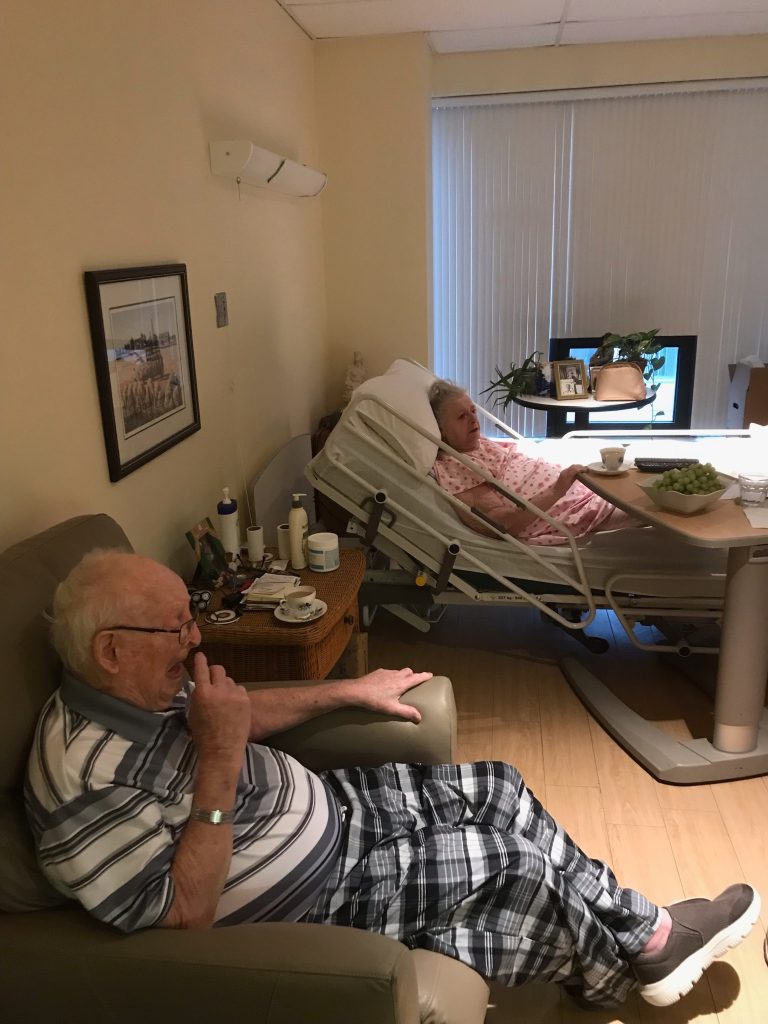
Les Floralies residents Rhoda and Fred were infected during the Strep A outbreak in the summer. (Credit: David Gill)
David Gill’s parents, Rhoda and Fred were infected during the outbreak and survived, but his father has since passed from other causes.
“There’s always potential for cross-contamination and stuff like that,” said Gill. :”Maybe it’s understaffed and the protocols are not followed.”
“Priority for us was to promptly address the reports of mistreatment in these residences. We had to respond quickly to major concerns voiced by the families and caregivers, and we took the necessary steps to identify and move forward with actions to address this distressing situation,” said Najia Hachimi-Idrissi, the interim CEO of the CIUSSS de l’Ouest-de-l’Île-de-Montréal at a press conference Friday morning.
Seniors Minister Sonia Belanger promised to act towards implementing Delamarre’s 21 recommendations and improve quality of care for all the residents of the long-term care system.
“What we saw at Floralies was not the treatment our seniors deserve,” she said in a statement.
She said changes were underway across the network, including adding more inspectors, and said her department would follow up to ensure homes are up to standard.
“I will not tolerate any form of abuse, particularly when it affects elders,” she added.
“I guess it takes abuse, it takes a death, for things to change,” said Gill. “That’s the sad reality.”
In the report, which is dated Oct. 7, Delamarre found widespread problems with the homes’ management, including a lack of qualified staff and lack of co-ordination and planning.
“The employees that were not good for the job, they put them out, said Daniel Bergevin, a resident of Les Floralies Lachine. “So there’s new people coming in.”
Professional services were nearly non-existent, and the facility lacked programs and policies regarding “wound care, use of restraints, following up on weight, hydration, behaviours linked to dementia, evaluating pain or end-of-life care,” the report read.
“The goal is that it does not happen again, that the residents receive the best possible services,” said Marie-Claude Ouellette, general manager of Résidences Floralies. “We cannot redo the past. There have been mistakes, there have been shortcomings, that, we cannot deny. But we can guarantee that if we, Les Floralies, have not demonstrated that we’re in full control of the situation, the CIUSSS will not withdraw.”
RELATED:
- Four dead after Strep A outbreak in Lachine seniors’ residence
- Montreal Public Health taking over two Floralies seniors residences
The report’s recommendations included the creation of a complete plan to improve care, including ensuring adequate staffing, as well as working more closely with residents.
He suggested the province also needs to clarify the roles and responsibilities of local health authorities and private homes.
“We will, in keeping with the recent changes in the legislative framework, heighten our supervision and monitoring with the help of a multi-disciplinary team that will intervene directly in these facilities regularly,” said Najia Hachimi-Idrissi, the interim CEO of the CIUSSS de l’Ouest-de-l’Île-de-Montréal.
While the homes are privately owned, half or more of their beds were occupied by residents covered by an agreement with the public health authorities.
The long-term care portions of the residences were placed under trusteeship by local health authorities for 180 days, as of Sept. 1, but that could be extended if needed, the province said.
“The situation has been stable for some time and our senior residents are receiving the care and services their health requires. However, we recognize that there is still much to do in order to ensure that the efforts invested at these facilities over the past few months are sustained in the long term,” Hachimi-Idrissi added.
“We’re going to be staying there until we make sure that the situation is well managed and the practices that we put in place is well integrated. And if it needs to stay longer, we’re going to stay longer. We want to make sure that the residents are in good hands.”
This report by The Canadian Press was first published Nov. 17, 2022.