Nigerians go to the polls Saturday in important vote for country, West Africa
Posted February 24, 2023 12:11 pm.
Voters in Nigeria will elect a new leader Saturday after President Muhammadu Buhari’s final term ends.
Eighteen candidates are vying to lead Africa’s most populous nation and largest economy.
The election is the most consequential vote in many years for Nigeria, a country of more than 210 million people, according to analysts.
The crucial election comes at a time when the country is battling an economic meltdown, high rate of insecurity, scarcity of fuel and the weakening of the naira – the country’s currency.
It is the first time since 1999, when the country returned to democratic rule, where the new president will be neither an incumbent nor a former military leader.
This is Nigeria’s seventh election since 1999, making this the longest uninterrupted democratic period.
MORE ON NIGERIA’S ELECTION:
- Could Nigeria’s cash shortage hurt the presidential vote?
- Nigeria presses ahead with vote amid cash shortage crisis
- Nigeria’s presidential frontrunners in final push for votes
And it’s not exactly clear who will come out on top.
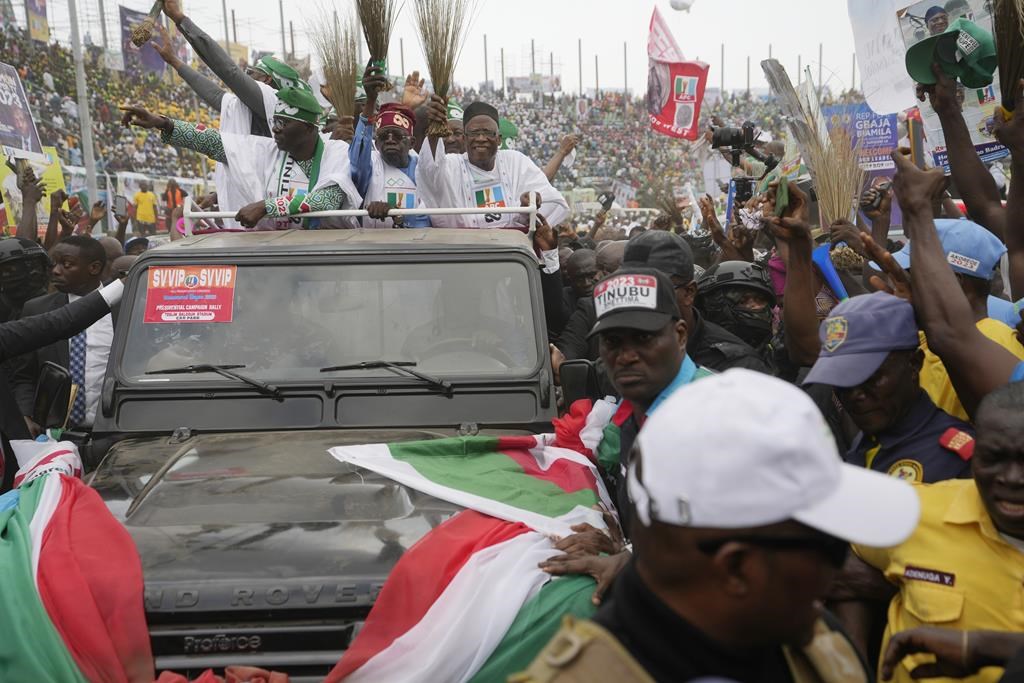
There are three frontrunners: Bola Tinubu, Atiku Abubakar and Peter Ob.
Bola Tinubu, 70 (All Progressives Congress)
Tinubu, who represents Buhari’s currently presiding party, is a top contender in the race. He is a former governor of Nigerian’s wealthiest state.
This wealthy political veteran boasts he was the backbone that led to Buhari’s victory in the previous election.
His source of wealth is unknown; he claims much of his wealth comes from family inheritance.
His decision to run earned him many influential loyalists. His political slogan is “Emi Lokan,” which is a Yoruba phrase that means “It’s my turn.”
Tinubu has been accused of being a “drug lord” by a vocal freelance investigative journalist. The 70-year-old has denied all allegations.
His age has been questioned by the country’s youth, who feel he may be too old. Tinubu has also been criticized for avoiding debates and public town hall meetings.
Many observers believe Tinubu has a good chance of winning the election.
Atiku Abubakar, 76 (People’s Democratic Party)
Atiku, who is running for the main Opposition PDP, is making his sixth appearance on a presidential ballot after five losses.
The 76-year-old served as vice-president from 1999-2007. He is a businessman whose source of wealth stems from various investments. He has been investigated for corruption in the past but has denied any wrongdoing.
For the longest time, the president of Nigeria has come from the northern region. Atiku is a northerner, and there is some belief his chances are winning are hurt by that – because Nigerians may want to elect someone from a different region.
Nigeria is mainly split into tribes: the westerners are predominantly Yoruba; the easterners are predominantly Igbo, and the northerners are predominantly Hausa-Fulani.
Peter Obi, 61 (Labour Party)
Obi is referred to as the “internet’s favourite” by popular Nigerian musician Seun Kuti, the son of Fela Kuti.
He is a two-time governor of Anambra state.
Obi’s lifestyle is seen as rejecting luxury. He has been seen flying economy, driving himself, being very approachable and living a modest life.
The 61-year-old is the only Christian among the top candidates. His eastern region has never produced a president since the nation returned to democracy in 1999.
Some sympathizers have described him colloquially as “Mr. Clean” because he has never been tied to any corruption. Though he was impeached as governor, it was not on corruption charges.
Obi is very popular among Nigerian youths, and has been described as a candidate of hope for young people. He is expected to draw many young Nigerians to polling stations.
RELATED: ‘Now or never’: Young Nigerians pin hopes on key election
The Nigerian electoral commission says it has recorded the highest number of registered voters.
More than 93 million Nigerians are expected to vote on Saturday.
It is important to note that voting will not take place in over 200 polling units, in Imo and Taraba states due to insecurity.
—With files from The Associated Press