‘Fundamental rights of security’: Montreal’s Chinatown residents respond to homelessness and social cohabitation report
Posted July 11, 2025 2:25 pm.
Last Updated July 11, 2025 5:26 pm.
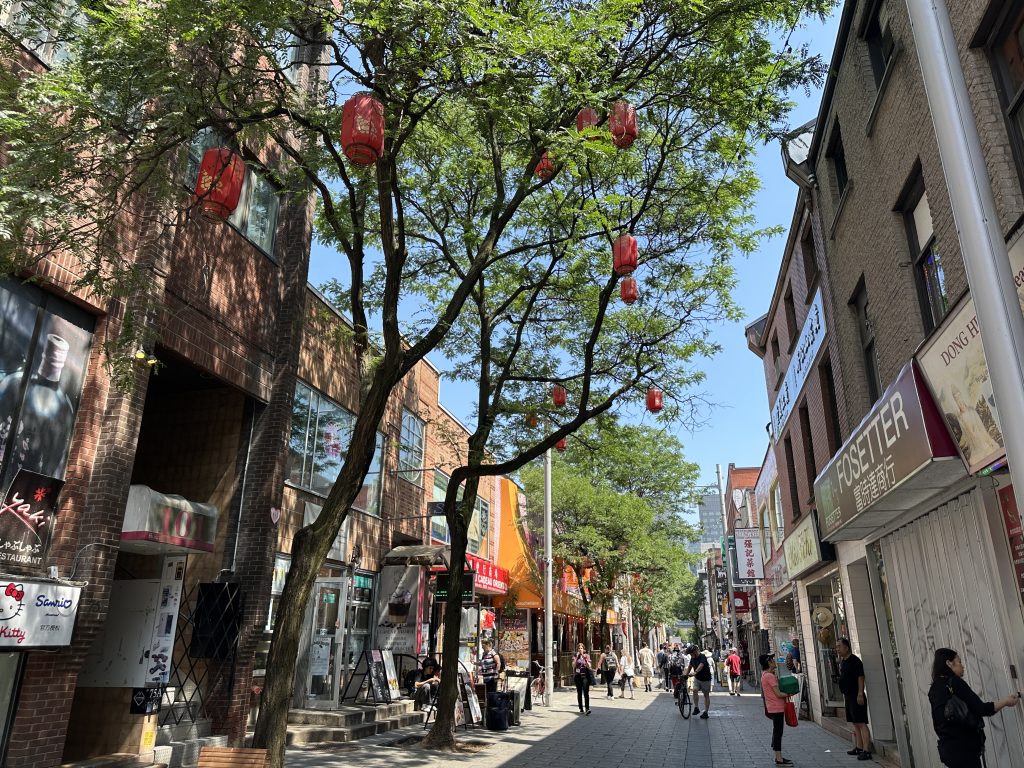
Residents of Montreal’s Chinatown say they are concerned and uncertain about the future of their neighbourhood after the release of a wide-ranging report on homelessness and social cohabitation.
The 300-page report, released Thursday by the Office de consultation publique de Montréal (OCPM), calls for major changes to how the city handles homelessness. It recommends the city suspend the dismantling of encampments until a new policy is developed and provide basic services like drinking water, sanitation, electricity, and storage.
The report also recommends ending the use of private security in managing public spaces related to homelessness—something that has recently happened in Chinatown—and replacing them with trained social workers or SPVM community service agents.
But for people who live in the area, many questions remain.
Visible homelessness has grown
Yvan Michaud, secretary of the Association of Residents of Chinatown, said homelessness in the area has grown noticeably in the past few years.
“I’ve been living here for almost 30 years now. So I can tell you that there’s always been homelessness downtown in Chinatown. But for the last four years, I’d say it’s been exploding, especially with the opening of a shelter here at the beginning of the pandemic,” he said.
“It was closed in 2023, but since then, there’s some habit within the homeless population. They tend to gather here in spite of the fact there’s no shelter because of habits, because probably they have secure pushers and things like that. It’s sad, but that’s the reality of things.”
He added that residents with young children are feeling the impact. “There are indeed families living here with children. So they are concerned. But for their children and their safety, it raises their concern a lot.”

Reaction to encampment recommendation is mixed
While the report calls for the city to stop dismantling encampments for now, Michaud said the situation is complex.
“I think ideally, the best option would be to let people encamp themselves because they have no other solutions. But because it’s within residential neighborhoods, it do arise a lot of tensions with the residents around, whether it’s Chinatown or other neighborhoods,” he said.
Still, Michaud appreciated that the report highlighted specific neighbourhoods in urgent need of help.
“What we are pleased with, essentially, is the notion that the commission recognizes the fact that resources for homelessness must be more fairly distributed around Montreal. And they specifically talk about Milton Park, Chinatown, and the Gay Village as places where they have to be more urgent measures taken by the city to tackle the problem.”
Younger residents voice concern for safety
Carman Tang, a Chinatown resident and new member of the local association, said she started noticing changes in the area over time.
“At first it was okay because I was so young and I was starting high school so I wouldn’t like notice that much of a situation but at the moment it’s really like persistence, there’s more and more every day,” she said.
Tang described seeing drug use in public spaces.
“There’s a lot of drugs out there. I would see sometimes exchange of money with a bag of cocaine and I pretty much don’t like it because I have younger siblings… she’s four at the moment and seeing that is like I’m kind of protective you know of my sister my siblings and I don’t think it would be a good example for children to see that kind of stuff out there.”

Tang said she is glad the OCPM acknowledged the issues in Chinatown but still feels unsure about what action the city will take.
“I would say it’s half-half so I’m not sure if they’re gonna do anything about it… but the report just came out, it’s newly, it’s fresh, it’s 300 pages so we’re just gonna have to see.”
Support for switching from private security
The OCPM report recommends using community-focused teams instead of private security to handle issues related to homelessness in public spaces. That suggestion received support from some Chinatown residents.
“I think it’s more appropriate because those agents are trained to act, which is not necessarily the case for private security forces,” said Michaud. “So yes, I think the police is more equipped to handle that type of situation, I think.”
Others, like Michel Laval — a resident and executive member of the Association of Residents of Chinatown — weren’t convinced.
“Well, I don’t know if it’s a good idea,” Laval said. “It’s okay to have more and more securities in this area, but is it the answer for the situation? I don’t know.”

He added that nighttime disruptions are a major concern. “When people at three o’clock here shouting, fights and drugs and whatever, it’s not a good surrounding to raise children or to feel safe. That’s my main concern.”
Residents want to be heard—and funded
Both Tang and Michaud said the city needs to better support Chinatown residents and their organizations.
“When the city will recognize that we have indeed fundamental rights of security and to be heard and to be taken into account, then they will realize that they need to support us, even financially, which is not the case today,” Michaud said.
Tang agreed. “I would like to see firstly more maybe resources throughout for the homeless people and then for the resident I would say like more safety… I would like to say that we kind of want the OCPM to like fund the Association of Chinatown and then like give us a little bit of money so we can do a little bit of change by ourselves.”
City says report is being reviewed
Montreal’s executive committee member responsible for homelessness, Robert Beaudry, said Thursday that the city takes the report seriously but will not pause the dismantling of encampments.
The city says it will respond to every recommendation and, where necessary, explain why it cannot follow through and what alternatives might be offered.