Unpaid bonuses for nurses: FIQ’s case before Tribunal
Posted August 25, 2025 3:07 pm.
Last Updated August 25, 2025 5:05 pm.
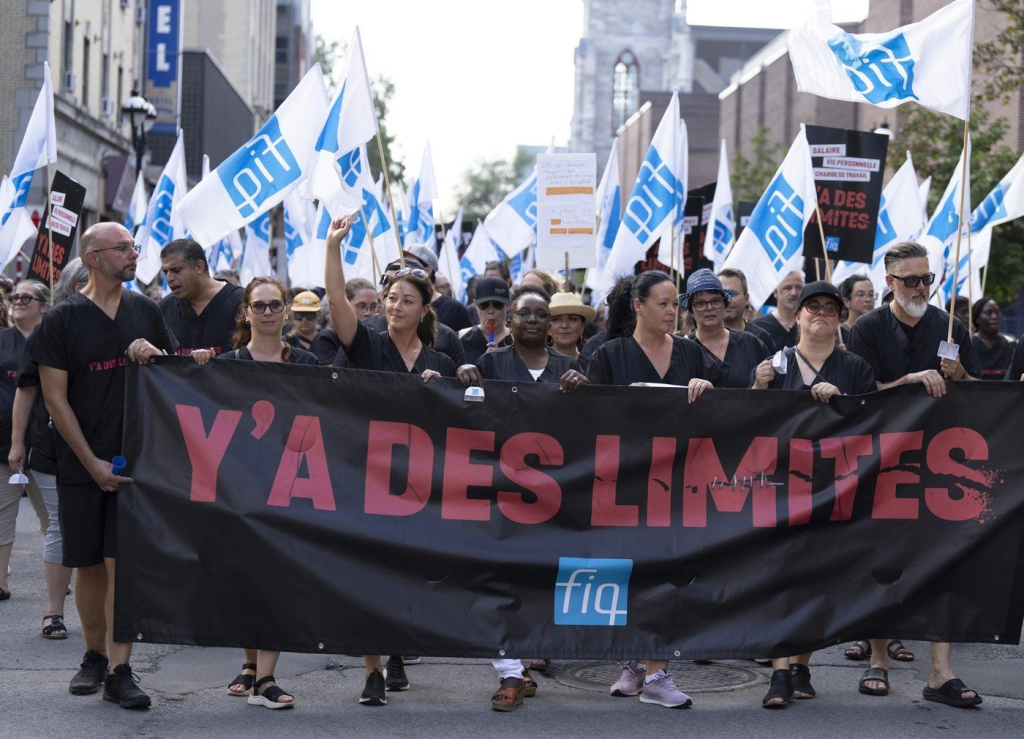
On Monday, the Administrative Labour Tribunal began hearing the FIQ’s motion against Santé Québec and other healthcare institutions regarding certain bonuses and adjustments that have still not been paid to nurses, even though the collective agreement was signed in December 2024.
Administrative judge Myriam Bédard began hearing on Monday the motion of the Fédération interprofessionnelle de la santé (FIQ) against Santé Québec and other health institutions, because of certain bonuses and adjustments that have still not been paid or have been paid late to nurses, despite the collective agreement being signed on December 5, 2024.
Some bonuses were to be paid 45 days after the collective agreement was signed, others 120 days after, i.e., before April 5. There were new bonuses and bonuses that were modified, such as those for evening and night shifts.
However, according to the first witness from the Fédération interprofessionnelle de la santé (FIQ), Jérôme Rousseau, “there are still bonuses that have not been paid” to date.
When the FIQ asked for explanations from Quebec over the months, “programming difficulties” in the payroll systems were cited, he reported.
The FIQ therefore filed a complaint against Santé Québec and the employers for obstructing union activities, in which it requested not only the “immediate” payment of bonuses and adjustments, but also interest, as well as moral and punitive damages.
Rousseau reported that this is not the first time this has happened, noting that the FIQ had experienced similar difficulties with the 2021-2023 collective agreement. At the time, several thousand dollars, even $12,000 and $15,000, were owed to nurses, he said.
The second FIQ witness, Marc-André Courchesne, said that the delays in payments for the 2021-2023 agreement had caused so much dissatisfaction among members that, as soon as discussions began for the renewal of this agreement, at the end of 2022, he made sure that the deadlines would be met this time. And Quebec, he says, was reassuring.
Credibility affected
And, according to him, when there are such delays in the payment of amounts owed, members’ anger turns toward the union, which is criticized for not knowing how to negotiate and for not sufficiently monitoring these deadlines—which affects its credibility with its members, Rousseau said.
There is a kind of mistrust of the trade unions and “the entire negotiation process is being undermined,” he said.
The negotiation of the 2024-2028 FIQ collective agreement was very long, nearly two years. FIQ members had held eight days of strike action at the end of 2023, in addition to using a conciliator to bring the parties together.
There had been an agreement in principle, which the members rejected in April 2024, before the conciliator made a proposal to both parties, which was accepted.
The hearing will continue on Thursday.
–This report by La Presse Canadienne was translated by CityNews