Laval daycare bus crash: Should accused be considered high-risk offender?
Posted September 15, 2025 7:46 am.
Last Updated September 15, 2025 5:38 pm.
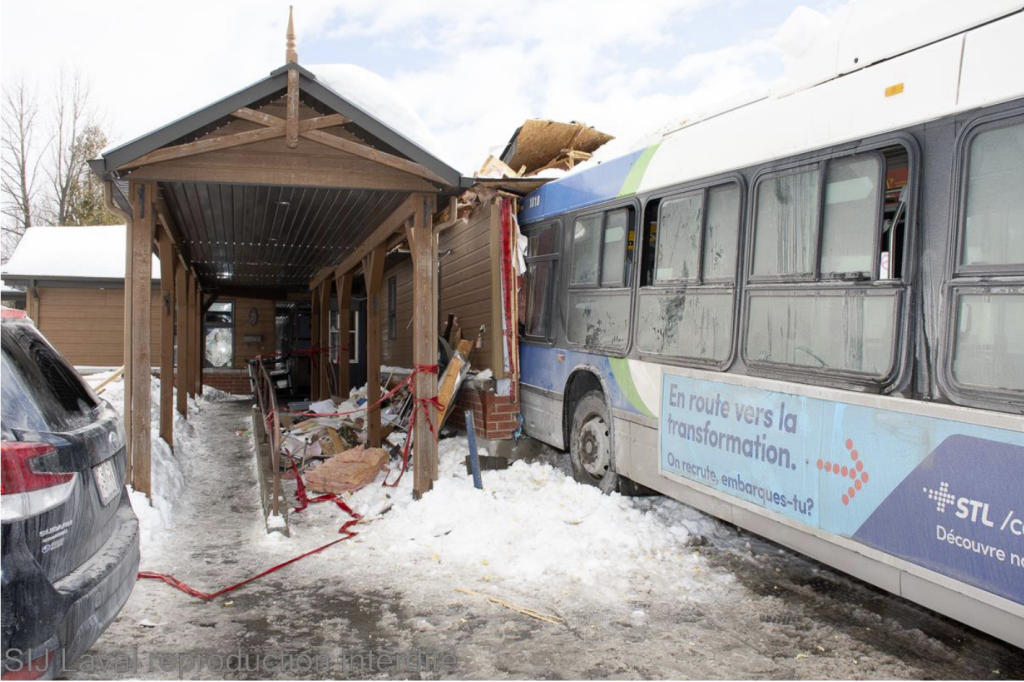
The hearing to determine if high-risk offender status should be imposed on the 53-year-old Quebec man found not criminally responsible for killing two children and injuring six others when driving a Laval city bus into a daycare in February 2023 began on Monday.
On April 29, former bus driver Pierre Ny St-Amand was declared not criminally responsible after Superior Court Justice Éric Downs accepted a joint recommendation from the Crown and defence that he was likely in psychosis, unable to determine right from wrong, when he crashed the bus into the daycare on Feb. 8, 2023.
“It’s either that we demonstrate that the accused shows a marked probability of causing another violent crime, or that the brutality of the act committed is so big, so intense, that it shows in itself a probability that this happens again,” said Crown prosecutor, Simon Blais.
At the Laval courthouse on Monday morning, Sylvain Faucher, a psychiatrist, was the first witness to be interviewed. Faucher was given a mandate to determine Ny St-Amand’s dangerousness and concluded that he presents moderate dangerousness in the context of determining a high-risk to reoffend.
“Tomorrow we’ll have the psychiatrist that was mandated by the courts, and maybe tomorrow or the day after we’ll have the psychologist that was mandated by the accused,” said Blais.
Ny St-Amand was present in the courtroom Monday wearing a grey sweatshirt. He was not handcuffed, but was kept in a secured area where he listened during the hearing.
Members of families with children from the daycare were also present.
Being declared a high-risk offender would mean that a person is held under strict conditions notably concerning absences when being detained at a psychiatric facility.
“I can compare it to adding a padlock to a door that’s already locked,” said Blais. “So it guarantees that the accused would stay detained at the Philippe-Pinel Institute and that he would not be allowed to leave, but for escorts. And to have that removed, he would need to pass again in terms of the Superior Court.”
“Maybe the Crown has some concerns that eventually if he’s let out into the public, there’s a high risk of him reoffending, so they’re going to make their case to the judge, and the judge is going to see if that is the title that they should give to him,” said criminal defence lawyer, Kwadwo Yeboah. “It has a very dear consequence on an individual, meaning that even after he’s done his sentence or whatever it will be given to him, the court can still keep him behind the bars because they deem that he’s so dangerous.”
“If he stays at Pinel for a certain time, he’s always going to be at the hands of the justice system,” Yeboah added. “He wouldn’t get at one point to walk free with us outside, because he will be deemed so dangerous to let out.”
Justice Downs has set aside one week to hear arguments from prosecutors and the defence team for Ny St-Amand.
“Let’s remember that he was declared non-criminal irresponsible, so he’s not doing a sentence per se,” said Blais. “But he is right now incarcerated at the Philippe-Pinel Institute, and it will stay like that until the judge will decide on the issues that we have to decide this week and in November.”
The defence has said it will challenge whether the high-risk offender status is constitutional. A separate hearing on that matter is scheduled for a week beginning Nov. 10, Downs said in May.
“His lawyers are probably going to argue that it’s unconstitutional and the Crown is probably going to argue that this individual is so dangerous for society that the judge should actually keep him behind bars, even after his sentence is done,” said Yeboah.
Back in May, Downs told defence lawyers he wanted a response from federal government lawyers on the high-risk designation, which was added to the Criminal Code in 2014 for people found not criminally responsible for violent crimes.
“The judge will gather all the information that he gets,” said Yeboah. “I doubt that he might give a decision right away on the bench, because this is something that’s relatively very serious, that has a lot of consequences on an individual.”
Killed in the crash were Jacob Gauthier, four, and a five-year-old girl named Maëva, whose family name is protected by a publication ban at the request of her parents.
Six other children were injured.
-With files from The Canadian Press