Doctors: Arbitration would cost additional $1.8B, says Dubé
Posted September 24, 2025 11:42 am.
Last Updated September 24, 2025 6:24 pm.
As soon as it was proposed, the Legault government’s offer of mediation to doctors was met on Wednesday with conditions that could lead to its rejection.
The Quebec Federation of General Practitioners (FMOQ) responded with its demands late in the afternoon.
In the event of an impasse, mediation must lead to arbitration, and secondly, Bill 106, at the heart of the dispute with the medical federations, must be abandoned, the FMOQ stated in a written declaration.
However, the government has suggested that the mediation offer is only valid if the principles of Bill 106 are preserved.
This legislation, which would link part of remuneration to the achievement of performance targets for patient care, has been denounced by both the FMOQ and the Federation of Medical Specialists (FMSQ).
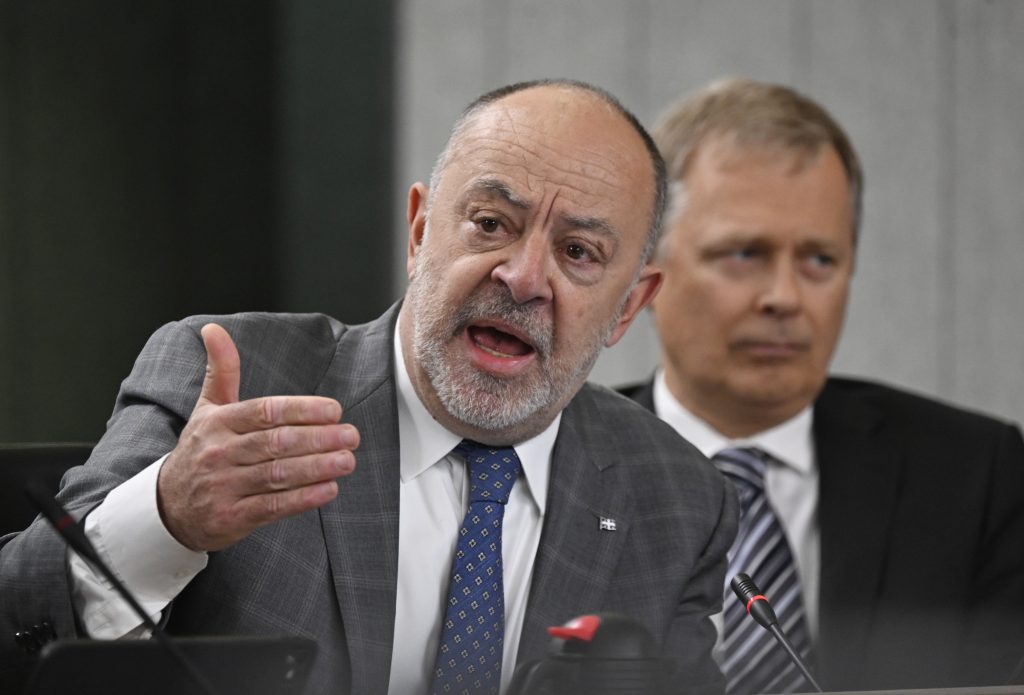
Health Minister Christian Dubé and Treasury Board President France-Élaine Duranceau both came out after Wednesday afternoon’s cabinet meeting with a statement reaching out to the medical federations.
“I asked the federations to consider entering into a mediation process to find a way forward, to find a solution,” summarized Duranceau, without answering questions from reporters.
The FMOQ responded quickly by setting its own conditions. The FMSQ had not yet responded to our call by evening.
In addition, Dubé himself had rejected a proposal from the FMOQ that same morning.
The federation filed a motion in court on Friday requesting independent arbitration, but the minister rejected this option, claiming that it would cost $1.8 billion.
The government’s attempts to find common ground therefore seem compromised, to say the least.
Already on Wednesday morning, Premier François Legault had expressed his exasperation by telling doctors “enough is enough” in response to the pressure tactics of the FMOQ and FMSQ, which are having an impact.
But for his part, Dubé was trying to strike a more conciliatory tone.
He argued that he had shown “great openness” in the talks by making concessions. He listed, in particular, the adjustments for older doctors nearing retirement, as well as for the regions. He is also prepared to be more flexible on the regulatory power granted to him by section 8 of his bill.
Patient care advocate Paul Brunet said doctors had requested independent arbitration like in Ontario and California, but the minister refuses, citing cost. He added: “I wonder what has been so costly since we had negotiations between parties.”
The government has set two conditions for mediation to take place. The medical federations must renounce their pressure tactics during mediation, and the principles of Bill 106 must be maintained.
The parties will have to agree on the mediator and the schedule.
It should be noted that in the mediation process, the mediator attempts to bring the parties together and find a possible solution.
In arbitration, the arbitrator imposes an enforceable solution.
The CAQ government is attempting to find common ground in the standoff with the two medical federations, which has been ongoing for several months.
On Tuesday, family doctors voted to suspend teaching medical students starting October 1, joining specialists who’ve already taken the same step in protest of Bill 106.
Dr. Clifford Albert, a McGill clinical instructor, said: “Our system, 20 years ago was in the ICU and now we’re basically at the morgue.”
Dr. Paul Saba, a former council president and health care advocate, said: “We need to incentivize, encourage doctors, fund the doctors to work more, continue to work. And train new doctors. We need to incentivize and not coerce.”
Doctors warn that Bill 106 pushes speed over quality.
Albert added, “you can’t put it into a box and say we’re gonna link patient doctor remuneration to the time spent with the patient because the patients need more time today. We’re not dealing with the same patient we had 15 or 20 years ago. The population is aging. Patients take more time to evaluate.”
Brunet added that the government’s approach treats health care like a factory floor: “In terms of quality of care, do you push doctors for performance? This is not a machine shop. This is not a manufacturer. It’s about patients. I would ask doctors to be even more, not lengthy, but slower with patients. Listen to them. Care for them. Do the complete job that has to be done.”
He also warned that while doctors cannot strike at the expense of patients, the long-term consequences could be dire: “On a longer run, yes, something will have to be done because new doctors will not be coming in and will not be able to help the patients.”
The Fédération des médecins spécialistes will meet Wednesday night with presidents from 36 local associations to set their next steps and pressure tactics.
Patients are already struggling, one Montreal resident said, “I’ve been in Montreal for 10 years, I’ve been waiting for 8 years. I applied 8 years ago, and I still haven’t had a… response.”
Another said that when her old doctor retired she dreaded going back into the system to wait for a new one.
For Mackenzie Allard she expressed that “it definitely was a relief to finally get the care, because there were definitely moments where I needed the care and instead had to seek other options that took a lot of time. And sometimes when you’re dealing with smaller issues, it’s harder to get the necessary care, because it’s not viewed as an emergency.”