‘Envied by countries’: Anand defends Canada’s certification process as Bombardier stock down after Trump threat
Posted January 30, 2026 10:10 am.
Last Updated January 30, 2026 5:46 pm.
A day after U.S. President Donald Trump took aim at Canada’s airline manufacturing industry and threatened to decertify Bombardier’s jets, the company’s stock took a hit Friday.
The stock of the country’s largest airline manufacturer dropped by nine per cent as markets opened, before recovering to about 4.38 per cent lower after 2 p.m.
In a post on his Truth Social platform, Thursday, Trump said he will impose a 50 per cent tariff on aircraft sold into the United States over what he claims is Canada’s refusal to certify Gulfstream business jets made in the U.S.
Trump claimed Canada has “wrongfully, illegally, and steadfastly” refused to certify the Gulfstream 500, 600, 700 and 800 jets which in turn is also prohibiting the sale of the business jets.
Trump said he will also decertify Bombardier Global Express business jets until Gulfstream receives certification.
“If, for any reason, this situation is not immediately corrected, I am going to charge Canada a 50% Tariff on any and all Aircraft sold into the United States of America,” he wrote.
Trump’s threat posted on social media came after he threatened over the weekend to impose a 100 per cent tariff on goods imported from Canada if it went forward with a planned trade deal with China. But Trump’s threat did not come with any details about when he would impose the import taxes, as Canada had already struck a deal.
In Trump’s latest threat, the Republican president said he was retaliating against Canada for refusing to certify jets from Savannah, Georgia-based Gulfstream Aerospace.
‘Diversification name of the game’
At an event organized by the Montreal Council on Foreign Relations, Friday, Canadian Foreign Minister Anita Anand responded to Trump’s threats, “We are going to continue to support the aerospace industry and to ensure that we are there for Bombardier and the industry and indeed all sectors of the Canadian economy.”

Anand also defended Canada’s certification process.
“The process of certification that Canada has is envied by countries around the world because of its comprehensiveness and the fact that it emerges from a very stable and reputable set of institutions,” she said, adding that Transport Minister Steven MacKinnon was working with the U.S. authorities to address their concerns.
Montreal mayor, Soraya Martinez Ferrada was also in attendance Friday at the event. During a press scrum, Martinez Ferrada said that Montreal should be working with Ottawa on strategy.
“We want to make sure that we’re supporting the efforts in terms of diversification of markets and supporting industries like the one Bombardier which is a very important asset of Montreal,” said Martinez Ferrada.
“We should remember that approximately 3,000 Bombardier employees are American and work in the United States. And, this is an example of how integrated our economies are,” she said.
Anand added the Carney government was also focused on a broader trade diversification strategy in order to “not put all our eggs in one basket,” referring to the reliance on U.S.
“We’ve got to begin negotiations with countries that historically or at least in the recent past we had not been negotiating with,” Anand said of her conversation with Carney when she decided to run again for election after announcing her retirement following Justin Trudeau’s resignation early 2025.

Bombardier caught up in trade war
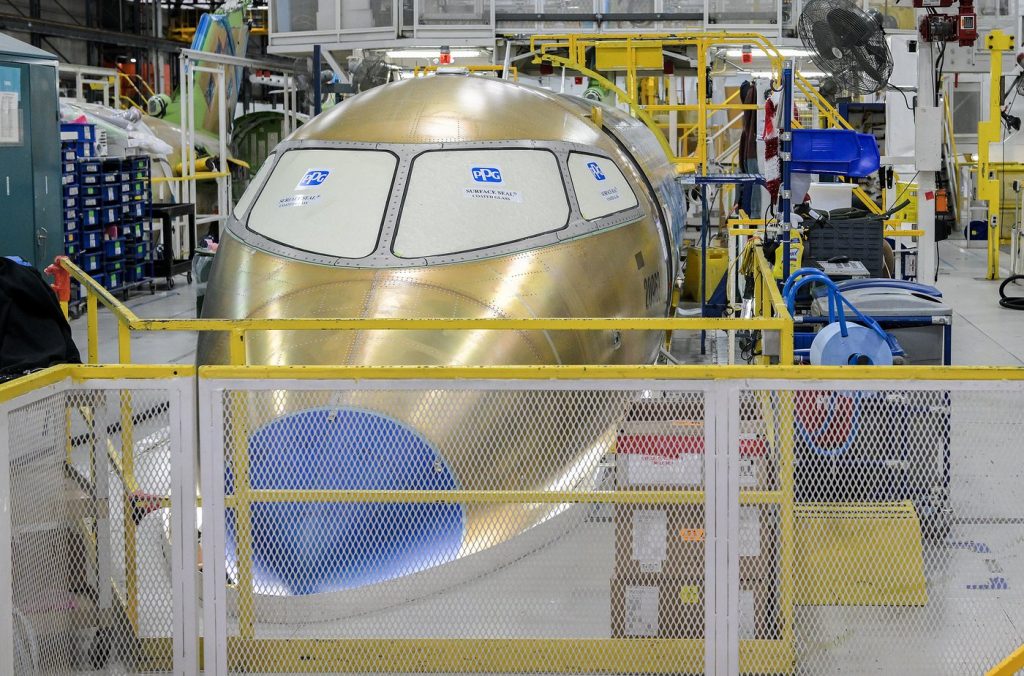
Bombardier and Gulfstream are head-to-head rivals, with the Global series battling for market share against Gulfstream’s latest models.
McGill University aviation expert John Gradek said Trump’s threats were at the behest of Gulfstream and that the American competitor was attempting to circumvent Canadian certification process.
“(Transport Canada) found problems and issues with the Gulfstream 700 and the Gulfstream 800,” Gradek said. “A few lines are freezing at low temperatures. That has to be fixed before the airplane gets certified.”
“Gulfstream went knocking to the president to basically get him to take some action to stop Bombardier from being a competitor in the U.S.,” Gradek added.
Bombardier said in a statement that it has taken note of the president’s post and is in contact with the Canadian government. The Montreal-based company said its aircraft are fully certified to Federal Aviation Administration standards and it is expanding U.S operations.
“Thousands of private and civilian jets built in Canada fly in the U.S. every day. We hope this is quickly resolved to avoid a significant impact to air traffic and the flying public,” the company said.
Gradek said certification is about safety and it would be unprecedented to decertify for trade reasons.
“Certification is not trivial. It is a very important step in getting planes to operate safely,” Gradek said. “Somebody is not picking on the Gulfstream. Decertification for trade reasons does not happen.”
Gradek said many Gulfstreams have been certified for years in Canada.
“This is really a smokescreen that’s basically throwing up another red flag in the face of (Prime Minister Mark) Carney,” Gradek said. “This is taking it to the extreme. This is a new salvo in the trade war.”
“If Mr. Trump wants to play the aviation war, so can we,” Gradek said, adding that he recommended that Canada closes its airspace to U.S. commercial aircraft in response to Trump’s threats.
The U.S. Commerce Department previously put duties on a Bombardier commercial passenger jet in 2017 during the first Trump administration, charging that the Canadian company was selling the planes in America below cost. The U.S. said then that Bombardier used unfair government subsidies to sell jets at artificially low prices.
The U.S. International Trade Commission in Washington later ruled that Bombardier did not injure U.S. industry.
Bombardier has since concentrated on the business and private jet market in its Global and Challenger families of planes. Both are popular with individual owners and businesses as well as fractional jet companies like NetJets and Flexjet. If Trump cuts off the U.S. market it would be a major blow to the Quebec company.
U.S.-Canada aerospace sector linked
Chanakya Ramdev, a former programmer analyst in the maintenance engineering team at Bombardier, said the aerospace industry between the U.S. and Canada was highly interconnected.
“I believe half or more than half of their planes are actually built for U.S. customers,” Ramdev said. “Customers like Air Force and many celebrities use Bombardier for their day to day transportation. So Bombardier has a huge impact for not just Canadians, but also many prominent Americans.”
Gradek said if Bombardier has a hard time selling its aircrafts to the U.S. there were not a lot of other options for Canada, given the price point of the planes in question.
“This is not like Canola. This is not like any grains or any food stuffs. You know, this is a very expensive airplane. So there’s a very few markets that can take this airplane. So the US is still the primary market for the purchase of these types of airplanes,” Gradek said.
But, ultimately, any effects on the Canadian aerospace sector would have an impact on the U.S. as well.
“Whatever slowdown we had in Canadian aerospace has resulted in these threatened tariffs are able to ripple into the US as well,” Gradek said. “So it’s not just Canadian aerospace workers that will be impacted.”
— With files from The Canadian Press