CAQ leadership: Drainville and Fréchette clash over language, immigration during second debate amid protest
Posted March 28, 2026 8:42 am.
Last Updated March 28, 2026 5:58 pm.
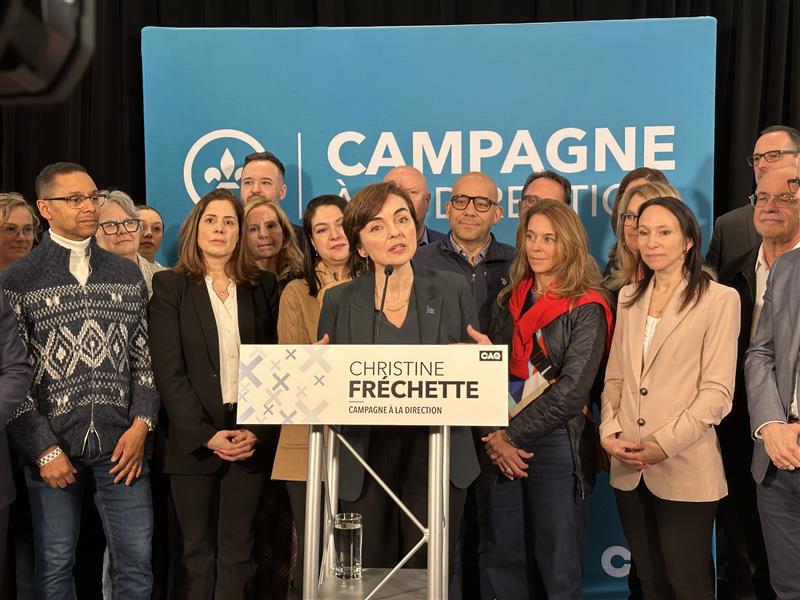
Unsurprisingly, sparks flew between the two candidates for the leadership of the Coalition Avenir Québec (CAQ), Christine Fréchette and Bernard Drainville, over immigration and the protection of the French language during their second and final debate of the race.
Drainville presented himself as the candidate best suited to defend Quebec’s identity and adopt a stricter immigration policy.
“This morning, we’re going to talk about health care, housing, and education, but we’re also going to talk about immigration, because there’s a connection,” he said in his opening remarks. “The choice is this: even more immigration, or do we protect public services?” the candidate asked CAQ members gathered at the Château Royal in Laval.
Later, he criticized Fréchette for taking wavering positions on immigration and the defense of the French language.
He accused Fréchette of hesitating to close Roxham Road when she was the minister of immigration, citing a statement made by the Sanguinet MNA in 2023.
“This is really going too far,” retorted Fréchette, arguing that the quote had been taken out of context, which sparked outrage among the crowd.
On the issue of the Quebec Experience Program (PEQ), the aspiring leaders expressed reservations about the program’s abolition by Immigration Minister Jean-François Roberge, but do not agree on how to accommodate the “PEQ orphans.”
Designed for international students and temporary foreign workers, the PEQ offered a fast track to permanent residency for those who had lived in Quebec for at least two years and met the language requirements.

Drainville suggested granting a grandfather clause to temporary workers in priority sectors, such as health care or education, so that these immigrants’ applications would be processed according to the PEQ criteria. Citing data from the Ministry of Immigration that has not been made public, he claims that 18,000 temporary immigrants will be eligible for this measure.
For her part, Fréchette promised to extend the entire program for two years to facilitate the transition to the Skilled Worker Selection Program (PSTQ).
She did not specify the number of people who would obtain permanent residency, despite repeated requests from Drainville on this matter.
She did, however, maintain that the immigration threshold set by Quebec at 45,000 permanent immigrants per year would be respected.
“There’s no need to scare people. 45,000 is the number we agreed on together,” Fréchette said.
Political analyst Karim Boulos said the debate on immigration must be based on Quebec’s needs.
“The birth rate in Quebec is one of the lowest in North America,” Boulos said. “So immigration isn’t a luxury, immigration is a necessity.”
The shadow of Air Canada CEO Michael Rousseau loomed over the end of the debate. Bernard Drainville, who had called for Rousseau’s resignation over a condolence message presented solely in English, criticized his rival for showing “hesitation” in condemning Air Canada’s action.
“I asked the board of directors to remove Rousseau from his position that very same day,” Fréchette defended herself.
Boulos said the political debate on the deceased Air Canada pilots may not go well with some voters.
“If I was a family member of one of the pilots who passed away, I’d be furious that you’re trying to make some political gains,” Boulos said.
She promised to expand the scope of Bill 101 to include adult education and vocational training institutions.
Housing and homelessness
According to Drainville, one of the main causes of the homelessness crisis is “mass immigration,” which is putting pressure on the province’s rental markets.
He cites a report from the Canada Mortgage and Housing Corporation (CMHC) that forecasts a higher vacancy rate in the Montreal metropolitan area by 2025 due to a decline in non-permanent residents.
The same report also notes that the increase in housing supply is “primarily attributable to the completion of numerous new construction projects.” Despite the easing of the rental market, rents have continued to rise, the report states.
“In 2025, the growing gap between rising rents and rising incomes has exacerbated affordability issues in the Greater Montreal area,” the report states.
Fréchette wants to help young Quebecers who wish to become homeowners by reimbursing the welcome tax for first-time buyers.
The MNA for Lévis has the same goal, but he proposes advancing first-time buyers up to 20 per cent of the cost of a new home. The government would recoup 20 per cent of the price upon resale, a measure sharply criticized by Fréchette.
“You’re coming here to make money off young homeowners for the government’s benefit—wow! (…) That’s going to result in interest rates that are practically higher than the banks’,” exclaimed Fréchette, urging his opponent to back down from his proposal.
Fréchette used the debate to announce new proposals.
Among other things, she promises to expand the scope of Bill 101 to include adult education and vocational training institutions. According to her estimates, this measure will enable an additional 10,000 people to earn a diploma in French each year.
In healthcare, she “is committed to providing one million additional hours of home care.”
Final debate
Saturday’s face-off was the second and last debate between the two candidates.
While Fréchette has had a consistent lead over the Drainville, some Quebecers seemed open to changing their minds.
“I was for Ms. Frechette but I’m listening more and more to the other candidate who’s starting to talk to me,” said Michel. “So, we’ll see how it goes, but so far, I’m making a little switch.”
Another Quebecer Flora said, ” I think we’re looking for someone that’s an executioner and that can get the job done.”
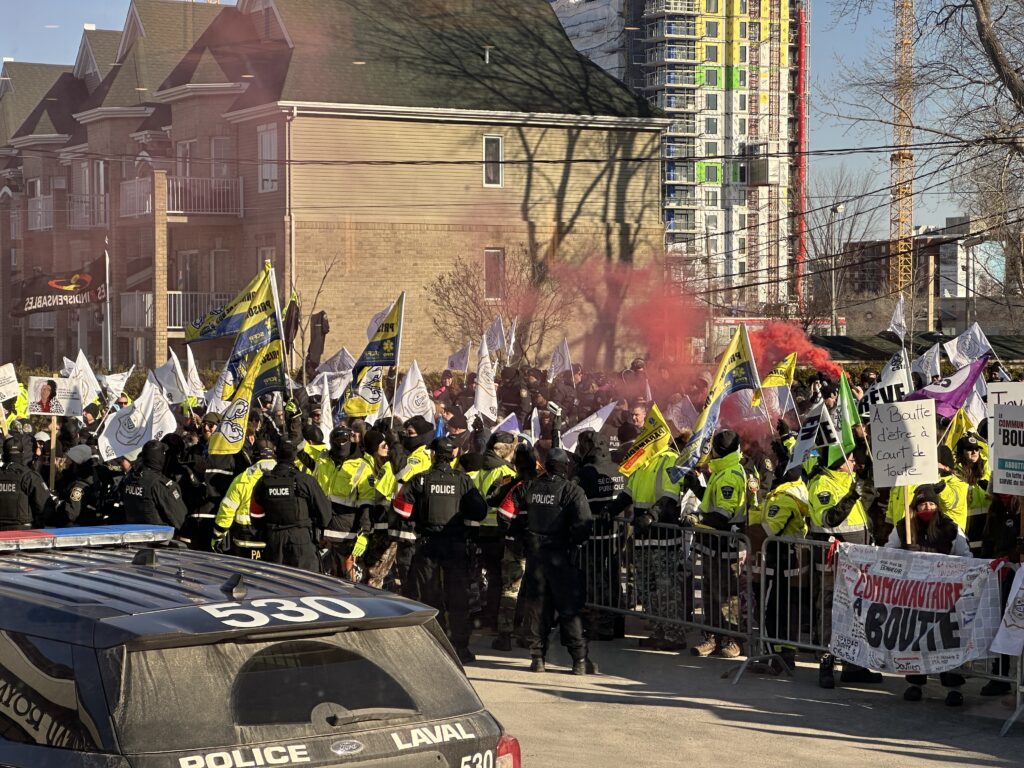
Hundreds of protestors gathered near the venue of the protest in Laval. Some could be seen holding signs against fossil fuels, which both candidates seemed to be open to at the last debate. Other signs said “Le communautaire à boutte” (Community organizations are fed up). Various community groups are on strike to denounce funding cuts by the CAQ government.
A previous debate, focused on economic issues, took place last week in Quebec City, during which the candidates spoke on public finances, infrastructure, transportation, the regions, and Canadian-American relations.
The new leader of the CAQ, and Quebec’s next premier, will be elected on April 12. The party has just under 20,600 members who will be eligible to vote. The current party leader, François Legault, has confirmed that he will remain the member for L’Assomption until the next general election.
New endorsements
Before the debate began, MNA Lionel Carmant, who had walked out of the CAQ, endorsed Fréchette. The independent MNA said he is ready to rejoin the party if the candidate wins the race.
“I’ve had lengthy discussions with her about the health and social services system (…) and it aligns with my ideals,” Carmant explained on the sidelines of the debate.
Carmant had left the party due to disagreements over the reform of the compensation system for specialist physicians. Fréchette told reporters that she had made no promises to him regarding the reform of specialist physician compensation.
Drainville, for his part, received the support of the CAQ youth leadership.
“We need a leader and a premier who isn’t afraid to make tough decisions and who has the courage to shake things up,” reads a letter published Saturday in the Journal de Montréal and signed by William Denis, president of the CAQ’s youth wing, and two other members.
“During the last debate, we saw in him undeniable qualities as a debater: his ideas are clear, forthright, and expressed with confidence,” they wrote.
– With files from La Presse Canadienne