B’nai Brith Canada: police officers should be allowed to wear religious symbols on the job
Posted September 8, 2022 1:30 pm.
B’nai Brith Canada says it’s asked all provincial Ministers of Justice and Public Security, except for Quebec’s, to emulate the U.S. state of Connecticut’s example and permit police officers to wear religious symbols while on the job.
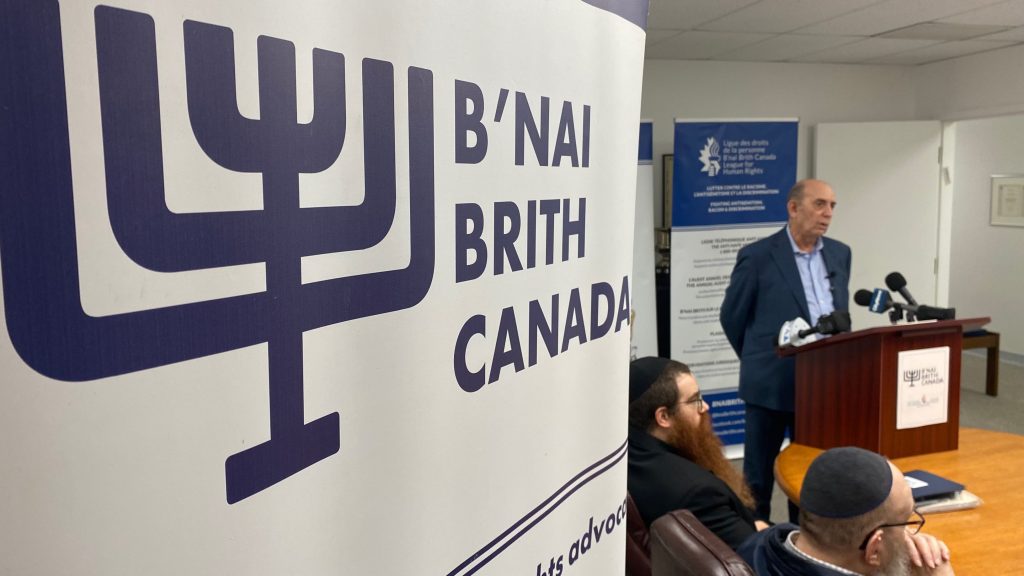
Marvin Rotrand, B’nai Brith Canada’s National Director of its League for Human Rights, said at a press conference in Montreal on Thursday, that departments would “benefit from a larger, more diverse, pool of talented candidates.”
“In all cases, the departments we surveyed say the minor uniform changes are supported by the public and that officers wearing religious symbols are as professional and effective as officers who don’t. A province-wide law means that local departments don’t have to be convinced one at a time to have more accommodating uniform regulations.”
B’nai Brith says a survey they recently conducted on police uniform policies showed that over the past two years, more departments in the U.S. and Canada have changed the rules to ensure that qualified candidates from religious minorities could be hired.
They explain that the survey revealed the Canadian military, the Royal Canadian Mounted Police, the Ontario Provincial Police, the Toronto Police Service, the Vancouver Police, Calgary Police Service, Halifax Police and many others, are all now hiring candidates wearing turbans, hijabs and kippahs.
“Several police departments have agreed to work with B’nai Brith to ensure that officers have access to an approved kippah. For its part, the RCMP agreed to allow officers to wear their own kippahs until such time as an approved version is available in the force’s stores,” said B’nai Brith.
“There is no proof that Quebec’s prohibition on officers wearing religious symbols provides any benefit,” said Michael Mostyn, B’nai Brith Canada’s Chief Executive Officer – referring to the province’s Bill 21.
B’nai Brith says it’s hopeful that the Connecticut law will become the norm across North America in the next few years.