‘Joyce had a lot of strength’: reflecting on Indigenous mother’s death almost two years later
Posted September 26, 2022 1:58 pm.
Last Updated September 29, 2022 10:10 pm.
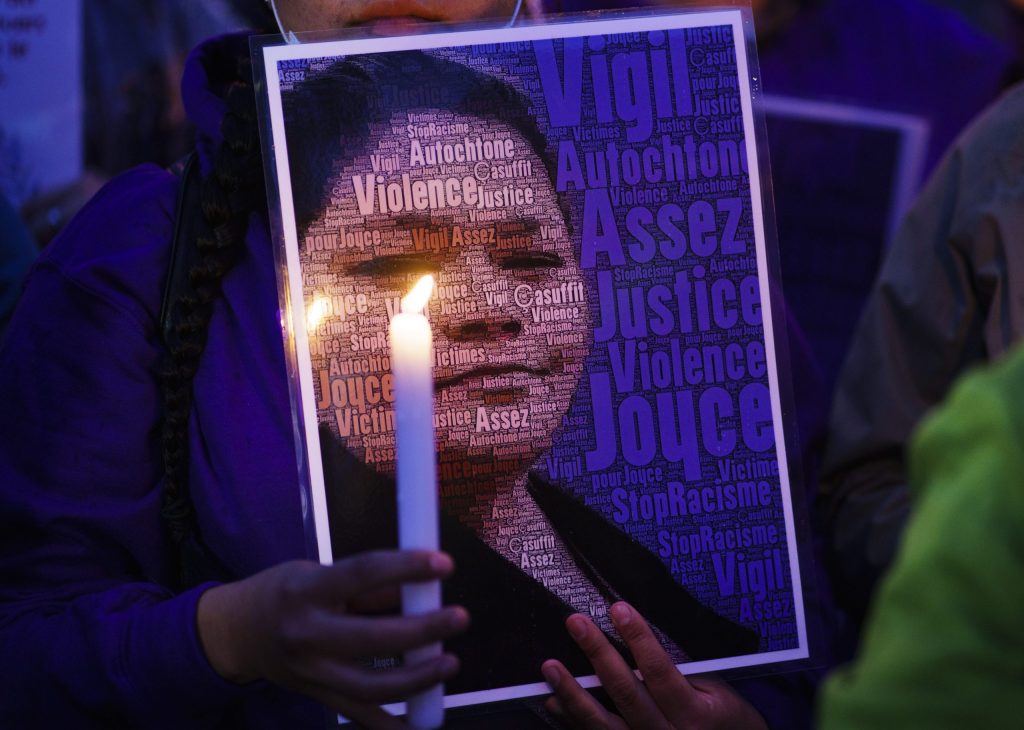
As we near the two-year anniversary of Joyce Echaquan’s death, many in the medical community continue to call out racism and reflect on the Atikamekw woman’s death.
“Joyce had a lot of strength,” says Indigenous registered nurse Glenda Sandy about the mother of seven, who live-streamed her final moments as healthcare workers were heard hurling racist slurs at her. Echaquan died Sept. 28, 2020 at a Joliette hospital, northeast of Montreal.
“I would describe what she did as a bolt of lightning that just shed a light on what we’ve known for a very very long time – and what we’ve lived through, and what we’ve experienced.”
Sandy explaining that as a nurse at the time, she was ashamed to be associated with the profession.
“I was ashamed to be a nurse. I felt for her. I felt for her family, her children as a mother myself and as a grandmother. It really affected me very deeply and it took me a long time to get back to where I am now.”
#WATCH: "Joyce had a lot of strength," says Indigenous nurse practitioner Glenda Sandy about Joyce Echaquan on the nearing two-year anniversary of her death, where she recorded herself in her final moments as healthcare workers were heard hurling racist slurs at her. pic.twitter.com/DVpmx4PByV
— Brittany Henriques (@BritHenriques) September 26, 2022
In 2021, Quebec coroner Gehane Kamel said Echaquan would likely still be alive if she were a white woman and that systemic racism contributed to her death.
Echaquan was rushed to hospital on Sept. 26, 2020 by ambulance complaining of severe stomach pains. A public inquiry heard she was initially misdiagnosed as going through withdrawal from opioids or narcotics.
“Based on this prejudice, it followed that her pleas for help will not be taken seriously,” Kamel wrote at the time. “This label will follow her throughout her stay and will guide the actions of the nursing staff until her death.”
The report made several recommendations to various bodies, but the first one is for the government to acknowledge systemic racism, something Quebec Premier Francois Legault’s government repeatedly refused to do.
“In Ms. Echaquan’s case, if there hadn’t been a video, it’s a safe bet that this event would never have been brought to public attention,” Kamel wrote. “When the system withdraws defensively on itself, this is the very definition of systemic racism.”
RELATED:
- Indigenous community questions sincerity of Legault’s comments on racism in Joliette hospital
- Legault apologizes for comments on Joyce Echaquan’s death
- Echaquan family announces lawsuit against Quebec hospital in wake of coroner’s report
- Coroner urges Quebec to recognize systemic racism as report into Echaquan’s death released
Kamel said the existence of systemic racism was raised numerous times after Echaquan’s death, particularly with regard to the Atikamekw community’s concerns about receiving medical care.
She noted the findings of the Viens Commission, a Quebec inquiry that reported in 2019 on Indigenous communities’ interaction with government services, showed the Atikamekw had long-standing complaints about the Joliette hospital, well before Echaquan’s death.
“I remember seeing that video the day, you know, when she died, and I was shocked, as does the rest of the world. And I thought, wow, how could she have suffered so much when she didn’t get the care she deserved? And this happens fairly often. And many indigenous people have faced racism in the health care system, let alone in the rest of society,” said Dr. Darlene Kitty, a Cree family physician from Chisasibi, QC.
Indigenous health workers say not enough significant change has happened to keep Indigenous patients safe.
“It starts with learning about this knowledge, you know, what’s it like in the communities? What are the social determinants of health that affect them? For example, housing, gender issues, education and culture. Culture is a good social determinants of health,” explained Dr. Kitty.
“Especially the training that’s recently been offered in Quebec. I believe it’s not been well done. I’ve done the training. And as an Indigenous health professional, there are a lot of gaps in that training for example, they spoke out a little bit on residential schools, but they didn’t really talk about the abuses that the children have suffered there. I think this information has to come from Indigenous people themselves, leaders, scholars, patients, health professionals.”
MORE:
For many, like Sandy, Echaquan is a hero.
“What she did was just so brave and did so much for Indigenous people,” added Sandy. “Joyce has a lot of courage a lot of strength and I honour her memory, I honour her strength.”
“She helped me find my voice and speaking out about what I’ve seen in my almost 20 year career as a nurse. I think right now there’s a lot of work to be done and I’m doing what I can to make change.”