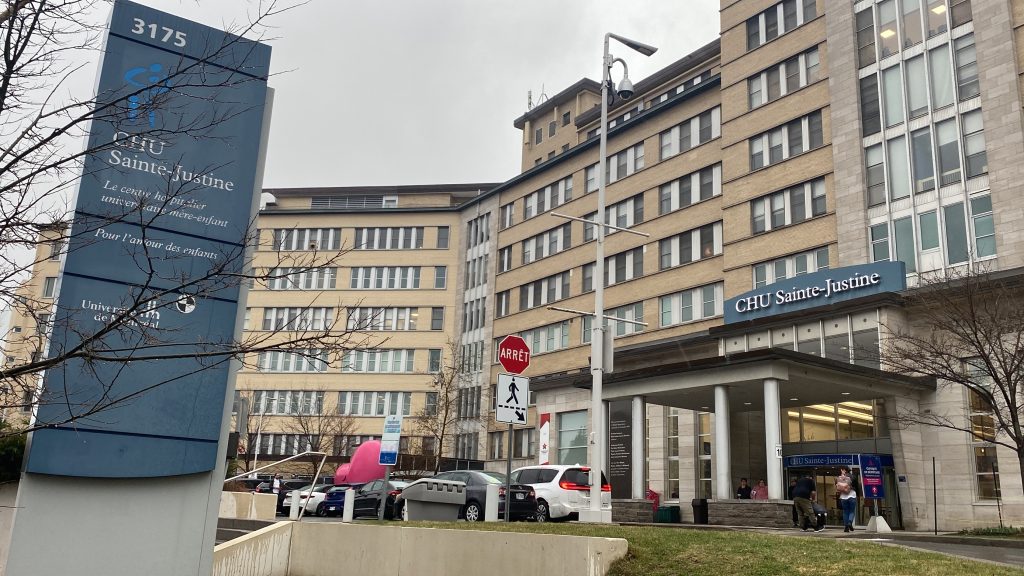
Sainte-Justine Hospital inaugurates ‘unparalleled’ pediatric imaging research centre
Posted October 30, 2024 1:26 pm.
Last Updated October 30, 2024 1:30 pm.
Montreal’s Sainte-Justine Hospital inaugurated the IMAGINE Centre on Wednesday, which is being billed as the most sophisticated pediatric imaging research centre in Canada.
The centre’s state-of-the-art equipment will allow researchers to detect brain abnormalities more quickly and more precisely than ever before, including at-risk children, such as premature babies or those on the autism spectrum.
Researchers are delighted that for once, the centre will be entirely devoted to pediatric research, as opposed to an adult medicine centre that children will benefit from in their spare time.
“For once we will not be the (fifth) wheel of the carriage,” said Dr. Gregory Lodygensky, a clinician-researcher at CHU Sainte-Justine and co-director of the IMAGINE Centre. “We are there for the children, with the best equipment available, and it’s extraordinary.”
The capabilities of the country’s unique center border on science fiction.
In particular, it is equipped with such advanced movement correction techniques that sedation will be greatly reduced, if not completely useless. In other words, it will virtually no longer be necessary to sedate small patients to prevent them from fidgeting during the examination.
Researchers will also now be able to examine children in real or simulated environments using technologies such as virtual reality, which will recreate everyday situations during examinations. This will make it possible to analyze how the brain reacts to social or behavioural stimuli in contexts approximating reality.
“We’re not just talking about a new piece of equipment,” said the other co-director of the IMAGINE Center, Patricia Conrod, who is also a researcher at the Azrieli Research Center at CHU Sainte-Justine. “It’s an entire centre that is equipped to better study the development of the brain and its interaction with its environment.”
Artificial intelligence will also optimize image analysis, improving the detection of brain anomalies on the one hand and residual brain integrity on the other.
This type of approach will make it possible to use magnetic resonance imaging (MRI) in the evaluation of new brain protection therapies.
“The centre is equipped with gradients that are capable of achieving up to a quarter or even 50 per cent more image quality,” said Dr. Lodygensky. “This allows you to either go for a higher resolution, which is useful because children have smaller brains, or to go faster, but at equivalent resolution, which is also useful in pediatrics because children don’t always want to stay in the machine. So, it allows us to do quality work.”
For babies born prematurely, the MRI can also detect abnormalities in the white matter of the brain, which are often associated with cognitive or motor delays. Thanks to longitudinal monitoring, the evolution of brain development will be observed in order to adjust therapeutic interventions to maximize the chances of normal development.
Functional MRI will be able to precisely identify the brain areas responsible for epileptic seizures, thus facilitating the implementation of personalized treatments, such as neurostimulation or surgery, depending on the location and severity of the seizures.
The centre will allow researchers to explore the impact of certain rare genetic diseases on brain development, said Dr. Lodygensky.
“We will be able to better evaluate the impact of the disease, but the idea is also to evaluate the effectiveness of the drugs that we would give to protect the brain and to see if there is an area (of the brain) rather than another that is improved by this or that drug,” he said. “So, it gives us a little better understanding of the mechanisms of both the disease, but also of the treatments, if any exist.”
Prevention
In a majority of cases, the first symptoms of a mental health disorder appear during childhood or adolescence, said Conrod.
By deploying the right interventions at the right time, she added, it is possible to change the neurodevelopmental trajectory of a young person, and that is what the new centre will allow researchers to do.
“One in four young people will have a mental health problem before the age of 25,” stated Conrod. “At Sainte-Justine, we have enormous expertise, but we lacked the technological tools to measure the development of young people’s brains.”
Prevention in mental health, explained those responsible for the project, will be facilitated by advances in brain imaging, “making it possible to identify biomarkers of neuropsychiatric vulnerability very early.”
For example, researchers will be able to spot early signs of disorders such as anxiety, depression or attention problems, or the effects of substance use disorders and chronic stress.
“The brain changes every year,” emphasized Conrod. “There are changes from birth to adulthood. So, we need a critical mass of data, for example, to be able to develop normative development curves. So, that implies a collaborative spirit with other institutions and a whole framework for harmonizing measurements and data.”
The IMAGINE Centre, she said, is also “a critical mass of cutting-edge equipment.”
“But it’s also a very large number of exceptional experts who are collaborating to address important challenges, and who are truly positioned to advance pediatric science,” concluded Conrod. “It’s unparalleled in North America or anywhere else in the world.”
–This report by La Presse Canadienne was translated by CityNews